
Table of Contents

If you have been looking for a low-risk, beginner-friendly way to launch an online business without investing in inventory, then learning how to start dropshipping on eBay is one of the smartest moves you can make in 2026. The model is elegantly simple: list products on eBay at a retail price, wait for buyers to purchase, then order from your wholesale supplier at a lower cost and have them ship directly to your customer. You never touch the product, rent a warehouse, or buy stock in advance. Your profit is the difference between what the buyer paid and what you paid the supplier — minus eBay’s fees.

The marketplace you are tapping into is enormous. According to Marketplace Pulse, eBay had 135 million active buyers in 2025 and generated a Gross Merchandise Volume of $79.6 billion. For a dropshipper, that built-in audience is invaluable — you do not need to spend money on ads, build a social media following, or grow an email list before making your first sale. eBay brings buyers to your listings through its own search engine, and those buyers are actively looking to purchase.

But eBay dropshipping is not a passive income machine that runs itself. It is a real business that rewards sellers who understand the platform’s rules, research products with data, build reliable supplier relationships, and manage their stores professionally. Sellers who cut corners — sourcing from retailers eBay prohibits, ignoring their seller metrics, or listing without a clear pricing strategy — find themselves with suspended accounts and zero income before they ever get off the ground.

This guide is designed to be the only resource a complete beginner needs when looking how to sell on ebay successfully. We cover every step in sequence — from your very first account registration to product research, supplier vetting, listing creation, fee calculation, order management, and long-term scaling. Every piece of data has been verified against 2026 sources. Let’s start at the very beginning.

What Is eBay Dropshipping and How Does It Work?

Dropshipping is a retail fulfilment model where you — the seller — do not hold any physical inventory. Instead of buying products in bulk and storing them somewhere, you list items on eBay at a retail price. When a buyer purchases your listing, you then order that product from your wholesale supplier at a lower wholesale cost, providing the customer’s shipping address. The supplier ships the item directly to your buyer. You keep the margin between what the buyer paid and what you paid the supplier, minus eBay’s selling fees.

Here is the complete eBay dropshipping transaction flow, step by step:

  1. Research a product with consistent demand on eBay, available from a wholesale supplier at a price that allows a profitable margin after fees.
  2. Create a listing on eBay with a retail price, an optimized title, complete item specifics, accurate description, and quality product images.
  3. A buyer finds your listing through eBay’s search results or category browsing and completes a purchase.
  4. You receive payment via eBay Managed Payments. The funds are held until the transaction is confirmed.
  5. You place an order with your wholesale supplier using the buyer’s exact name and delivery address. You instruct them to include no third-party branding or invoices in the package.
  6. The supplier ships the item directly to your customer, handling all packaging and logistics.
  7. You upload the tracking number to eBay as soon as your supplier provides it, so the buyer can track their delivery.
  8. eBay releases your payout to your bank account on a rolling schedule, typically within one to two business days after the transaction is confirmed.

The appeal of this model is significant: no capital tied up in unsold stock, no warehouse or storage costs, no packing or shipping to manage, and the ability to test multiple products in multiple niches simultaneously with minimal financial exposure. Many successful eBay dropshippers start part-time alongside a full-time job, building income gradually until the store justifies full-time focus.

Does eBay Allow Dropshipping?

This is one of the first questions every new seller asks, and the direct answer is yes — with clear, non-negotiable conditions. Getting this right before listing a single product is essential, because misunderstanding eBay’s policy is one of the leading causes of new account restrictions and suspensions.

eBay’s official Drop Shipping and Product Sourcing policy states: “Drop shipping, where you fulfil orders directly from a wholesale supplier, is allowed on eBay.” However, the same policy explicitly states that listing an item on eBay and then purchasing it from another retailer or marketplace that ships directly to your customer is not allowed.

What eBay Allows

  • Wholesale dropshipping: Sourcing from a legitimate wholesale supplier or manufacturer at trade prices, with a direct commercial business relationship.
  • Third-party fulfilment of your own inventory: You own the stock but use an external fulfilment centre to store and ship it, as long as you are identified as the seller on all documentation.
  • White-label fulfilment: Your supplier ships in neutral packaging with no branding, invoices, or marketing materials from their side.

What eBay Prohibits

  • Retail arbitrage: Purchasing from Amazon, Walmart, Target, or any other online retailer and having it shipped to your eBay buyer. This is the most common violation and is actively detected.
  • Branded retail packaging: Buyers receiving Amazon Prime boxes or Walmart receipts triggers complaints, defects, and account flags.
  • Listing products you cannot deliver: Listing items without a confirmed, reliable supply arrangement within your stated handling time.

Why eBay Enforces This Strictly

Retail arbitrage became widespread on eBay and created a terrible buyer experience — customers were receiving Amazon Prime packages for products they could have bought on Amazon themselves, often at lower prices. eBay’s automated systems now detect these patterns through tracking number origins and buyer complaint data. Violations start with listing removal and search suppression, then escalate to account restrictions and permanent suspension.

Legitimate wholesale dropshipping is fully supported on eBay. Build your business on real supplier relationships and you will never have a policy problem. If your account ever does get restricted despite following the rules, our guide walks you through exactly what to do when your eBay account is suspended and the complete appeals process to get it reinstated.

Why eBay Is a Great Platform for Dropshipping Beginners

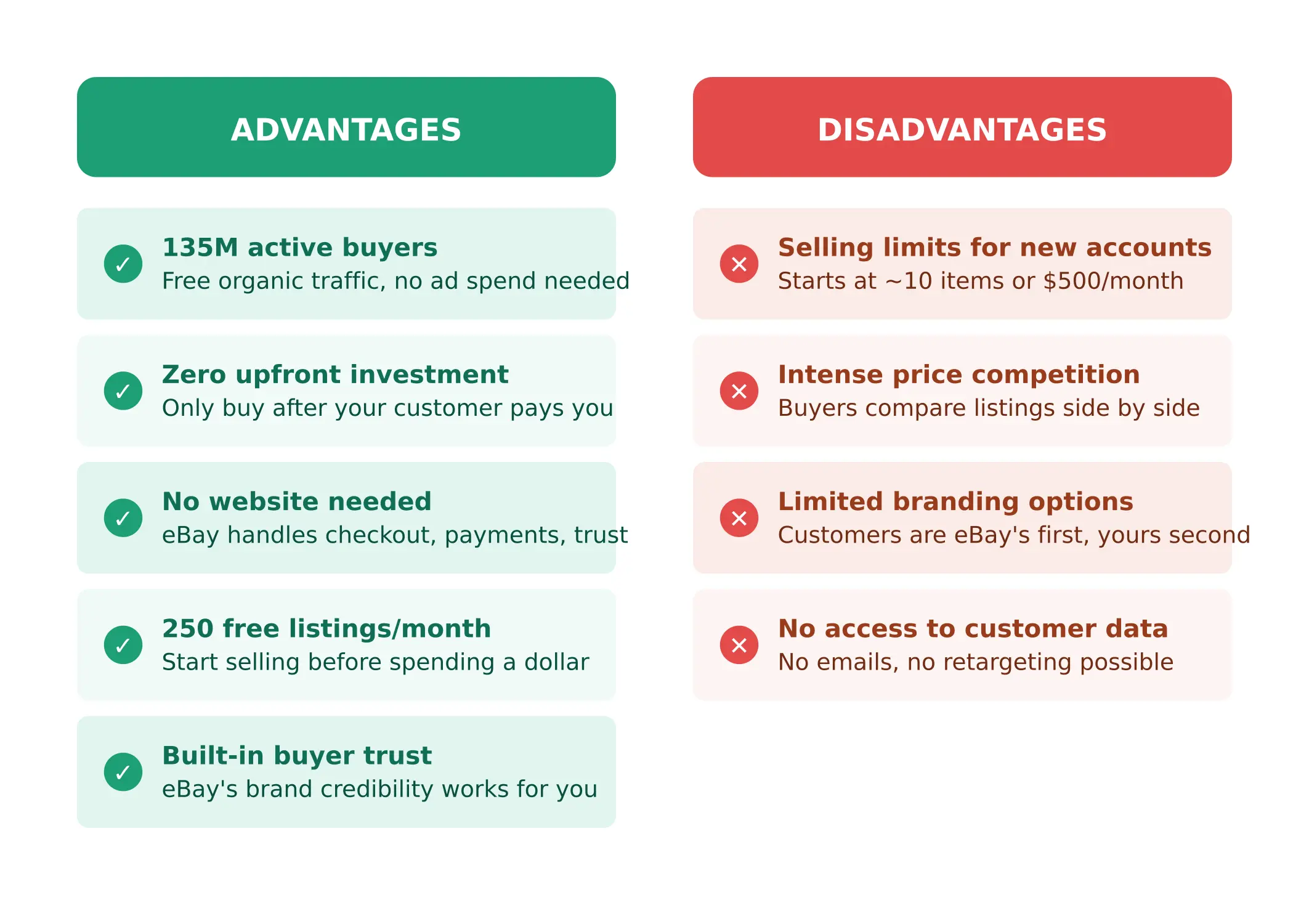
ebay dropshipping pros cons

Advantages of eBay Dropshipping

  • 135 million active buyers: eBay’s built-in audience means your listings get immediate exposure to shoppers who are actively looking to buy — without you spending a dollar on advertising.
  • Zero upfront inventory investment: You only buy from your supplier after a customer pays you. Your financial risk is practically zero.
  • No website needed: Unlike Shopify, eBay handles your entire selling infrastructure — product pages, checkout, payments, and dispute resolution — all in one platform.
  • 250 free listings per month: Start building a catalogue and making sales before spending anything.
  • Established buyer trust: eBay’s Money Back Guarantee and decades of brand recognition give buyers confidence in your listings even when your account is brand new.
  • Multiple international marketplaces: Sell across eBay.com, eBay.co.uk, eBay.de, eBay.ca, eBay.com.au and more from a single account, reaching buyers worldwide.
  • 61% of GMV via mobile: Your listings automatically reach buyers shopping on phones without any additional optimization needed.

According to Capital One Shopping, 65% of eBay sellers say the platform contributes directly to their business success, and 94% credit eBay with helping grow their business.

Disadvantages of eBay Dropshipping

  • Selling limits for new accounts: New accounts start at roughly 10 items or $500/month. These increase with consistent performance but feel restrictive early on.
  • Intense price competition: eBay is price-transparent — buyers can compare every listing side by side. Competing purely on price is a race to the bottom.
  • Limited branding: eBay does not allow you to build a distinctive brand identity the way your own website does. Customers are eBay’s customers first, yours second.
  • No access to customer data: eBay does not share buyer emails or personal information, limiting your ability to build a customer list or run retargeting.

Strict performance monitoring: A bad week with a poor supplier can damage your seller metrics in ways that take time to recover from.

Passive Income Opportunity

Turn eBay Into a Monthly Income Stream — Without the Daily Grind

Stop trading time for money. Our team builds and runs your eBay dropshipping store from day one — product research, listings, orders, and customer service — all done for you. Your only job is to collect your monthly profits.

✓ No Inventory ✓ No Experience Needed ✓ We Handle Everything ✓ Monthly Profits

Zero daily workload  ·  Expert team  ·  Real monthly profits

How Much Does It Cost to Start Dropshipping on eBay? (2026 Fees)

 Understanding eBay’s fee structure before you list a single product is one of the most important steps you can take as a new seller. These fees directly determine whether each sale is profitable or a loss, and many beginners make the mistake of calculating margins without properly accounting for them. Here is every fee you need to know, with accurate 2026 data sourced directly from eBay’s official fee page.

Insertion Fees (Listing Fees)

An insertion fee is charged each time you create a listing. The good news for beginners: eBay gives every seller 250 free fixed-price listings per month as a standard allocation, regardless of whether you have a Store subscription. This means you can list and test up to 250 products before spending anything on listing fees.

Once you exceed your free listing allocation, insertion fees apply:

  • No Store / Starter Store: $0.30 per additional listing
  • Basic Store: $0.25 per additional listing
  • Premium Store: $0.10 per additional listing
  • Anchor Store: $0.05 per additional listing

Important: insertion fees are non-refundable even if the item does not sell. They are also charged each time a Good ‘Til Cancelled listing renews each month.

eBay Store Subscription Fees (2026 — Verified from eBay.com)

While you can sell without a Store subscription using your 250 free listings, opening an eBay Store is highly recommended for dropshippers because it unlocks significantly higher listing volumes, reduced final value fees, and a branded storefront. Here are the current 2026 prices, verified directly from eBay’s official fee page:

  • Starter Store: $7.95/month (monthly) | $4.95/month (annual) — 250 free fixed-price listings
  • Basic Store: $27.95/month (monthly) | $21.95/month (annual) — 1,000 free fixed-price listings
  • Premium Store: $74.95/month (monthly) | $59.95/month (annual) — 10,000 free fixed-price listings
  • Anchor Store: $349.95/month (monthly) | $299.95/month (annual) — 25,000 free fixed-price listings
  • Enterprise Store: $2,999.95/month (annual only) — 100,000 free fixed-price listings

For most beginners starting out, a Basic Store at $21.95/month (annual) is the recommended starting point. It provides 1,000 monthly listings, lower final value fees than the Starter tier, and access to Promotions Manager and additional seller tools. The subscription typically pays for itself once you hit around $2,500 in monthly sales through the fee discount alone.

Final Value Fees (2026 — The Most Important Fee to Understand)

The final value fee is the percentage of each sale that eBay takes. It is calculated on the total sale amount — meaning the item price PLUS any shipping and sales tax charged to the buyer. This is the most impactful fee on your profit margin and must be factored into every pricing decision you make.

eBay updated its fee structure in early 2025 and these are the current 2026 rates:

Without a Store (or Starter Store):

  • Most categories: 13.25% to 13.6% on the total sale amount up to $7,500 per item + $0.40 per order (or $0.30 for orders $10 or under).

  • Books, Movies, Music (Media): 15.3% + $0.40 per order.

  • Jewelry & Watches: 15.3% on sales up to $5,000; 9.3% on the portion over $5,000.

  • Guitars & Basses: 6.7% + $0.40 per order.

  • Athletic Shoes (over $150): 8% flat — the $0.40 per-order fee is waived.

With a Basic, Premium, Anchor, or Enterprise Store:

  • Most categories: 12.35% to 12.7% on total sale up to $7,500 + $0.40 per order.

  • Books, Movies, Music (Media): 15.3% + $0.40 per order (No discount for store holders in this category).

  • Jewelry & Watches: 12.35% up to $5,000; 7.35% on the portion over $5,000.

  • Guitars & Basses: 6.7% + $0.40 per order.

Key insight: Upgrading from no Store to a Basic Store reduces your final value fee from 13.6% to 12.7% on most categories — a saving of 0.9% per sale. On $10,000/month in sales, that is $90 saved — which is more than four times the monthly cost of an annual Basic Store subscription ($21.95).

Important 2026 Update: eBay officially set its per-order fee at $0.40 for all orders over $10 as of the 2025 Seller Update. Always factor this fixed charge into your profit calculations, especially for low-dollar items where it represents a larger percentage of your margin.

eBay’s official Page for All Fees > Here

Promoted Listings Fees

eBay Promoted Listings Standard is an optional advertising feature. You set an ad rate — a percentage of the final sale price — and only pay that fee when a buyer actually purchases through your promoted placement. There is no charge if the promotion does not lead to a sale. Typical ad rates range from 2% to 15%, with higher rates giving your listings more prominent placement in search results.

Promoted Listings Advanced (eBay’s PPC-style ads) operates differently — you set a daily budget and pay per click, whether or not the click results in a sale. This format is better suited for experienced sellers than beginners.

International Fee

If you sell to buyers outside the US, eBay charges an additional 1.65% international fee on the total sale amount, applied on top of your final value fee. This is automatically calculated and deducted from your payout.

Sample Profit Calculation (2026 Accurate Fees)

Here is a real-world example using verified 2026 fee rates for a Basic Store seller in a standard category:

  • Product sells on eBay for $50.00 (including $5 shipping charged to buyer)
  • eBay Final Value Fee (12.7% on $50): $6.35
  • Per-order fee: $0.40
  • Promoted Listings (5% ad rate): $2.50
  • Wholesale cost from supplier: $20.00
  • Net profit: $50.00 − $6.35 − $0.40 − $2.50 − $20.00 = $20.75 (41.5% net margin)

This is a healthy example with a good wholesale cost. Real margins vary by category, supplier pricing, and how much you invest in promoted listings. Always run this calculation before committing to any product. Never list without knowing your exact margin.

Taxes for US eBay Dropshippers

Sales Tax

eBay automatically calculates, collects, and remits sales tax on all US marketplace transactions on your behalf under Marketplace Facilitator laws, which are now enacted in all 50 US states. This means you do not need to manage sales tax on eBay sales — it is handled entirely by eBay. Your transaction records show sales tax collected and remitted by eBay, listed separately from your seller proceeds.

Income Tax

Your eBay dropshipping profits are taxable as business income. eBay issues Form 1099-K to sellers who process over $600 in gross sales in a calendar year — this threshold was lowered from $20,000 as part of recent IRS reporting updates. Even if you do not receive a 1099-K, you are still legally required to report all eBay business income on your federal tax return.

Your taxable income is your net profit — revenue minus deductible business expenses. Common deductions for eBay dropshippers include: eBay Store subscription fees, promoted listings spend, research tool subscriptions, home office expenses, and any other directly business-related costs. Keep records of all expenses throughout the year.

Business Structure

Operating as a sole proprietor is the simplest starting point for most beginners. As your income grows, forming an LLC provides liability protection and may offer tax advantages. Consult a CPA with experience in e-commerce businesses to determine the right structure for your specific situation. The IRS Small Business Center also provides free guidance on your tax obligations as a small business owner.

How to Start Dropshipping on eBay: Step-by-Step for Complete Beginners

Now that you understand what eBay dropshipping is, what it costs, and what the rules are, it is time to walk through the exact steps to get your store live. Follow these steps in order — this sequence is specifically designed for someone who has never sold on eBay before. Do not skip steps or jump ahead, as each one builds on the last.

Step 1: Sign Up for an eBay Account
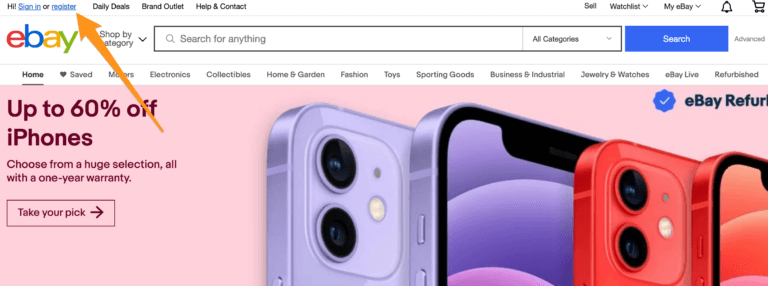
sign up for an ebay account

Go to eBay.com and click “Register” in the top-left corner. You will be given two account type options:

  • Personal Account: Designed for casual sellers. Simpler to set up — just your full name, address, date of birth, and email address. Suitable if you want to test the platform with zero commitment before deciding to scale.
  • Business Account: Designed for sellers operating commercially with the intent to make a profit. Requires your business name, registered business address, phone number, and tax identification number (EIN or SSN for sole proprietors). Gives you access to higher selling limits, Store subscriptions, and advanced seller tools.

For dropshipping, a Business Account is strongly recommended. If you are a US sole proprietor without a registered LLC, you can register using your own name and Social Security Number as your business information. You can always start with a personal account and upgrade to business later — but note that once you convert to a business account, the change cannot be reversed.

After filling in your details, click Create Account. eBay may prompt you to verify your email address — do this immediately.

Step 2: Set Up eBay Managed Payments
eBay Managed Payments

Once your account is created, eBay will guide you to set up Managed Payments — eBay’s built-in payment processing system that replaced PayPal as the default payment method. You no longer need a separate PayPal account to receive funds.

To complete Managed Payments setup, you will need to:

  1. Verify your identity: eBay will ask for your legal name, date of birth, and the last four digits of your SSN for identity verification. This is required by financial regulations.
  2. Link a bank account: Connect your US checking or savings account where your payouts will be deposited. Make sure this is an account you actively use and monitor.
  3. Set your payout schedule: eBay typically processes payouts within one to two business days after each sale is confirmed. You can set your payout frequency to daily, weekly, bi-weekly, or on-demand.

Once Managed Payments is active, eBay automatically deducts your selling fees from your sales proceeds and deposits the net amount into your bank account. You will see a clear fee breakdown in your Seller Hub for every transaction.

Step 3: Configure Your Business Policies
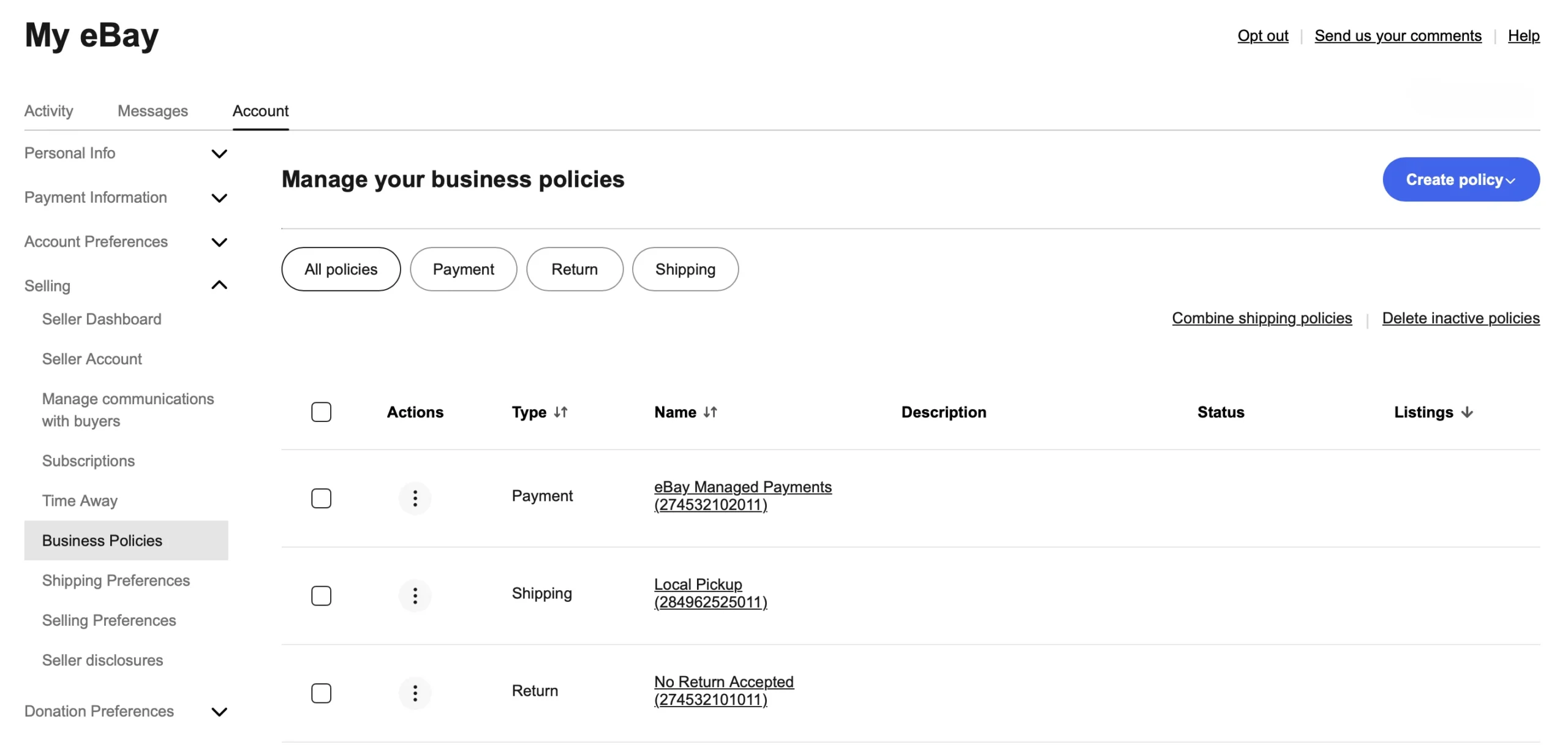
Configure Your ebay Business Policies

Before listing any dropshipping products, go to My eBay → Account → Business Policies and set up your three seller policy templates. These are reusable templates that automatically apply to your listings, defining the terms of every transaction. Getting these right before you start saves significant time and prevents buyer confusion.

Shipping Policy — Your shipping policy must accurately reflect your supplier’s actual dispatch time. If your supplier ships within two business days, your policy must state two business days. Never promise faster dispatch than your supplier can reliably deliver. Late shipments are one of the most damaging metrics on your account. For a full understanding of eBay’s shipping timeline rules and how handling time works, our detailed guide covers exactly how long eBay sellers have to ship, what counts as a late shipment, and how to configure your shipping policy to protect your metrics.

Returns Policy — Be clear and fair. eBay’s Money Back Guarantee means buyers can return items that are not as described regardless of your stated policy. A returns policy that accepts 30-day returns for any reason reduces disputes and tends to attract more buyers than a no-returns policy. Think of it as a selling tool, not just a legal obligation. For everything you need to know about configuring eBay’s seller policies correctly, our complete guide to eBay Business Policies walks through every setting and what each one means for your dropshipping operation.

Payment Policy — Set this to eBay Managed Payments as your accepted payment method, which is now eBay’s standard for all US sellers.

Step 4: Understand Your Selling Limits

Before you list your first product, you need to understand that every new eBay account starts with selling limits — a cap on the number of items you can list and the total value of sales you can make per month. For most brand-new accounts, this limit starts at around 10 items or $500 per month. This is eBay’s standard new-seller restriction, designed to protect buyers from unverified sellers.

Selling limits are temporary, and they increase automatically over time as you build a track record — or you can request a manual increase. Here is exactly how to handle them:

  • Check your current limits: Go to My eBay → Account → Selling Limits. This page shows your current monthly listing cap, how many you have used, and when your limits were last updated.
  • Do not try to exceed your limits: If you attempt to list more than your limit allows, eBay will block the listing. Do not try to create duplicate accounts to get around limits — eBay detects this and will suspend all related accounts.
  • Request a limit increase: After 30 days of active selling with clean metrics, go to the Selling Limits page and click “Request Limit Increase”. eBay will ask you a few questions about your business and typically responds within minutes to hours. Include a brief explanation of your business model — something like: “I am operating an eBay dropshipping store sourcing products from wholesale suppliers. I have maintained excellent seller metrics and would like to expand my catalogue.” Professional, polite requests with a clean track record almost always get approved.
  • Keep increasing over time: eBay typically increases limits monthly for sellers with good performance. Most active sellers reach limits of 500 to 1,000 items and $25,000+ per month within their first three to six months of consistent selling.

Step 5: List Your First Item Manually (Before Dropshipping)

This step is the one most beginners skip — and the one most experienced dropshippers wish they had done. eBay’s risk detection systems monitor new accounts very closely in the first 30 days. If a brand-new account suddenly lists 50+ products without any prior selling history, eBay’s systems may flag the account for review and temporarily restrict it while they investigate.

The safest and most effective way to avoid this problem is to sell one or two items you already own before listing any dropshipping products. Walk around your home and find any item in good or new condition that you no longer need — a book, a kitchen gadget, a piece of clothing, a small tool. The item does not need to be particularly valuable or interesting. It just needs to be:

  • Something you physically have and can ship yourself
  • Not electronics — eBay applies extra scrutiny to electronics listings from new accounts
  • Not copyrighted, branded, or restricted in any way
  • In new, like-new, or good condition

List the item manually — write your own title, take a few photos on a clean background with your phone, write a simple honest description, set a fair price, and ship it promptly when it sells. The entire experience, from listing to delivery to receiving feedback, is the most valuable crash course in eBay selling you can get.

Selling one or two items this way achieves three critical things: it signals to eBay’s algorithm that you are a legitimate, active seller with real fulfilment experience; it gives you your first seller feedback score (even one positive feedback transforms how buyers perceive your new account); and it gives you hands-on familiarity with the listing and order management process before you are managing it at scale with dropshipping orders. Do not skip this step.

Step 6: Do Your Product Research
ebay product research for dropshipping

With your account configured, your policies set, your Store subscription active, and your selling limits understood, you are ready to research your first dropshipping products. This is where most of your upfront time investment goes — and where most of the difference between a profitable store and an unprofitable one is made.

Do not list products based on gut feeling or what seems popular to you personally. Use data. The two free tools every beginner should start with are:

  • eBay Terapeak (inside Seller Hub → Research): eBay’s own built-in market research tool. Type in any product or keyword and Terapeak shows you: the average sale price over the past 12 months, the total number of units sold, the sell-through rate (percentage of listings that actually sold versus those that did not), and the top-selling listings in that category. If a product has a sell-through rate above 60% and consistent monthly sales, that is a strong demand signal.
  • eBay Sold Listings Filter (free): Go to eBay.com, search for any product, then on the left-hand filter panel check the box for “Sold Items.” This shows you only listings that actually resulted in a completed sale — what buyers paid, how recently, and which listing presentations converted best. This is your most direct window into real buyer behavior.

Look for products that: sell consistently every month (not just seasonally), have a sell-through rate above 50%, have an average sale price that gives you at least a 20% net margin after fees, and are available from wholesale suppliers at a price that supports that margin. We cover product research in full depth in the dedicated section later in this guide, and our breakdown of the top eBay product research tools for 2026 covers every available option from free to paid, with honest assessments of what each does best.

Step 7: Find and Vet Your Wholesale Supplier

Once you have identified products with confirmed demand and a viable margin, find a wholesale supplier who carries them. Your supplier must be a genuine wholesale or manufacturing business — not another online retailer, and never Amazon, Walmart, or any other retail site.

Before committing to any supplier, verify these five things:

  1. Place a test order: Order the product yourself to experience the full delivery flow — packaging quality, product condition, dispatch speed, and whether any third-party branding appeared in the box. If Amazon packaging arrives, this supplier is not eBay-compliant.
  2. Confirm dispatch time: Ask your supplier explicitly: “What is your processing and dispatch time from order placement?” Their answer must match or be faster than the handling time you plan to set in your eBay shipping policy.
  3. Confirm white-label shipping: Ask: “Do you ship without any of your own branding, invoices, or marketing materials in the package?” If they cannot confirm yes to this, do not use them for eBay dropshipping.
  4. Confirm tracking on every order: Ask: “Do you provide a tracking number for 100% of orders?” Tracking upload is one of eBay’s monitored performance metrics. A supplier who does not consistently provide tracking will damage your account health.
  5. Review their returns process: Get their returns policy in writing. What happens with damaged goods? Wrong items? How do they handle replacements? How quickly do they process them? You need to understand every scenario before a problem arises — not during one.

Our guide to the best eBay dropshipping suppliers is updated for 2026 and covers verified platforms with direct eBay integration, organized by product category.

Step 8: Calculate Your Profit Margin Before Listing

Before creating a single listing, run the full profit calculation for every product you plan to sell. This is non-negotiable. Many beginner dropshippers skip this step and list products that generate tiny or negative margins after fees — which means hours of work for zero profit.

Here is the formula: Net Profit = Listing Price − Supplier Cost − Final Value Fee − Per-Order Fee − Promoted Listings Fee

Using 2026 accurate fees for a Basic Store seller:

  • Look up the current eBay sale price for your product in your target category using Terapeak or Sold Listings
  • Subtract your supplier’s wholesale cost
  • Subtract eBay’s final value fee: 12.7% of the total sale amount (including any shipping charged to buyer)
  • Subtract the per-order fee: $0.40 for orders over $10
  • Subtract any Promoted Listings spend (typically 3% to 8% of sale price)
  • If the remaining number represents at least 20% of the listing price, the product is worth listing. If not, either find a cheaper supplier or choose a different product.

Example: Product sells for $40. Supplier cost $15. Final value fee (12.7%): $5.08. Per-order fee: $0.40. Promoted Listings (5%): $2.00. Net profit = $40 − $15 − $5.08 − $0.40 − $2.00 = $17.52 (43.8% margin). This is a strong product to list.

Step 9: Create Your First Dropshipping Listings
optimize ebay listings for dropshipping

You are now ready to list your dropshipping products. In Seller Hub, click “Listings” → “Create Listing”. eBay will first ask you to search for your product — type in the product name or barcode. If eBay finds a matching catalogue entry, it will pre-fill many fields for you automatically (title, category, item specifics, and sometimes photos). Review and edit these carefully — catalogue pre-fills are often incomplete or generic and need customization to rank well.

If eBay does not find a matching catalogue entry, you will build the listing from scratch. Here is every element you need to complete, in order:

Title (80 characters — use them all)

Your title is the most important factor for eBay search visibility. Include: product type, brand (if applicable and authorized), key attributes (size, color, material, style, model number), and condition. Use terms buyers actually search for — check eBay’s autocomplete suggestions and Terapeak’s top search queries for your product to confirm the exact phrasing buyers use.

Weak: “Garden Hose — Great Quality”

Strong: “Heavy Duty 50ft Garden Hose Flexible Lightweight 8-Pattern Spray Nozzle Water Pipe”

Category

Select the most specific applicable category for your product. Category selection affects your final value fee (some categories have lower rates), your item specifics options, and how eBay’s algorithm categorizes and displays your listing in browsing results. Choosing a broad parent category when a more specific subcategory exists will reduce your listing’s relevance score.

Item Specifics

Fill in every single available item specific — brand, size, color, material, MPN (Manufacturer Part Number), EAN/UPC, and any product-specific attributes for your category. eBay’s search algorithm weights item specifics heavily as relevance signals. Listings with fully completed item specifics consistently rank higher and appear in more filtered browsing results than listings with gaps. This is one of the easiest and most impactful listing optimization steps available.

Condition

Select the accurate condition for your product. For new dropshipping items, this is “New” or “New with tags” depending on the category. Never misrepresent condition — buyers who receive a product in a different condition than listed will open a “not as described” return, which is a defect on your account.

Photos (use all 24 slots)

eBay allows up to 24 photos per listing — use as many as you can. The main image must show the product clearly on a white or light neutral background with no text overlays, watermarks, or borders. Additional images should show: different angles, scale references (product next to a common object), packaging, accessories included, and any key features or details buyers would want to see. High-quality photos from multiple angles significantly improve buyer confidence and conversion rate.

Description

Optimize eBay Listing Titles

Write a description that gives buyers everything they need to make a confident purchase decision. Include: exact dimensions and weight, materials and construction, what is included in the package, compatibility information (if relevant), care instructions (if applicable), and any important limitations or caveats buyers should know. Use short paragraphs and bullet points — buyers skim, especially on mobile. Put the most important specifications first. Be honest. Buyers who receive exactly what the description led them to expect leave positive feedback. Buyers who feel surprised or misled leave returns and defects.

Pricing

Set your listing price based on your profit calculation from Step 8. Check Terapeak and Sold Listings one more time to confirm your price is within the competitive range for your category. Do not underprice to the point where your margin disappears — and do not overprice relative to active competition without a clear differentiating reason. Consider offering free shipping and building the cost into your listing price, as free shipping listings perform better in eBay’s search algorithm and appeal more strongly to most buyers.

Shipping Policy

Apply the shipping policy you created in Step 3. Double-check that the handling time in your policy exactly matches your supplier’s actual dispatch capability. If your supplier needs two business days to dispatch, your shipping policy must say two business days — not one, no matter how much faster you would prefer to look.

Returns Policy

Apply the returns policy you created in Step 3. Confirm it shows accurately on the listing preview before publishing.

Promoted Listings (Optional but Recommended for New Listings)

For brand-new listings with no sales history, organic search ranking starts very low. To generate initial visibility and your first sales faster, enable Promoted Listings Standard on the listing. Set an ad rate of 3% to 5% of the sale price. You only pay this rate when a buyer purchases through the promoted placement. The early sales you generate through promotion build your listing’s performance history, which progressively improves your organic ranking — meaning you can reduce or remove promoted listings spend once the listing is established.

Click “List It” to publish your listing. It typically takes 15 to 30 minutes to appear in eBay’s search results.

Step 10: Manage Your First Orders

Your first order is going to feel exciting — and slightly stressful. Here is the exact process to follow every single time a buyer purchases from your store:

  1. Check your eBay orders: You will receive an email notification when a buyer pays. Log into Seller Hub → Orders → Awaiting Shipment to see the order details: buyer’s full name, delivery address, product purchased, and variant selected (size, color, etc.).
  2. Place the supplier order the same business day: Go to your supplier’s website and place the order using the buyer’s exact name and delivery address as the shipping details. Select the correct product variant. In the order notes or special instructions field (if available), write: “Please do not include any branded packaging, invoices, or marketing materials. Ship in plain packaging only.” Check that the price you are paying your supplier matches what you expected from your profit calculation.
  3. Save the supplier order confirmation: Keep a record of every supplier order you place, including the supplier’s order number, the product, and the price paid. You will need this if there is ever an issue with the order.
  4. Upload the tracking number to eBay: Your supplier will email you a tracking number — usually the same day or next business day after dispatch. As soon as you receive it, log into Seller Hub → Orders → find the relevant order → click “Add Tracking” → enter the tracking number and select the shipping carrier. Do this immediately. Do not delay tracking upload. eBay monitors the percentage of orders where you upload valid tracking on time, and this metric must stay above 95% to maintain good account standing.
  5. Mark the order as shipped: Once tracking is uploaded and confirmed by eBay as valid, the order status will update to Shipped automatically.
  6. Monitor the delivery: Keep an eye on the tracking for each order. If a delivery is delayed or shows as stuck in transit, contact your supplier proactively and communicate the update to your buyer before they reach out to you. Proactive communication dramatically reduces the likelihood of a buyer opening a dispute.
  7. Check messages daily: Go to My eBay → Messages every day without exception. Respond to all buyer inquiries within 24 hours — ideally within a few hours. eBay measures your response rate and response time as part of your overall seller performance.

When the order is delivered and the buyer is satisfied, eBay will release your payout to your bank account on your chosen schedule. The transaction is complete. Do it again — and keep improving.
Done-For-You Service

Your eBay Store. Built, Managed, and Scaled by Experts.

Stores Automation handles every aspect of your eBay dropshipping business — so you do not have to. From setting up your store and finding winning products to fulfilling daily orders and managing customer service, we take care of it all while you earn.

✓ Store Setup ✓ Winning Products ✓ Order Fulfilment ✓ Customer Service ✓ Ongoing Optimisation

No inventory  ·  No daily hassle  ·  Professional management from day one

How to Find Winning Products for eBay Dropshipping

How to Find Winning Products for eBay Dropshipping

Image Source: ERPOLO

Product research is the highest-leverage activity in your entire dropshipping business. The difference between a store generating $5,000 a month and one generating nothing almost always comes down to product selection. Listing products that buyers are actively searching for, at prices that give you a workable margin, in categories where the competition is manageable — that is the core skill of a profitable eBay dropshipper.

What Makes a Winning Product?

  • Year-round, consistent demand: Check 12 months of sales history, not just recent weeks. You want products that sell every month — not just during a seasonal spike.
  • Manageable competition: Look for strong demand but search results not completely dominated by established sellers with thousands of sales at prices you cannot match.
  • Healthy net margin: Target a minimum 20% net profit after all eBay fees, promoted listings spend, and supplier cost. Below 15%, a single return or price fluctuation can wipe out your profit.
  • Fast supplier dispatch: Your supplier needs to ship within one to three business days. Slow dispatch is the single largest cause of late shipment defects.
  • Lightweight and durable: Products that ship cheaply and arrive undamaged. Heavy or fragile items add costs and damage risk.
  • Clear specifications: Products where dimensions, materials, and function are easy to describe accurately. Vague products generate returns from buyers whose expectations were not met.

Products to Avoid on eBay

  • Copyrighted or trademarked items without authorization: eBay’s VeRO program gives brand owners direct authority to remove your listings. Even legitimate branded products can trigger VeRO if listed without being an authorized reseller.
  • Age-restricted products: Alcohol, tobacco, adult content — restricted or prohibited on eBay.
  • Dangerous goods: Weapons, ammunition, flammable liquids, products with choking hazard risks.
  • Health products with unverified claims: Supplements, vitamins, and medical devices with before-and-after photos or medical benefit claims.
  • High-ticket branded electronics: Often VeRO-protected and require authenticity verification that dropshippers typically cannot provide.

Best Niches for eBay Dropshipping in 2026

Based on consistent demand data, healthy margins, and supplier availability, the following niches perform well for US-based eBay dropshippers in 2026. If you want specific product examples and detailed category analysis, our guide to the best things to sell on eBay for profit in 2026 breaks down top-performing items with real sales data and profit margin examples:

  • Home improvement tools and accessories — year-round demand, clear specs, enormous supplier variety
  • Garden and outdoor products — strong spring/summer peaks plus year-round maintenance demand
  • Pet supplies and accessories — growing market, broad product range, consistent repurchase patterns
  • Automotive parts and accessories — high-value, spec-specific searches, buyers with purchasing intent
  • Fitness equipment and accessories — strong year-round demand, especially home fitness
  • Baby products and nursery equipment — high-trust purchases with consistent demand
  • Office supplies and accessories — B2B and B2C demand, consistent pricing, reliable suppliers
  • Kitchen gadgets and appliances — gift-driven and practical, strong visual appeal for listing photos
  • Phone and tablet accessories — high volume, fast turnover, driven by regular device releases
  • Sports and outdoor equipment — niche opportunities with strong buyer intent

How to Research Products Effectively

  • eBay Terapeak: The gold standard for eBay-specific demand data. Shows historical sales volume, average sale price, and sell-through rate for any search term or product over the past 12 months. Available free to Store subscribers through Seller Hub.
  • eBay Sold Listings: Free, requires no tools. Search any product on eBay and filter to Sold Listings. Shows exactly what real buyers paid and how often items sold.
  • eBay Best Sellers and Trending sections: Browse eBay’s own curated lists of top-performing products in real time.
  • Competitor analysis: Find top dropshippers in your target niche. Sort their active listings by Most Sold. Identify the products moving consistent volume and the pricing and listing structure working for them.
  • Google Trends: Validate whether search interest is growing, stable, or declining over time. A product with rising Google search volume often signals rising eBay demand.
  • Zik Analytics: A dedicated eBay research platform providing category-level competitor data, demand metrics, and product scoring specifically designed for eBay sellers.
How to Create eBay Listings That Rank and Convert

Your eBay listing is your advertisement, your product page, and your customer’s first impression simultaneously. A well-optimized listing ranks higher in eBay’s search results, converts a higher percentage of viewers into buyers, and earns better organic placement over time as its sales history builds. Here is how to build listings that perform.

eBay’s Search Algorithm

eBay’s search algorithm — known as Cassini — ranks listings based on two types of signals: relevance (how well your title and item specifics match the buyer’s search query) and performance (your listing’s sales history, click-through rate, and conversion rate, combined with your overall seller account health). New listings start with zero performance history and earn their ranking through sales. This is why generating early sales matters so much — they build the algorithm’s confidence in your listing and improve your organic ranking position over time.

For a complete deep-dive into eBay’s ranking factors and advanced tactics to improve your store’s search visibility, our eBay SEO guide covers the Cassini algorithm, title keyword research, item specifics optimization, and the seller metrics that directly affect your search placement.

Writing Titles That Rank

Your title is the single most important element for eBay search visibility. Use all 80 characters. Include: the product name, brand (if authorized), key attributes (size, color, material, model number), and condition. Research titles using Terapeak’s search query data and by studying the titles of top-selling listings in your category.

Poor title: “GREAT GARDEN HOSE BEST QUALITY”

Strong title: “Heavy Duty 50ft Garden Hose with 8-Pattern Spray Nozzle — Flexible Lightweight Water Hose”

The strong title includes product type, key specs, accessories included, and relevant attributes buyers would search for — all within 80 characters.

Item Specifics

Fill in every available item specific — brand, size, color, material, MPN, EAN, and any product-specific fields. eBay’s algorithm weights item specifics heavily as relevance signals. Listings with fully completed specifics consistently rank higher and appear in more filtered browsing pages than those with gaps. Check your listings periodically as eBay regularly adds new required specifics to categories.

Product Description

Be detailed, honest, and scannable. Include: exact dimensions and weight, materials, what is in the box, compatibility notes, and any important limitations. Use short paragraphs and bullet points — buyers skim, especially on mobile. The most important information goes first. Buyers who receive exactly what your description led them to expect leave positive feedback. Buyers who feel misled leave returns and defects.

Photos

Use all 24 available image slots. eBay requires the main image to be on a white or light background with the product clearly visible and no text overlays or watermarks. Multiple angles, scale shots, packaging photos, and in-use images all increase buyer confidence. Buyers cannot inspect the product before buying — your images are their substitute.

Pricing Strategy

Research what top sellers are charging using Terapeak’s average sale price data and the Sold Listings filter. Price within the competitive range while confirming your margin is viable. A practical formula: (Supplier cost + all eBay fees + desired profit) = listing price. Or as a quick check: your listing price should be at least 1.4x your supplier cost to target a 20%+ net margin after the 2026 fee structure.

How to Manage Orders, Customer Service, and Seller Metrics

Order Fulfilment

When a buyer purchases, place the supplier order the same business day. Provide the buyer’s exact name and delivery address. Confirm no third-party branding is included. Upload tracking to eBay as soon as your supplier provides it.

Understanding eBay’s specific handling time rules — and what exactly counts as a late shipment from eBay’s perspective — is essential to keeping your metrics clean. 

The Four Seller Performance Metrics (2026)

eBay tracks these four metrics for every seller. Staying within the required thresholds is essential for maintaining search visibility, Top Rated Seller eligibility, and account standing:

  • Transaction Defect Rate: Must stay below 2% of transactions. Below 0.5% required for Top Rated status. Defects include: eBay-closed cases, out-of-stock order cancellations, and seller-initiated cancellations.
  • Late Shipment Rate: Must stay below 5% of total shipments (below 3% for Top Rated). eBay measures this against your stated handling time — consistently missing your own stated dispatch time generates defects.
  • Cases Closed Without Seller Resolution: Must stay below 0.3% of transactions. Always resolve buyer disputes before eBay steps in. Respond to all cases within 24 hours.
  • Tracking Uploaded on Time: Must be above 95% of orders. Upload tracking immediately when your supplier provides it. Never delay this step.

Sellers who consistently exceed these thresholds and meet the minimum transaction requirements qualify for Top Rated Seller status — which comes with a visible trust badge, improved search placement, and reduced final value fees. Our step-by-step guide to becoming a Top Rated Seller on eBay covers every requirement and the exact actions needed to qualify.

Handling Returns

Accept returns on items not as described immediately — fighting these always results in a case against you. Refund promptly. Work with your supplier separately to recover costs. For buyer remorse returns (“I changed my mind”), you can decline if your policy does not cover them, but accept if the buyer escalates — the case outcome almost always favors buyers anyway.

Customer Service

Check eBay messages at least twice daily. Respond to all inquiries within 24 hours. Resolve issues generously. A buyer who had a problem and received excellent service becomes one of your most loyal customers and most likely to leave a detailed positive review.

eBay Automation Service

We Build It. We Run It. You Profit. — That Simple.

Whether you are a busy professional, a first-time entrepreneur, or an investor looking for passive income — Stores Automation gives you a fully managed eBay dropshipping business that generates real monthly revenue without demanding your time.

You get

Monthly profits while we run everything

We handle

Setup, listings, orders, suppliers & support

Best for

Professionals, beginners & investors

You need

Zero experience, inventory, or daily involvement

Trusted by entrepreneurs worldwide  ·  Full-service eBay management  ·  Real results

How to Scale Your eBay Dropshipping Business

How to Scale Your eBay Dropshipping Business

Expand Your Catalogue Methodically

Add new products in controlled batches — research each one before listing and monitor performance for two to three weeks before adding more. Products with zero impressions after four weeks should be repriced, re-titled, or replaced. Focus on building depth in your strongest-performing niches rather than spreading across unrelated categories.

Diversify Your Suppliers

Working with two or three suppliers simultaneously protects you from being entirely dependent on one source. Allocate products across suppliers based on category strength, and maintain backup sourcing options for your highest-performing listings so a single supplier’s problem cannot derail your entire store’s metrics.

Sell Internationally with eBay’s International Shipping Program

Once your US store is running smoothly, eBay’s International Shipping Program makes it straightforward to reach buyers worldwide. eBay handles customs, duties, and international logistics from a domestic hub — you ship domestically as normal. This significantly increases your addressable market with minimal additional operational complexity. Our complete guide to the eBay International Shipping Program covers how it works, what it costs, and how to set it up in your listings.

Work Toward Top Rated Seller Status

Top Rated Seller is eBay’s highest recognition tier — awarded to sellers who consistently maintain excellent metrics above the required thresholds and meet minimum transaction volumes. Benefits include: a trust badge on every listing (improves buyer confidence and conversion), improved search placement, and a 10% discount on final value fees. These benefits compound significantly over time and represent a real long-term competitive advantage.

Consider Adding Reselling to Your Model

Many experienced dropshippers eventually expand into a hybrid model that combines dropshipping with reselling — purchasing clearance lots, manufacturer overstock, or liquidation inventory at below-market prices and flipping them on eBay at standard retail prices. This approach generates significantly higher margins than pure dropshipping for sellers who have built the platform knowledge to identify good opportunities. Our guide to reselling on eBay covers the best products to resell, how to source them, and the strategies that generate the highest profit margins.

The Biggest Challenges of eBay Dropshipping and How to Overcome Them

Price Competition and Margin Compression

eBay’s price-transparent search results mean buyers can compare every competing listing instantly. New sellers frequently get undercut by established sellers with better supplier pricing or higher Store tiers with lower fees. The solution is competing on value — not just price. Superior listing quality, faster handling times, more generous returns policies, and higher feedback scores all allow a listing to hold a modest price premium over weaker competitors. Build these advantages systematically rather than racing to the bottom on price.

Out-of-Stock Issues

Selling an item your supplier no longer has in stock is one of the most damaging operational errors in dropshipping. A cancellation counts as a transaction defect, and too many defects reduce your search visibility and can trigger account review. The prevention is real-time inventory synchronization between your supplier’s stock system and your eBay listings — this must be a non-negotiable requirement for any supplier you work with at scale.

Maintaining Account Health Through Growth

As order volume scales, maintaining excellent metrics becomes harder without systematic processes. One bad supplier week can move your late shipment rate or tracking upload rate in the wrong direction. The solution is operational discipline: clear processes for every step of the order flow, daily monitoring of your Seller Hub performance dashboard, and acting quickly the moment any metric starts trending toward a threshold.

Dealing with a Flagged Account

A flagged eBay account has its listings displayed lower in search results, reducing visibility and sales. A flagged account is different from a suspended account — it remains active but underperforms. The way experienced sellers manage flagged accounts is through volume: by listing more products, total store traffic increases despite the per-listing suppression. Simultaneously, improving your seller performance metrics — fast shipping, low return rates, excellent customer service, competitive pricing — gradually restores eBay’s confidence in your store.c

Want to Skip the Hard Work? How Stores Automation Does It All for You

By this point, you have a comprehensive understanding of exactly what it takes to build a profitable eBay dropshipping store in 2026. The steps are clear, the tools are available, and the opportunity is real. For some readers, this guide is exactly what they needed to go build it themselves. For others — professionals with demanding schedules, people with limited time or experience, or investors looking for managed passive income — the honest assessment is: this is more work than I can commit to right now.

That is precisely the problem that Stores Automation was built to solve. Stores Automation is a professional done-for-you eBay store automation service provider. Our experienced team builds your eBay store from scratch, manages every aspect of its daily operations, and scales it continuously on your behalf. You sign up, and we handle everything — product research, listing creation, supplier management, order fulfilment, customer service, and performance monitoring. You earn monthly profits from a professionally managed store without being involved in the day-to-day operations.

What Stores Automation Handles

  • Full eBay seller account setup and configuration
  • Data-driven product research using live market demand signals
  • SEO-optimized listings built to rank in eBay’s search algorithm
  • Supplier sourcing and vetting — only eBay-compliant wholesale sources
  • Daily order processing and fulfilment management
  • Customer service, buyer message responses, and returns handling
  • Ongoing store optimization, repricing, and performance monitoring
  • Seller metrics management to maintain account health and Top Rated eligibility

Ready to transform your Ebay store and achieve big wins? Contact us at Stores Automation,  Reach out to us at 302-204-8244 or via email at info@storesautomation.com. For more information, Sign up for Ebay Store Automation. Embark on the path to e-commerce success with Stores Automation – where small changes lead to big wins!

Frequently Asked Questions: How to Start Dropshipping on eBay

1. Is eBay dropshipping a real way to make money or just hype?

eBay dropshipping is a legitimate business used by thousands of sellers. With millions of active buyers, you’re selling to an existing market. Success comes from treating it like a business—doing proper research, using wholesale suppliers, and managing performance. It’s not hype, but it’s also not instant or passive income.

2. How do I know if a product will sell before listing it?

Validate demand using data. Check eBay’s Sold Listings to see real sales, and use Terapeak for 12-month trends, pricing, and sell-through rate. A sell-through rate above 50% with consistent sales indicates strong demand.

3. Retail arbitrage vs wholesale dropshipping — what’s the difference?

Retail arbitrage involves reselling from stores like Amazon or Walmart, which eBay does not allow. Wholesale dropshipping means sourcing directly from suppliers at trade prices, which is fully permitted. Using retail sources risks listing removal or suspension.

4. Is eBay dropshipping too complicated for beginners?

No. eBay is beginner-friendly and handles traffic, payments, and infrastructure. You only need to learn product research, listing, and order handling. Starting small—like selling a few items first—helps you build confidence before scaling.

5. What happens when a buyer places an order?

You must act quickly. Place the order with your supplier using the buyer’s details, request unbranded packaging, and upload tracking as soon as it’s available. Fast and consistent handling is critical for maintaining good metrics.

6. How much can I realistically earn in the first few months?

Most sellers get their first sales within 2–4 weeks. After 2–3 months, part-time sellers (100–300 listings) may earn $500–$2,000/month, while full-time sellers can reach $3,000–$8,000+. Results depend on effort and strategy.

7. What if the supplier sends the wrong item or it arrives damaged?

You are responsible as the seller. Resolve the issue quickly by accepting returns or offering a replacement/refund, then recover costs from your supplier separately. Fast resolution protects your feedback and account health.

8. Why do new accounts have selling limits, and how can I increase them?

Limits help eBay manage risk with new sellers. To increase them, verify your account, fulfill orders on time, maintain good metrics, gain positive feedback, and request an increase after about 30 days.

9. How do I avoid getting my eBay account suspended?

Avoid retail arbitrage, use reliable wholesale suppliers, and stay clear of restricted or branded items without authorization. Start slowly, test suppliers, and maintain strong shipping and service metrics to stay safe.

10. What if I don’t have time to manage a store daily?

You can use a done-for-you service that handles everything—setup, product research, fulfillment, and customer service—allowing you to earn without managing daily operations.

Final Thoughts: How to Start Dropshipping on eBay

eBay dropshipping remains one of the most accessible, scalable, and beginner-friendly ways to start an online business in 2026. The platform’s 135 million active buyers, zero-inventory business model, and built-in trust infrastructure make it uniquely suited for first-time e-commerce entrepreneurs who want to generate real income without significant upfront investment.

But the sellers who succeed are the ones who approach it as a real business: understanding and following eBay’s sourcing policy from day one, researching products with data instead of guesswork, building reliable wholesale supplier relationships, creating listings optimized for both search and conversion, managing seller metrics with discipline, and scaling systematically rather than recklessly