
💡 Key Takeaways
- Walmart charges zero monthly fees — no subscription, no listing fees, no item setup costs.
- Every Walmart Marketplace seller pays a referral fee of 6% to 20% per sale depending on product category.
- Walmart Fulfillment Services (WFS) fees start at $3.45 per unit and are based on shipping weight.
- WFS storage fees are $0.75 per cubic foot/month — rising to $2.25/cu ft during Q4 peak season for items stored over 30 days.
- New sellers in 2026 qualify for up to $75,000 in savings through Walmart's New-Seller Savings programme.
- Walmart's total fee burden is consistently lower than Amazon's — no $39.99/month Professional plan and lower average storage fees.
- Hidden costs include advertising spend, sales tax obligations, and pricing parity enforcement.
📚 Table of Contents
- What Are Walmart Marketplace Seller Fees?
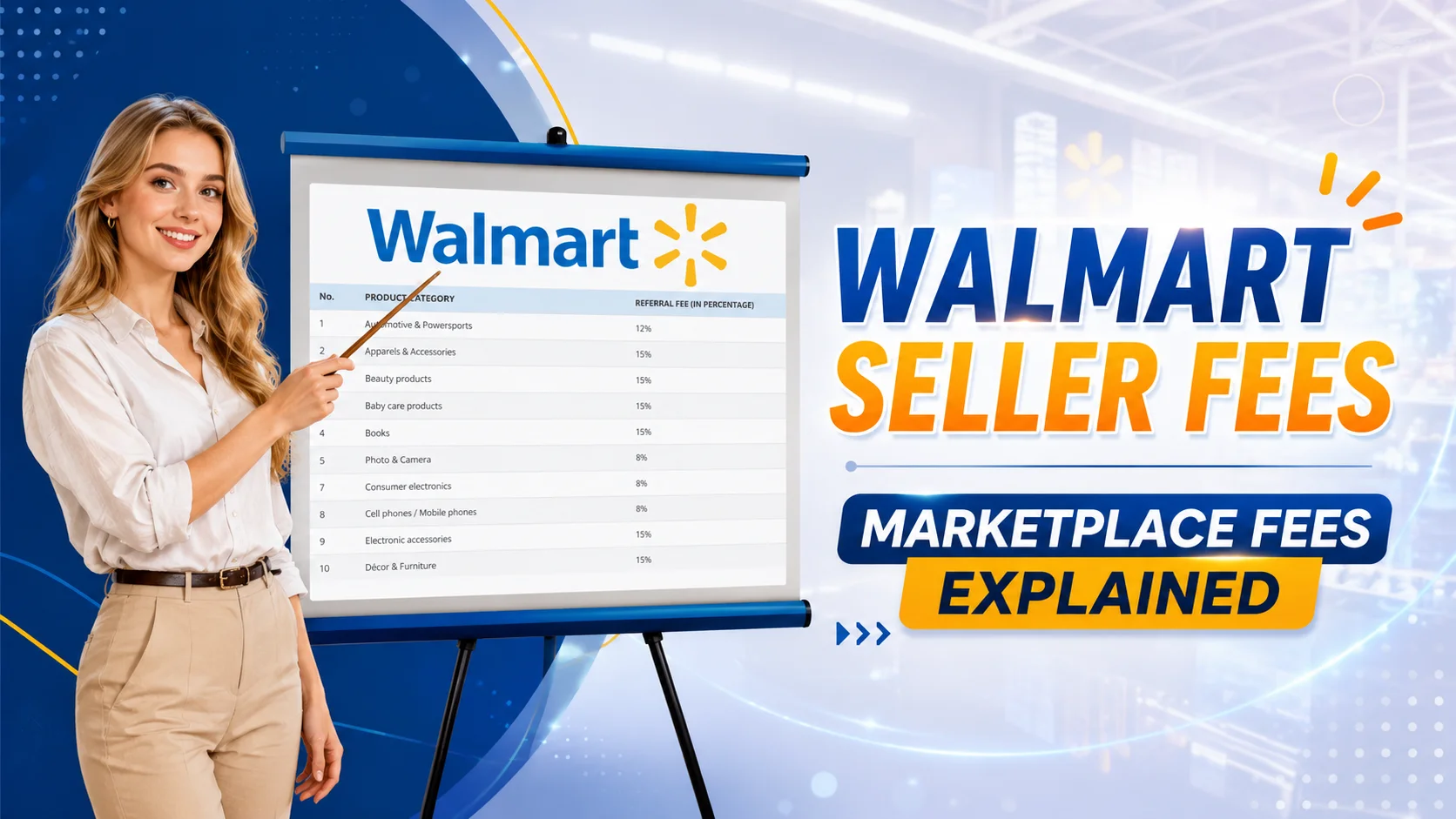
- Walmart Referral Fees by Category (Complete 2026 List)
- Walmart Fulfillment Services (WFS) Fees Explained
- WFS Storage Fees: What You Pay to Hold Inventory
- Return Processing Fees
- Hidden Costs Most Sellers Miss
- 2026 New-Seller Savings: Up to $75K in Discounts
- Walmart Fees vs Amazon Fees: Side-by-Side
- Real Margin Math: What a Sale Actually Costs You
- How to Reduce Your Walmart Seller Fees
- Frequently Asked Questions
Here is the direct answer: Walmart Marketplace seller fees consist of a referral fee of 6% to 20% per sale (required), plus optional WFS fulfilment fees starting at $3.45 per unit. There is no monthly subscription fee, no listing fee, and no item setup cost. If you are selling on Walmart without WFS, your only cost per sale is the referral fee.
That simplicity is one of Walmart's biggest advantages as a selling platform. But the details matter enormously — the referral fee you pay on a $15 baby product is 8%, while the same percentage on a $250 piece of jewellery is 20% up to that threshold. Getting this wrong costs you on every single sale.
This guide breaks down every fee you will encounter as a Walmart Marketplace seller in 2026: referral fees by category, WFS fulfilment and storage fees, return processing fees, and the costs that do not show up in any official fee schedule but hit your margins all the same. If you are evaluating selling on Walmart Marketplace or comparing it against your current platform, these are the exact numbers you need.
What Are Walmart Marketplace Seller Fees?
Walmart Marketplace operates on a commission-based fee structure. You pay a percentage of each sale rather than a flat monthly access fee. This is fundamentally different from Amazon, which charges $39.99 per month before you sell anything.
There are three types of fees Walmart Marketplace sellers encounter:
- Referral fees — a percentage of the total sales price taken on every completed order. Required for all sellers.
- WFS fees — fulfilment and storage fees that apply only if you use Walmart Fulfillment Services. Optional.
- Return processing fees — charged when customers return items fulfilled through WFS. Optional (only applies to WFS users).
Everything else you spend — advertising, shipping for self-fulfilled orders, software tools — falls outside Walmart's official fee schedule but still affects your actual margins. We cover those later in the hidden costs section.
💡 Total sales price definition: Walmart calculates referral fees on the total sales price, which includes the item price, shipping and handling charges, and gift wrap fees. This is important because sellers who charge for shipping are effectively paying referral fees on that shipping revenue too.
Walmart Referral Fees by Category (Complete 2026 List)
Referral fees are the one unavoidable cost of selling on Walmart Marketplace. Every category has its own rate — and several categories use tiered pricing where the percentage changes based on the selling price of the item. Understanding your category's fee structure before pricing your products is non-negotiable.
Which Walmart categories use tiered referral fees?
The following categories charge different rates depending on the total sales price of the item. Get your pricing calculations right — a $1 difference in price can shift you into a different fee tier.
| Category | Price Threshold | Referral Fee |
|---|---|---|
| Apparel & Accessories | Up to $15 | 5% |
| Apparel & Accessories | $15.01–$20 | 10% |
| Apparel & Accessories | Over $20 | 15% |
| Baby Products | Up to $10 | 8% |
| Baby Products | Over $10 | 15% |
| Beauty, Health & Personal Care | Up to $10 | 8% |
| Beauty, Health & Personal Care | Over $10 | 15% |
| Compact Appliances | Up to $300 | 12% |
| Compact Appliances | Over $300 | 8% |
| Electronics Accessories | Up to $100 | 15% |
| Electronics Accessories | Over $100 | 8% |
| Grocery | Up to $15 | 8% |
| Grocery | Over $15 | 15% |
| Indoor & Outdoor Furniture | Up to $200 | 15% |
| Indoor & Outdoor Furniture | Over $200 | 10% |
| Jewelry & Precious Metals | Up to $250 | 20% |
| Jewelry & Precious Metals | Over $250 | 5% |
| Outdoor Power Tools | Up to $500 | 15% |
| Outdoor Power Tools | Over $500 | 8% |
| Watches | Up to $1,500 | 15% |
| Watches | Over $1,500 | 3% |
⚠️ Important 2026 Fee Floor: For most categories, Walmart now applies a minimum referral fee of $1.80 per unit. Even if your percentage-based fee calculates to $0.40, you will be billed the floor. Always calculate your margins based on this minimum for items priced under $10. For categories like "Compact Appliances" and "Electronics Accessories," the tiered fee is marginal. For example, on a $400 appliance, you pay 12% on the first $300 and 8% only on the remaining $100. Don't simplify the math by applying the lower percentage to the whole amount
Which Walmart categories charge a flat referral fee?
These categories use a single rate regardless of selling price:
| Referral Fee | Categories |
|---|---|
| 3% | Watches (portion over $1,500) |
| 5% | Jewellery & Precious Metals (portion over $250) |
| 6% | Personal Computers |
| 8% | Major Appliances, Camera & Photo, Collectibles (approved sellers), Consumer Electronics, Video Game Consoles |
| 10% | Plumbing, Heating, Cooling & Ventilation; Tires & Wheels |
| 12% | Automotive & Powersports, Base Power Tools, Industrial & Scientific, Musical Instruments, Printer Cartridges |
| 15% | Books, Home/Kitchen/Decor/Garden, Luggage, Music, Office Products, Outdoors & Sports, Pet Supplies, Shoes/Handbags/Sunglasses, Software & Computer Video Games, Tools & Home Improvement, Toys & Games, Video & DVD, Everything Else |
⚠️ Incorrect categorisation costs you on every sale. If your product is miscategorised, you either overpay or underpay referral fees. Walmart can retroactively adjust fees on incorrectly categorised products. Sellers have 90 days from the order settlement date to dispute an incorrect referral fee through Walmart Seller Center.
Choosing the right category is one part of the equation. Understanding which products actually sell well in each fee tier helps you build a catalogue with healthy margins from the start. Our guide to best-selling Walmart items maps the top-performing product types across categories so you can identify where demand and favourable fee rates overlap.
Walmart Fulfillment Services (WFS) Fees Explained
WFS is Walmart's equivalent of Amazon FBA. You ship inventory to Walmart's fulfilment centres and they handle storage, packing, shipping, and returns. WFS listings get the "Fulfilled by Walmart" badge and 2-day shipping tags — both of which improve search ranking and conversion rate significantly.
WFS fees are based on shipping weight, calculated as the greater of unit weight or dimensional weight (for items between 1 lb. and 150 lb.). You also add 0.25 lb. for packaging materials and round up to the nearest pound.
How to calculate dimensional weight: (Length × Width × Height in inches) ÷ 139. Compare this to your actual unit weight. Use whichever is greater, then add 0.25 lb. for packaging and round up.
What are the WFS standard fulfilment fees in 2026?
| Shipping Weight | WFS Fulfilment Fee |
|---|---|
| 1 lb. or less | $3.45 |
| 2 lb. | $4.95 |
| 3 lb. | $5.45 |
| 4–20 lb. | $5.75 + $0.40 per lb. above 4 lb. |
| 21–30 lb. | $15.55 + $0.40 per lb. above 21 lb. |
| 31–50 lb. | $14.55 + $0.40 per lb. above 31 lb. |
| 51 lb. or more | $17.55 + $0.40 per lb. above 51 lb. |
Quick example: You sell a product weighing 6 lb. with dimensions 12" × 10" × 10". Dimensional weight = (12 × 10 × 10) ÷ 139 = 8.63 lb. Add 0.25 lb. for packaging and round up: shipping weight = 9 lb. Fee = $5.75 + (5 × $0.40) = $7.75 per unit.
What surcharges apply on top of standard WFS fees?
Certain product types carry additional charges on top of the base fulfilment fee:
- Apparel items: +$0.50 per item
- Hazardous materials (chemicals, aerosols, batteries): +$0.50 per item
- Items priced under $10: +$1.00 per item
- Oversize Tier 1 (longest side 48"–96", or median side over 30", or L+girth 105"–130"): +$3.00
- Oversize Tier 2 (longest side 96"–108", or L+girth 130"–165"): +$20.00 (unit weight starts at 90 lb. for fee calculation)
What about big and bulky items?
Items exceeding standard size limits — unit weight over 150 lb. (up to 500 lb.), longest side over 108", or L+girth over 165" — fall into the big and bulky category:
- Big and bulky fee: $155 base + $0.80 per lb. above 90 lb.
Example: A 230 lb. item costs $155 + (140 × $0.80) = $267.00 in fulfilment fees. Factor this in before listing large products through WFS.
📊 Is WFS worth it? The "Fulfilled by Walmart" badge and 2-day delivery tag are significant ranking and conversion advantages. Products fulfiled through WFS consistently outperform self-fulfilled listings in Walmart's search algorithm. Run the numbers for your specific products — on items under 2 lb., the $3.45–$4.95 WFS fee often competes directly with your own shipping costs.
Want a Fully Managed Walmart Store That Handles All of This for You?
Calculating fees, managing WFS inventory, and staying profitable on Walmart requires constant attention. Our team at Stores Automation builds and manages your entire Walmart seller account — from setup and product sourcing to listing optimisation and performance management.
WFS Storage Fees: What You Pay to Hold Inventory
Storage fees apply to all inventory held at Walmart fulfilment centres. They are calculated monthly based on the cubic footage your inventory occupies. Storage fee management is one of the most overlooked costs for sellers new to WFS — particularly heading into Q4 when the rates change significantly.
How to calculate storage cubic footage: (Length × Width × Height in inches) ÷ 1,728 = unit cubic feet.
What are the WFS storage fees by season?
| Period | Storage Duration | Fee per Cubic Foot/Month |
|---|---|---|
| Standard (January–September) | Any duration | $0.75 |
| Peak (October–December) | 30 days or fewer | $0.75 |
| Peak (October–December) | More than 30 days | $2.25 (effectively) |
| Long-term (any time of year) | Over 12 months | $2.25 |
The 365-Day LTS "Cliff": While storage is cheap initially, any inventory sitting in a WFS warehouse for more than 365 days is subject to a massive Long-Term Storage fee of $7.50 per cubic foot per month. This is nearly 10x the standard rate.
WFS Penetration Discount: In 2026, Walmart offers "Penetration Discounts." If you send more than 85% of your catalog to WFS, you may qualify for up to 20% off fulfillment fees and up to 60% off storage fees, provided your "Days on Hand" (inventory velocity) remains healthy. Check your Seller Center dashboard monthly to see if you qualify for these automatic rebates.
The Q4 storage rate for items stored over 30 days during peak season is three times the standard rate. Sellers who over-stock inventory heading into October and let it sit through December face storage fees that can significantly erode the margin gains from holiday season sales. Tight Walmart inventory management is not optional during Q4 — it is a direct financial necessity.
Return Processing Fees
Walmart charges return processing fees when customers return items fulfilled through WFS, provided the return reason is not Walmart's fault. These fees follow the same weight-based structure as the standard fulfilment fee schedule — heavier items cost more to process as returns.
If you self-fulfil your orders (not using WFS), returns are entirely your responsibility. You handle the shipping, customer communication, any replacement or refund processing, and the return logistics. For high-volume sellers, the time cost of self-managed returns is worth factoring into the WFS vs self-fulfil decision.
In 2026, Walmart has streamlined return costs. If a customer returns a WFS item for 'Buyer Remorse' (e.g., 'Changed my mind' or 'Found better price'), the seller is charged the return processing fee. However, if the return is due to Walmart's logistical error (e.g., 'Arrived late' or 'Damaged during shipping'), Walmart waives this fee. Monitor your 'Disputes' tab in Seller Center to ensure you aren't paying for Walmart's mistakes.💡 Return strategy tip: Your returns rate directly affects your Walmart seller reviews and your account health metrics. Products with inaccurate descriptions or misleading images generate higher return rates — which increases both your return processing fees and your Order Defect Rate. Accurate listings reduce returns. That is a fee reduction and a performance improvement at the same time.
Hidden Costs Most Sellers Miss
Walmart's official fee schedule is refreshingly simple. But sellers who build their margin calculations exclusively around referral fees and WFS charges get surprised by costs that sit outside that schedule. Here are the most important ones to factor in from day one.
Does Walmart charge advertising fees?
Walmart does not require advertising spend, but it is increasingly necessary for visibility — especially in competitive categories. Walmart Sponsored Products campaigns operate on a cost-per-click model, with CPCs typically ranging from $0.30 to $1.50 depending on the keyword and category. That is significantly cheaper than Amazon's average CPC, but it is still a real cost that should be modelled into your margin calculations before setting prices.
What about sales tax obligations?
Walmart Marketplace sellers are responsible for collecting and remitting sales tax in applicable states. Walmart does collect and remit marketplace facilitator taxes in most US states, which reduces the administrative burden significantly — but not all states qualify. Verify your specific obligations when setting up your Walmart Seller Center account to ensure you are compliant from the first sale.
What is Walmart's pricing parity requirement?
Walmart's algorithm actively monitors your prices across other platforms. If your Walmart listings are priced higher than the same products on Amazon, your own website, or other marketplaces, Walmart can unpublish those listings. This is not a fee in the traditional sense, but it is a cost if it results in lost sales or forces you to lower your prices across all channels. Understanding the broader landscape of selling on Walmart vs Amazon helps you build a pricing strategy that satisfies both platforms' requirements simultaneously.
Shipping costs for self-fulfilled orders
Sellers who manage their own fulfilment are responsible for all outbound shipping costs. On lightweight products, self-fulfilment can be cost-competitive with WFS. On heavier or larger items, WFS almost always wins on per-unit cost. Run the comparison per SKU, not as a blanket decision for your entire catalogue.
Let Our Team Handle Walmart Fees, Compliance, and Operations
Our Walmart automation services cover everything — from product sourcing and WFS management to fee monitoring and performance optimisation. You collect the revenue without running the day-to-day operation.
2026 New-Seller Savings: Up to $75K in Fee Discounts
Walmart launched an enhanced New-Seller Savings programme for sellers who go live after February 1, 2026. The total value available is up to $75,000 — a combination of referral fee discounts, WFS credits, and advertising credits that directly reduce your cost structure during the critical first year.
Here is what the 2026 programme offers:
- 20% off base referral fees on your first $50,000 in gross merchandise volume
- 30% off base referral fees between $50,000 and $500,000 in GMV
- 40% off for high-velocity sellers who exceed $500,000 in GMV within their first 12 months (capped at a total savings of $72,000).
- Up to $2,000 in WFS fulfilment credits
- 10% off fulfilment costs for items shipped with WFS
- Up to $1,000 in Search Engine Marketing credits
If you are considering launching a Walmart seller account and have not yet applied, 2026 is a financially compelling year to do it. The referral fee discounts alone — 20–30% off your standard rate — can meaningfully improve your margins during the ramp-up period when your sales velocity is still building. Getting the application right is the first step — our complete guide to the Walmart Seller Center account setup covers the application requirements and approval process in detail.
Walmart Fees vs Amazon Fees: Side-by-Side
If you are weighing Walmart against Amazon, the fee comparison is one of the clearest arguments in Walmart's favour. Here is how the two platforms stack up on every major cost category:
| Fee Type | Walmart Marketplace | Amazon | Advantage |
|---|---|---|---|
| Monthly subscription | $0 | $39.99/month (Professional) | Walmart |
| Listing fees | $0 | $0 | Equal |
| Referral fee range | 6%–20% | 6%–45% (Device Accessories) | Walmart |
| Fulfilment (min fee) | $3.45 (WFS) | ~$3.22 (FBA) | Amazon (slight) |
| Fulfilment (avg cost) | ~15% less than competitors | Market benchmark | Walmart |
| Storage (Jan–Sep) | $0.75/cu ft/month | $0.87/cu ft/month | Walmart |
| Storage (Oct–Dec) | $0.75 (under 30 days) | $2.40/cu ft/month | Walmart |
| Annual subscription saving | $0 vs $480/year on Amazon | $480/year minimum | Walmart |
Walmart wins on total cost for most seller profiles. The $480/year subscription saving alone is meaningful for new sellers. Lower storage fees are significant for anyone who holds WFS inventory through Q4. And the referral fee ceiling of 20% (Jewellery) versus Amazon's 45% (Device Accessories) gives Walmart a real edge in certain categories.
The areas where Amazon has the edge: its FBA minimum fulfilment fee is marginally lower, and its global marketplace network gives access to international markets that Walmart does not currently match. For sellers building a US-focused business, those advantages rarely outweigh Walmart's fee structure benefits. For a full strategic comparison, our detailed guide on Walmart 1P vs 3P selling covers the different selling structures available on the platform and their respective cost implications.
Real Margin Math: What a Sale Actually Costs You
Let's run the numbers on two real product scenarios to show exactly what Walmart fees do to your margins.
Scenario 1: Home goods item, $34.99 selling price, WFS-fulfilled, 2 lb. unit weight
- Selling price: $34.99
- Referral fee (15% — Home/Kitchen): $5.25
- WFS fulfilment fee (2 lb.): $4.95
- Storage (per unit, monthly allocation): ~$0.08
- Total Walmart costs per sale: $10.28
- Gross margin if product cost is $9: $34.99 − $9 − $10.28 = $15.71 (44.9% gross margin)
Scenario 2: Baby product, $8.99 selling price, WFS-fulfilled, under 1 lb.
- Selling price: $8.99
- Referral fee (8% — Baby Products under $10): $0.72
- WFS fulfilment fee (under 1 lb.): $3.45
- Under-$10 surcharge: +$1.00
- Total Walmart costs per sale: $5.17
- Gross margin if product cost is $2.50: $8.99 − $2.50 − $5.17 = $1.32 (14.7% gross margin)
The second scenario illustrates the margin squeeze on low-price items through WFS. The $1.00 under-$10 surcharge combined with the $3.45 minimum fulfilment fee makes WFS economically challenging for items priced below $10. Self-fulfilment often makes more sense for low-price, lightweight products in this range.
📊 Use Walmart's official fee calculator: Walmart Marketplace provides a fulfilment fee calculator within Seller Center. Input your product dimensions, weight, and selling price to get exact WFS fee projections before committing inventory to fulfilment centres.
How to Reduce Your Walmart Seller Fees
Verify your product category is correct
Category miscategorisation is the most common source of overpaid referral fees. A home décor item filed under "Everything Else" at 15% should be in "Home/Kitchen/Decor/Garden" — which is also 15%, so the rate is the same. But in many cases, the difference matters. Check your product type assignments in Seller Center regularly, and dispute any incorrect charges within the 90-day window.
Optimise your product dimensions for WFS
WFS fees scale with shipping weight, which depends on dimensional weight for larger items. Tighter, more compact packaging reduces dimensional weight, which reduces your fulfilment fee. On products you sell in volume, even a $0.40 per unit reduction in WFS fees has a significant annual impact. Review your packaging against the dimensional weight formula before finalising your WFS inbound shipments.
Keep Q4 inventory lean
The tripling of storage rates during peak season for items stored over 30 days is avoidable with better inventory planning. Use Walmart inventory management software to model your sell-through rate before sending Q4 shipments. Send what you expect to sell in 30 days, and replenish rather than over-stock. The storage cost savings often exceed the additional inbound shipping costs from more frequent smaller shipments.
Win the Buy Box to maximise revenue per fee dollar
Your referral fee is a fixed percentage, but your revenue per unit depends entirely on whether you win the sale. Sellers who consistently win the Walmart Buy Box convert more of their impressions into revenue, which means each unit of fee paid generates more actual income. Competitive pricing, fast fulfilment, and strong seller metrics are the core Buy Box drivers — all of which are worth more than minor fee optimisation at scale.
Use the New-Seller Savings programme if eligible
If you launched after February 1, 2026, you should be enrolled in Walmart's New-Seller Savings programme. The 20–30% referral fee discount during your first $500,000 in GMV is the single largest fee reduction available to any Walmart seller. Verify your enrolment status in Seller Center and ensure your account is correctly set up to receive the discounts — they are not always applied automatically without proper account configuration.
Frequently Asked Questions
How much does it cost to sell on Walmart Marketplace?
Selling on Walmart Marketplace costs nothing to start — there is no monthly subscription fee, no listing fee, and no item setup cost. You pay a referral fee of 6% to 20% of the total sales price on each completed order, depending on your product category. If you use Walmart Fulfillment Services, you also pay WFS fulfilment fees starting at $3.45 per unit and storage fees of $0.75 per cubic foot per month.
What is the Walmart referral fee for most categories?
The most common referral fee on Walmart Marketplace is 15%, which applies to the largest number of product categories including books, home goods, pet supplies, toys, and anything that falls under "Everything Else." Several high-value categories like Personal Computers (6%) and Consumer Electronics (8%) have lower rates. The highest rate applies to Jewellery and Precious Metals at 20% for items up to $250.
How do WFS fees compare to Amazon FBA fees?
WFS starts at $3.45 per unit versus Amazon FBA's starting fee of approximately $3.22. On the surface, Amazon is slightly cheaper on the minimum. However, WFS storage fees ($0.75/cu ft Jan–Sep) are lower than Amazon's ($0.87/cu ft), and WFS Q4 storage rates are dramatically lower — Amazon charges $2.40/cu ft in Q4 compared to Walmart's $0.75/cu ft for items stored under 30 days. Walmart also reports WFS is on average 15% cheaper than competitive fulfilment options when total costs are compared.
Does Walmart charge monthly fees?
No. Walmart Marketplace does not charge any monthly subscription fee, annual fee, or account maintenance fee. This is one of the most significant differences between Walmart and Amazon, where the Professional Seller plan costs $39.99 per month ($480 per year). On Walmart, your only guaranteed cost is the referral fee on each sale you make.
What are the WFS storage fees during Q4?
During October through December, Walmart charges $0.75 per cubic foot per month for items stored 30 days or fewer — the same rate as off-peak months. For items stored more than 30 days during peak season, an additional $1.50 per cubic foot per month is added, bringing the effective rate to $2.25 per cubic foot. Items stored more than 12 months at any time of year are also charged $2.25 per cubic foot per month. Managing inventory turnover carefully during Q4 is the primary way to avoid these elevated storage charges.
Can Walmart sellers dispute incorrect referral fees?
Yes. If you believe your product was incorrectly categorised and charged the wrong referral fee rate, you can file a dispute through Walmart Seller Center. Disputes must be submitted within 90 days of the order settlement date. The most effective way to prevent this is to verify your product type assignment in Seller Center before your listings go live — catching miscategorisation before sales are processed avoids the dispute process entirely.
Bottom Line: Are Walmart Marketplace Fees Worth It?
Yes — and the fee structure is one of the strongest reasons why. No monthly subscription means your first sale is profitable without first covering overhead. Referral fees between 6% and 20% are competitive with Amazon across most categories and meaningfully lower in several. WFS storage fees are structurally cheaper year-round, with a particular advantage in Q4 when Amazon's rates spike dramatically.
The 2026 New-Seller Savings programme makes the timing even more compelling for sellers who have not yet launched. A 20–30% reduction on referral fees during your first $500,000 in GMV is a real margin advantage during the period when every dollar matters most.
The key is knowing your numbers before you list. Run the margin calculation for your specific products using the referral fee rate for your actual category, the WFS fee for your product's shipping weight, and a realistic estimate of your storage turnover. Sellers who do this accurately build sustainable Walmart businesses. Sellers who estimate loosely get surprised by the gap between their expected and actual margins.
If you want support building and managing a Walmart seller account that is optimised for profitability from day one, our Walmart automation services cover every operational and strategic layer — from product research and supplier sourcing to fee management, listing optimisation, and monthly performance reporting.
📚 More Walmart Seller Guides
Ready to Build a Profitable Walmart Seller Business?
Whether you want to manage your Walmart store yourself or have our experienced team run it for you, Stores Automation is here to help you grow in 2026.
Explore Walmart Automation → Sign Up Now →