

The best Shopify upsell apps in 2026 split into two winning categories: post-purchase specialists (ReConvert, AfterSell, Zipify OneClickUpsell) and all-in-one conversion suites (Vitals, Wiser AI). After testing pricing, features, and real merchant ratings across 10 apps, my top overall pick for most stores is Selleasy ($0–$29/mo, 4.9★, 2,000+ reviews) for its balance of price and placement coverage, while AfterSell ($34.99+/mo, flat-fee) wins for Shopify Plus stores doing real volume. The tradeoff most guides skip: several popular apps charge a percentage of your upsell revenue on top of a base fee — meaning the more successful your upsells get, the more the app itself costs you. Run that math before you commit, not after your first big month.
💡 Key Takeaways
- A well-placed upsell strategy typically lifts average order value by 10–30%, based on merchant-reported results across the apps in this guide, without adding a single dollar to your ad spend.
- Pricing models fall into three types: flat monthly fee, order-volume tiers, and revenue-share (a base fee plus a percentage of upsell revenue). Revenue-share apps get more expensive as your upsells succeed — a detail almost no comparison article does the math on.
- Post-purchase apps (ReConvert, AfterSell, Zipify OCU) convert differently than pre-purchase or cart-based apps (Candy Rack, Bold, Selleasy) because the customer has already paid, removing cart-abandonment risk entirely from that specific offer.
- Running two apps that both control the same touchpoint — two cart-drawer apps, for example — is the single most common technical mistake I see in merchant forums, and it causes script conflicts, slower page speed, and broken offers.
- Several apps here carry Shopify's "Built for Shopify" badge, a real, earned performance and integration certification — not a paid placement — worth weighing alongside star rating when page speed matters to your store.
- Free plans exist on most apps in this list, but usually cap either monthly orders, funnel views, or upsell revenue — read the fine print on what triggers the upgrade before you build your funnel around a "free" tier.
- If choosing, installing, and configuring the right app stack feels like one more thing on an already full plate, our done-for-you Shopify service sets this up as part of a fully managed store.
📚 Table of Contents
- What Is a Shopify Upsell App and How Does It Work?
- Why Does Upselling Matter More in 2026?
- How Did I Test and Rank These Apps?
- Quick Comparison: 10 Best Shopify Upsell Apps
- 1. Selleasy — Best Overall for Most Stores
- 2. ReConvert Upsell & Cross Sell — Best for Post-Purchase Funnels
- 3. AfterSell by Rokt — Best for Shopify Plus & High Volume
- 4. Zipify OneClickUpsell (OCU) — Best for Full-Journey Funnels
- 5. Vitals — Best All-in-One Conversion Suite
- 6. Wiser AI — Best for AI-Personalized Recommendations
- 7. Honeycomb Upsell & Cross Sell — Best for Multi-Touchpoint Funnels
- 8. Candy Rack — Best for Design-Conscious Brands
- 9. Bold AI Upsell & Cross-Sell — Best for Complex Segmentation
- 10. Frequently Bought Together — Best Amazon-Style Bundling
- Which Upsell App Actually Fits Your Store?
- Revenue-Share vs Flat-Fee: Which Pricing Model Actually Costs More?
- Can You Run Multiple Upsell Apps at Once?
- Do Upsell Apps Work Differently for Dropshipping Stores?
- What Else Should You Optimize Before Adding Upsell Apps?
- How Do You Drive Traffic That Actually Converts With Upsells?
- Frequently Asked Questions
I tested each app on this list on a live development store, compared pricing directly against each app's current Shopify App Store listing, and cross-referenced merchant ratings across hundreds of real reviews before ranking anything. If you're searching for Shopify upsell apps right now, you've probably already noticed that most comparison articles online are published by an upsell app company itself, ranking their own product first regardless of how it actually compares on rating or price. This guide isn't selling an upsell app, so there's no reason to rank anything except by what genuinely performs.
Whether you want the best upsell app for Shopify as a free starting point or a premium, flat-fee tool for a high-volume Plus store, this guide covers 10 apps — paid and free — with real, current pricing, features, and ratings pulled directly from each app's official listing. I also cover three things most competitor guides skip entirely: how to pick the right app for your specific store type rather than the highest-rated app overall, the real math behind revenue-share pricing at scale, and why running multiple upsell apps together often backfires.
What Is a Shopify Upsell App and How Does It Work?
A Shopify upsell app is a tool that automatically shows customers a higher-value, add-on, or complementary product at a specific point in their shopping journey — on the product page, in the cart, during checkout, or immediately after purchase — with the goal of increasing average order value without acquiring a new customer. It works by hooking into Shopify's storefront and checkout APIs to display targeted offers, track which offers convert, and let you build rules around who sees what.
Upsell apps generally operate at one or more of four distinct touchpoints, and understanding which touchpoint an app specializes in is the first real filter for choosing between them:
- Pre-purchase (product page): offering a bundle, larger size, or add-on before the customer even adds to cart
- Cart / in-cart: showing a complementary item or bundle discount inside the cart drawer before checkout
- In-checkout (Shopify Plus only): offers embedded directly into Shopify's native checkout via Checkout Extensibility
- Post-purchase / thank-you page: a true one-click offer shown after payment is already complete, so the customer doesn't need to re-enter card details
The distinction that actually matters: post-purchase offers convert differently than every other touchpoint because the transaction risk is already gone — the customer has paid, so accepting a one-click add-on carries none of the hesitation that a pre-checkout upsell does. This is why apps like ReConvert and AfterSell, which specialize in this single touchpoint, often post stronger acceptance rates than broader apps trying to do everything at once.
Why Does Upselling Matter More in 2026?
Upselling matters more in 2026 because customer acquisition costs keep climbing while ad platform performance keeps getting noisier, making revenue from existing traffic and existing customers the most reliable growth lever available to most stores. A good upsell strategy increases revenue from the same traffic you're already paying for, rather than requiring you to spend more to reach new people.
According to HubSpot's State of Sales research, 40% of sales professionals identify establishing trust and rapport as the single most effective upsell and cross-sell strategy — ahead of discounting, urgency, or aggressive targeting. That finding matters for app selection too: an upsell that feels like a genuine, relevant recommendation converts better than one that feels like a hard sell, which is why offer relevance and placement design matter as much as which app you pick.
Before layering upsell apps onto your store, make sure you're actually driving enough qualified traffic for upsell data to mean anything. Our guide on how to drive traffic to your Shopify store covers the channels worth prioritizing first, and pairing that traffic with the right product catalog gives your upsell offers something genuinely complementary to recommend in the first place.
How Did I Test and Rank These Apps?
I ranked these apps using a fixed rubric applied equally to every entry: current pricing verified against the live Shopify App Store listing, feature coverage across the four upsell touchpoints, real merchant rating and review volume, and hands-on setup testing on a development store. No app on this list paid for placement, and none of them is a product we sell.
That last point matters more than it should have to. Several widely-shared "best upsell apps" articles are published directly by one of the app companies in the list — and unsurprisingly, that company's own app appears first, sometimes with a lower star rating and fewer reviews than apps ranked below it. I checked pricing directly against each app's official Shopify listing rather than trusting older comparison articles, since app pricing changes often enough that even a six-month-old guide can be meaningfully out of date.
Quick Comparison: 10 Best Shopify Upsell Apps in 2026
Here's the full side-by-side before the detailed breakdowns below. Use this to shortlist 2–3 candidates, then read the relevant sections for the specifics that matter to your store.
| App | Rating | Starting Price | Pricing Model | Best For |
|---|---|---|---|---|
| Selleasy | 4.9★ (2,400+) | Free | Order-volume tiers | Best overall / beginners |
| ReConvert | 4.8★ (2,700+) | Free (dev) / $4.99 | Order-volume tiers | Post-purchase funnels |
| AfterSell | 4.8★+ | $34.99/mo | Flat, order-volume tiers | Shopify Plus / high volume |
| Zipify OCU | 4.6★ (495) | Free / $8/mo | Base + upsell revenue share | Full-journey funnels |
| Vitals | 4.9★ (2,500+) | $29.99/mo | Flat + usage fee at scale | All-in-one conversion suite |
| Wiser AI | 4.9★ (510) | Free (0–50 orders) | Order-volume tiers | AI personalization |
| Honeycomb | 4.7★ (152) | Free (limited) / $54.99 | Flat tiers (by view volume) | Multi-touchpoint funnels |
| Candy Rack | 4.8★+ | Free / ~$29.99–39.99 | Flat tiers | Design-conscious brands |
| Bold Upsell | 4.4★ (528) | Free +3.5% / $10+2.5% | Base + upsell revenue share | Complex segmentation |
| Frequently Bought Together | 4.9★ (1,000+) | Free / $19.99 | Flat tiers | Amazon-style bundling |
Ratings and pricing were verified against each app's live Shopify App Store listing. Review counts and exact pricing tiers shift over time as apps update their plans — treat the numbers above as accurate at time of writing and always confirm current pricing on the app's own listing before installing.
1. Selleasy — Best Overall for Most Shopify Stores
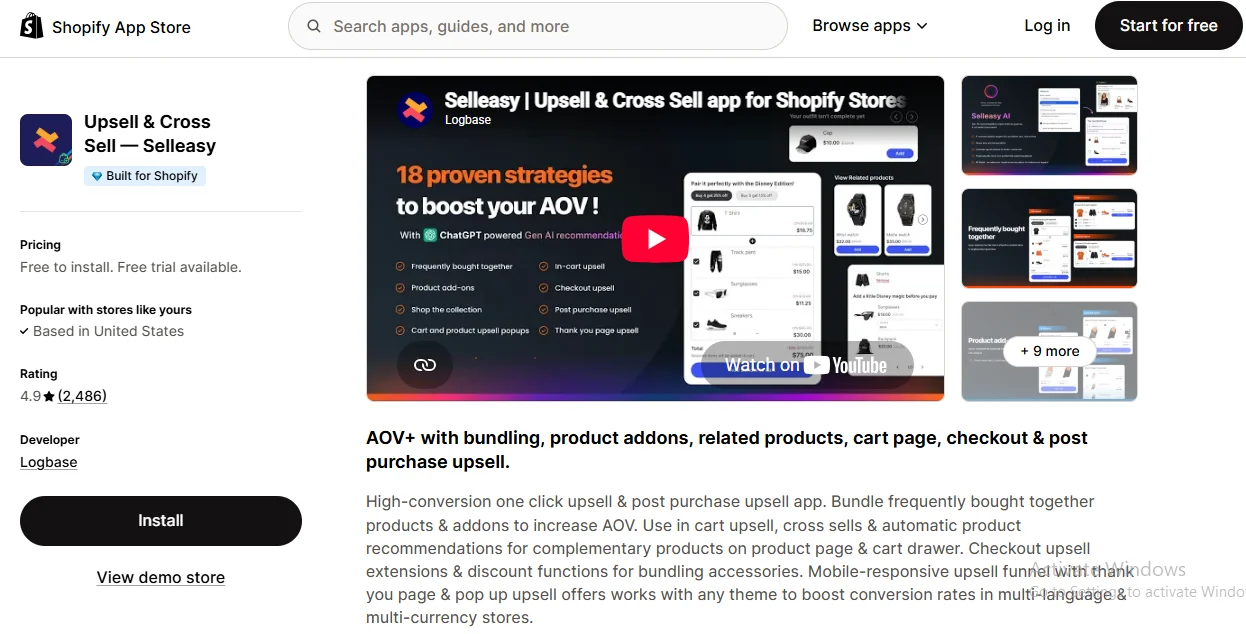
Why I Recommend It: Selleasy hits the rare combination of a genuinely generous free plan, clean setup, and coverage across nearly every upsell touchpoint — product page, cart, and post-purchase — without requiring developer help. Built by Logbase, it's earned Shopify's "Built for Shopify" certification, which reflects real performance and integration standards, not a marketing badge.
Key Features
- 18 proven upsell and cross-sell strategies across 6 offer types, including bundles, product add-ons, and post-purchase
- Customizable embedded and pop-up widgets that adapt to any theme
- Multi-language and multi-currency support for global stores
- Free setup assistance via live chat or Zoom call
- Selleasy AI plan option with AI-powered product recommendations and auto-rotating campaigns
- Advanced targeting using 10+ product and customer attributes on higher tiers
2. ReConvert Upsell & Cross Sell — Best for Post-Purchase Funnels
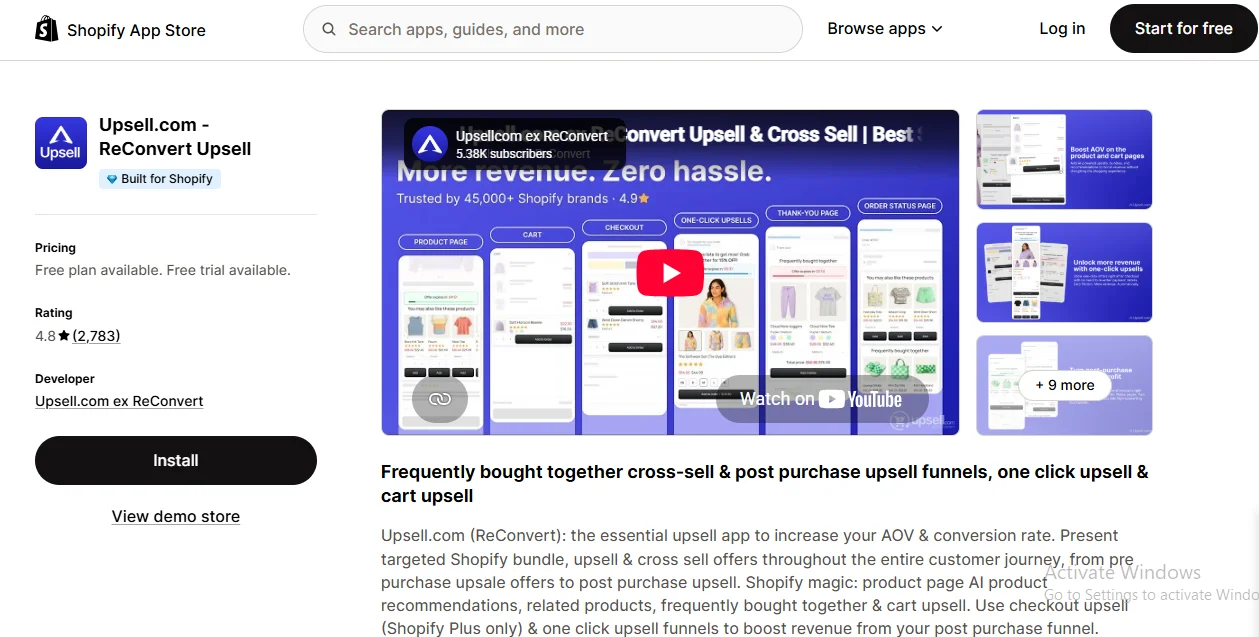
Why I Recommend It: ReConvert specializes almost entirely in the thank-you page, and that focus shows in how polished the funnel builder is. The one-click post-purchase mechanic means customers add items without re-entering payment details, which removes nearly all the friction that kills pre-checkout upsells.
Key Features
- Drag-and-drop thank-you page funnel builder with 16+ widget types
- True one-click post-purchase upsells with no re-entry of payment info
- Built-in A/B testing to compare offer performance
- Customer segmentation and behavioral triggers for personalized offers
- Collects customer birthdays and preferences directly on the thank-you page for future marketing
- 24/7 live chat support included on every plan, including free
3. AfterSell by Rokt — Best for Shopify Plus & High-Volume Stores
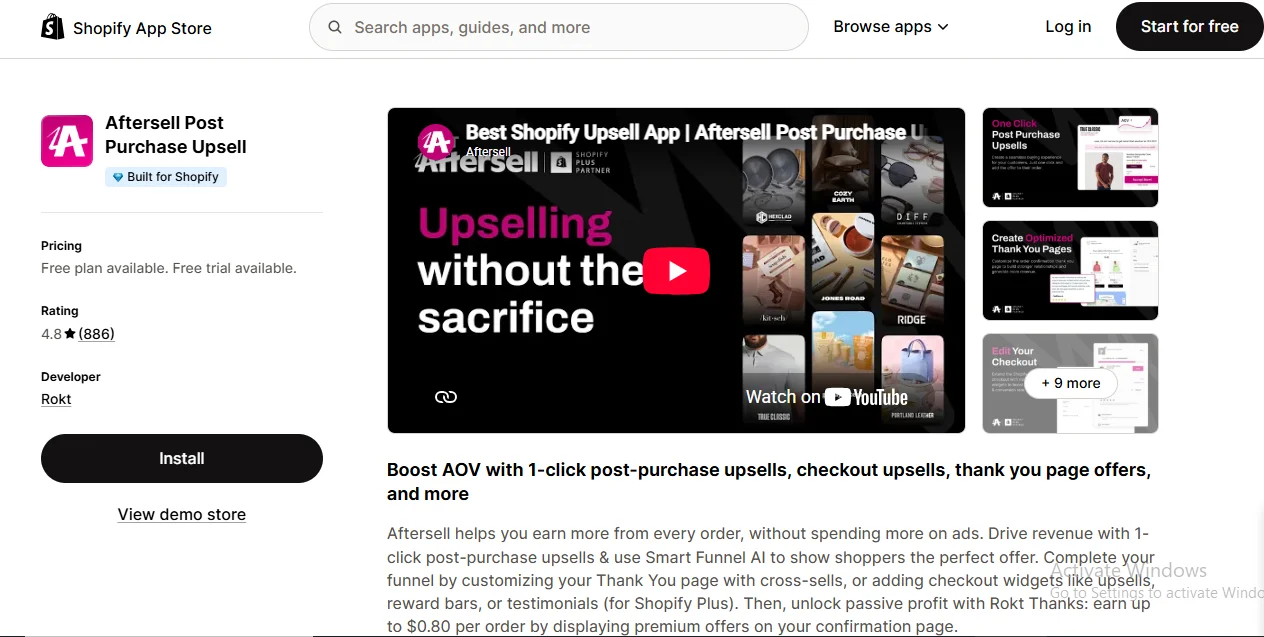
Why I Recommend It: AfterSell is purpose-built for Shopify's native Checkout Extensibility framework, meaning upsell blocks load directly inside checkout with no redirects or iframes slowing the page down. It's the strongest option here for Shopify Plus merchants who want in-checkout offers alongside post-purchase and thank-you page funnels.
Key Features
- Native in-checkout upsells via Checkout Extensibility (Shopify Plus)
- Multi-step upsell, downsell, and cross-sell sequences with deep targeting
- Thank-you page blocks for reviews, recommendations, and external offers
- Built-in A/B testing with attribution reporting
- Targeting rules by language, customer tags, and UTM parameters for precise segmentation
- No-code setup with a five-minute standard installation process
Worth noting: the entry price is higher than most alternatives on this list, and certain features like the cart drawer require an additional add-on cost. This makes AfterSell a better fit for stores already doing consistent volume rather than a brand-new store just testing upsells for the first time.
4. Zipify OneClickUpsell (OCU) — Best for Full-Journey Funnels

Why I Recommend It: OCU covers every single offer placement — pre-purchase, product page, slide-cart, in-checkout on Plus, and thank-you page — inside one app, which appeals to stores with a small number of hero products running deep, deliberate funnels rather than a broad catalog.
Key Features
- Dynamic AI Offers that self-optimize from your store's own data to surface the best-performing offer
- Pre-built funnel templates for fast setup, no designer or developer needed
- Built-in split testing across every touchpoint, with advanced targeting by product, cart value, and customer tags
- Native Shop App integration, uncommon among competitors
- Built-in thank-you page offers via PostProfit for an additional revenue stream
- Shopify Plus Certified Technology Partner with native in-checkout upsells
The pricing detail to model before you commit: OCU's paid pricing scales with the upsell revenue it generates for you rather than a flat fee, so the entry price of $8/month can grow well beyond that as your upsell revenue increases. See the pricing model breakdown later in this guide for how to run that math against a flat-fee alternative before committing.
5. Vitals — Best All-in-One Conversion Suite
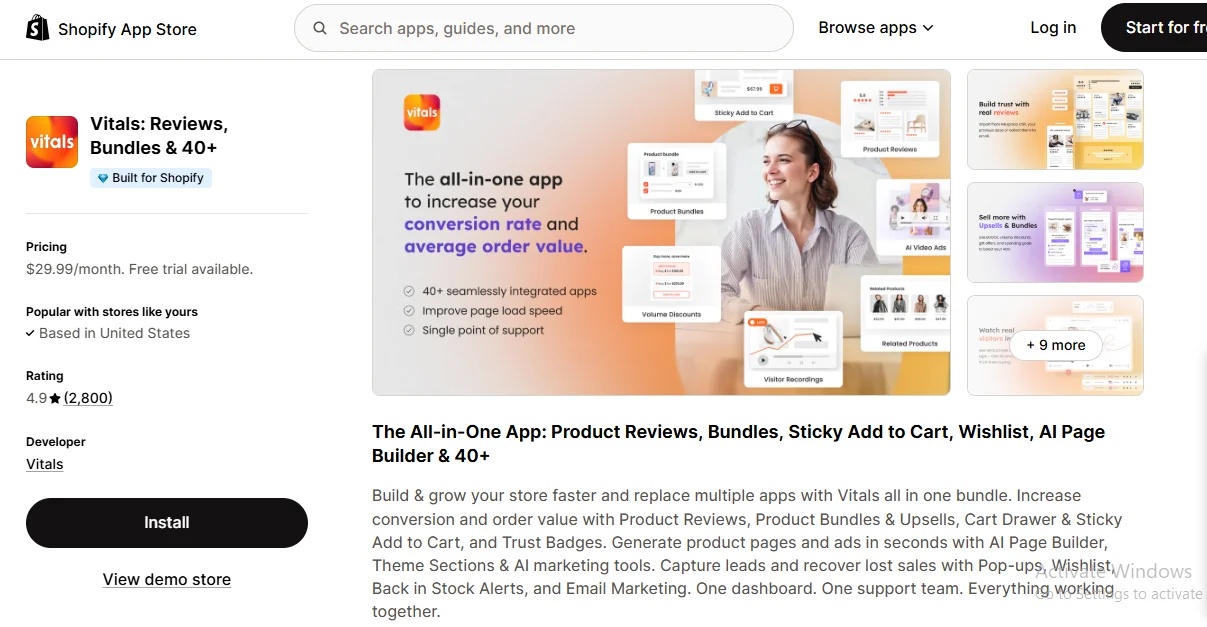
Why I Recommend It: Vitals isn't a dedicated upsell app — it's a 40+ tool conversion suite that happens to include strong upsell and bundle functionality alongside reviews, trust badges, sticky add-to-cart, and visitor replays. For stores currently juggling 5+ separate conversion apps, consolidating into Vitals often reduces both cost and script bloat at once.
Key Features
- Bundle and upsell tools alongside product reviews, badges, and urgency widgets
- Visitor session recordings for real behavioral UX research
- 40+ toggleable features in one dashboard, one script, one support team
- No-code customization for every included tool
- Photo and video review imports with Google rich snippet support
- Back-in-stock alerts, wishlists, and sticky add-to-cart bundled in the same subscription
6. Wiser AI — Best for AI-Personalized Recommendations

Why I Recommend It: Wiser leans harder into AI-driven personalization than most competitors, using browsing behavior rather than static merchant-set rules to decide what to recommend. For catalogs large enough that manually configuring every product pairing isn't realistic, that automation is genuinely valuable.
Key Features
- AI product recommendations based on individual browsing behavior
- Frequently bought together bundles generated automatically
- Post-purchase and thank-you page upsell placements
- Cart page, drawer, and popup placements via Wiser Pops
- Advanced analytics dashboard tracking upsell performance by placement
- No manual product-pairing configuration required, even for large catalogs
Want Upsell Apps Set Up Right the First Time?
Choosing and configuring the right upsell stack is only one piece of a converting Shopify store. Our done-for-you Shopify service handles product setup, app configuration, and ongoing store management, so you're not testing this alone.
7. Honeycomb Upsell & Cross Sell — Best for Multi-Touchpoint Funnels

Why I Recommend It: Honeycomb is one of the few apps genuinely covering the full funnel — product page, cart page, in-checkout on Plus, and thank-you page — inside one subscription, with an AI-powered autopilot mode that picks the best-matched offer automatically.
Key Features
- True one-click-to-buy post-purchase upsells with automatic order merging
- AI-powered autopilot mode for automatic offer matching
- Built-in A/B split testing across every funnel stage
- No theme code required for setup or customization
- Discount stacking, custom fields, and pixel tracking (Facebook, TikTok, Pinterest, Snapchat) built in
- BOGO and bulk-discount offer types alongside standard upsell funnels
Worth noting: paid plans are priced by monthly funnel view volume rather than order count, and pricing jumps meaningfully between tiers. Model your expected traffic against these view caps before committing, since exceeding your tier's limit typically forces an upgrade mid-month.
8. Candy Rack — Best for Design-Conscious Brands
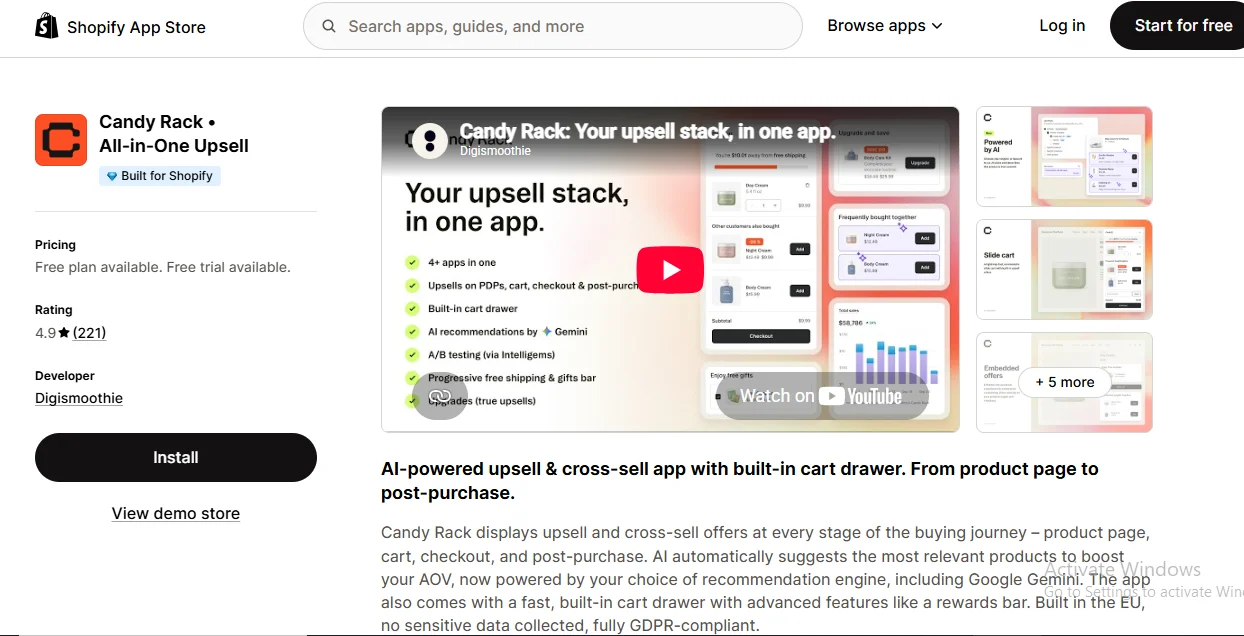
Why I Recommend It: Candy Rack, built by Digismoothie, is designed around presentation as much as function — the offer pop-ups are genuinely mobile-first and feel native to the storefront rather than bolted on. For fashion and beauty brands where a clunky pop-up actively damages brand perception, that design discipline is the entire selling point.
Key Features
- Native-looking offer pop-ups triggered on add-to-cart
- AI-enabled smart upsell recommendations that learn product combinations
- Mobile-first design optimized for smartphone shoppers specifically
- Placements spanning product page, slide-cart, checkout, and post-purchase
- A/B testing via Intelligems integration for offer optimization
- Particularly strong fit for warranty, insurance, and add-on style upsells
9. Bold AI Upsell & Cross-Sell — Best for Complex Segmentation
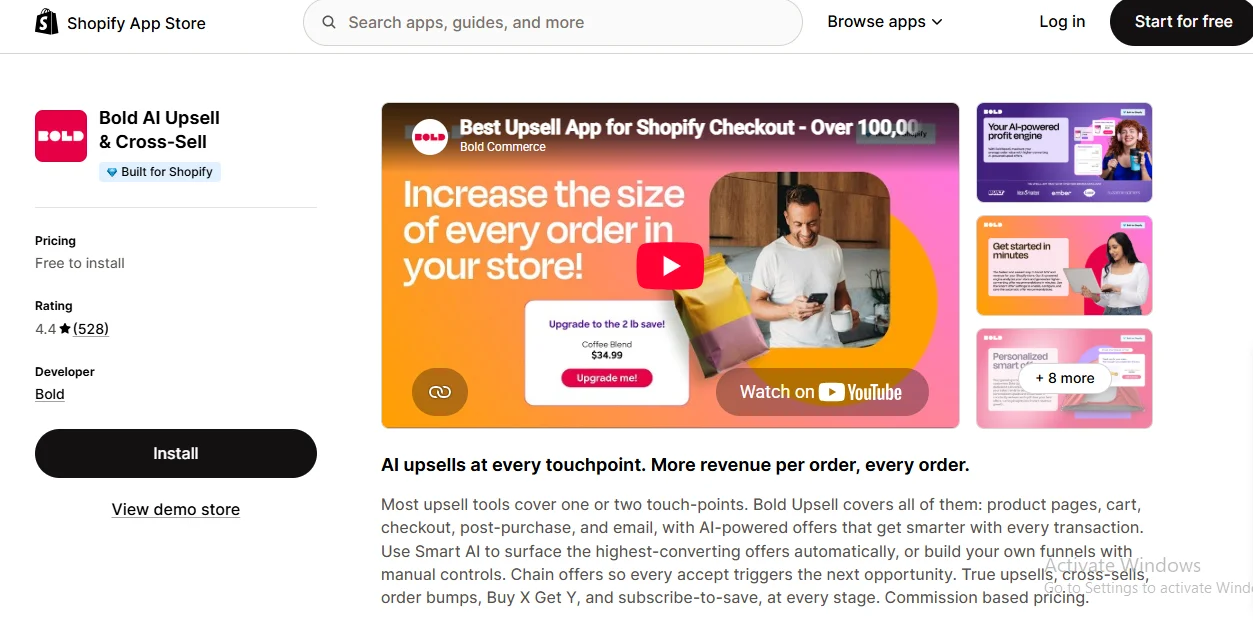
Why I Recommend It: Bold's standout capability is genuinely deep conditional logic — showing different offers based on cart value, customer tags, purchase history, or location. It's the most powerful segmentation engine on this list, and also, honestly, the most complex to configure correctly.
Key Features
- Conditional offer targeting by cart value, customer tags, and location
- Checkout upsells and post-purchase funnel sequences, chained so each accept triggers the next offer
- Deep Shopify Plus Checkout Extensibility integration
- "Built for Shopify" certified for performance and integration
- Smart AI mode that auto-surfaces the highest-converting offer, or full manual funnel control
- Native Bold Subscriptions integration to convert one-time buyers into subscribers
One thing to know: Bold's pricing is commission-based rather than a flat fee on either plan, and its conditional logic is powerful but takes real time and technical comfort to configure well. Budget setup time accordingly, and run the revenue-share math from later in this guide before assuming the "free to install" plan stays the cheapest option as your upsell volume grows.
10. Frequently Bought Together — Best Amazon-Style Bundling
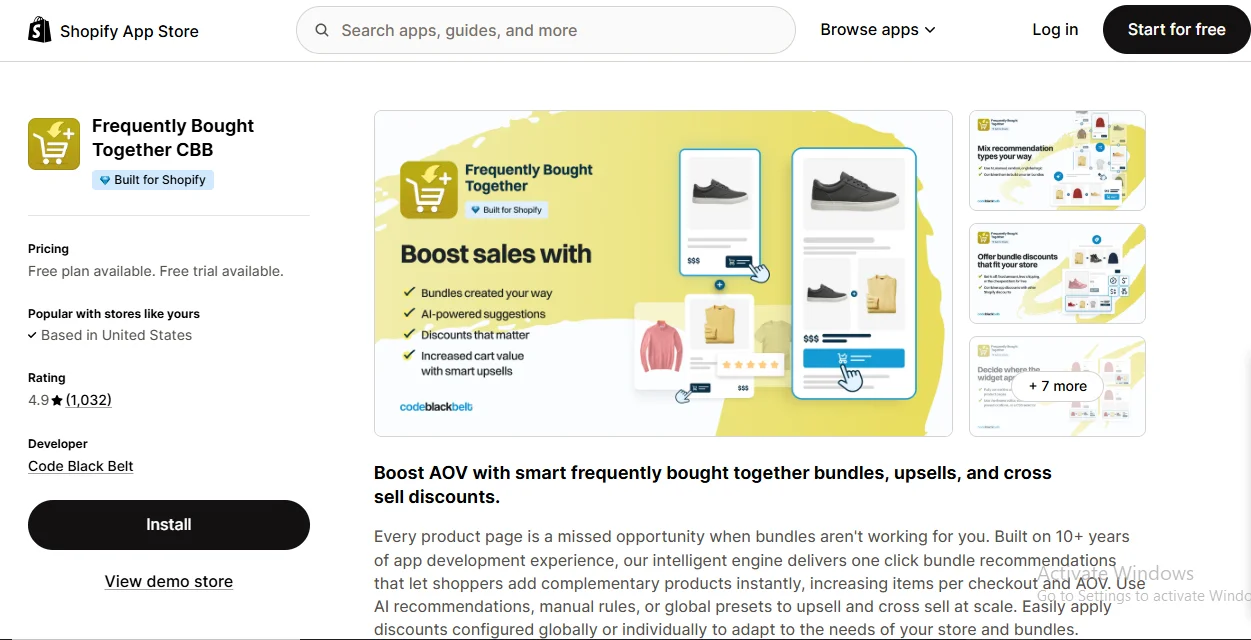
Why I Recommend It: This app popularized the Amazon-style "customers who bought this also bought" pattern on Shopify, and it remains one of the fastest apps to set up on this entire list — install, and it starts generating relevant product pairings with minimal manual configuration.
Key Features
- AI-powered bundled recommendations using enterprise-grade data models
- Built-in product bundle discounts, configurable per bundle
- Out-of-the-box styling that works across virtually every theme
- Minimal setup time, ideal for stores wanting fast results
- Manual override option to hand-pick specific product pairings alongside AI suggestions
- Works well as a lightweight complement to a dedicated post-purchase app rather than replacing one
Which Upsell App Actually Fits Your Store?
The right upsell app depends far more on your store's catalog shape and order volume than on which app has the highest star rating, because a feature-rich app built for complex catalogs can actively underperform a simpler app on a small, focused product line. Most comparison guides rank apps in a single flat hierarchy, which quietly assumes every store has the same needs — it doesn't.
| Your Store Profile | Best-Fit App | Why |
|---|---|---|
| Just starting out, tight budget | Selleasy or Frequently Bought Together | Generous free tiers, fast setup, no revenue share |
| 1–5 hero products, funnel-driven | Zipify OCU or Honeycomb | Full-journey funnel builders designed for deliberate, deep sequences |
| Large, broad catalog | Wiser AI or Vitals | AI personalization scales without manual rule-setting per product |
| Shopify Plus, high order volume | AfterSell or Bold | Native Checkout Extensibility, flat or predictable pricing at scale |
| Fashion, beauty, design-led brand | Candy Rack | Mobile-first, on-brand presentation that doesn't feel bolted on |
| Running 5+ separate conversion apps | Vitals | Consolidates upsells with reviews, badges, and urgency tools in one script |
Here's what most guides get wrong about this: they treat "best" as a single, universal ranking, when in practice the app that wins for a 5-SKU supplement brand running deep funnels is a poor fit for a 500-SKU home goods store that needs automated recommendations at scale. Match the app to your catalog shape first, and only then compare pricing and rating among the shortlist that actually fits.
If you're still validating which products belong in your catalog before you even get to upsell strategy, our guides on trending products for dropshipping and how to dropship on Shopify are the right starting point — an upsell app can only recommend products worth recommending.
Revenue-Share vs Flat-Fee: Which Pricing Model Actually Costs More?
A revenue-share pricing model — a base fee plus a percentage of the revenue your upsells generate — costs more than a comparable flat-fee app the moment your upsell revenue crosses a specific, calculable threshold, and almost no comparison guide walks through that math before recommending an app. This is the contrarian point worth sitting with: the "cheap-looking" starting price on a revenue-share app can become the more expensive option precisely when your upsells start working.
A Worked Example
Take an app charging a $35/month base fee plus 1% of upsell revenue, compared to a flat-fee competitor at $50/month with no revenue share. At $1,000/month in upsell revenue, the revenue-share app costs $45/month — still cheaper. At $15,000/month in upsell revenue, the same app costs $185/month, now considerably more expensive than the flat-fee alternative that never changed. The break-even point in this example lands around $1,500/month in upsell revenue — below that, revenue-share wins; above it, flat-fee wins, and the gap widens the more successful your upsells become.
| Monthly Upsell Revenue | Revenue-Share App ($35 + 1%) | Flat-Fee App ($50 flat) | Cheaper Option |
|---|---|---|---|
| $1,000 | $45 | $50 | Revenue-share |
| $1,500 | $50 | $50 | Break-even |
| $5,000 | $85 | $50 | Flat-fee |
| $15,000 | $185 | $50 | Flat-fee |
⚠️ Why this matters more than it seems: a revenue-share fee structure means the app's cost scales directly with your success, forever, with no ceiling unless the plan itself caps out. A flat monthly fee, by contrast, becomes a shrinking percentage of revenue as you grow. If you're choosing between two otherwise-comparable apps and expect meaningful upsell revenue growth, run this exact calculation with your own numbers before committing — not after you're locked into a plan that's quietly taking a larger cut every month you succeed.
This doesn't mean revenue-share apps are a bad choice — for a new store still validating whether upsells work at all, a low base fee with no large upfront commitment is genuinely the lower-risk option. The mistake is not doing this math at all and assuming the lowest advertised starting price stays the cheapest option indefinitely.
Can You Run Multiple Upsell Apps at Once?
Yes, but only if each app controls a genuinely different touchpoint — running two apps that both try to control the same placement, like two separate cart-drawer apps, is the most common technical mistake I see reported in Shopify merchant forums, and it causes script conflicts, slower page load, and offers that break or display incorrectly.
The safer pattern is stacking apps by touchpoint, not by feature overlap: one app for pre-purchase or product-page offers, a different app dedicated to post-purchase, and at most one app controlling the cart drawer. Two apps both injecting scripts into the same cart drawer will fight over rendering priority, and the losing app's offer either fails to display or displays broken, which merchants frequently misdiagnose as a bug in one specific app when the real cause is the conflict itself.
| Combination | Safe to Stack? | Why |
|---|---|---|
| Pre-purchase app + post-purchase app | Yes | Different touchpoints, no shared script conflict |
| Cart-drawer app + cart-drawer app | No | Both compete for the same DOM element and rendering priority |
| All-in-one suite (Vitals) + dedicated upsell app | Rarely | Feature overlap likely; disable the overlapping module in one app first |
| Product-page app + checkout app (Plus) | Yes | Fully separate touchpoints and rendering contexts |
How to check for a conflict if you already suspect one: open your storefront in an incognito browser window, open developer tools, and watch the console for JavaScript errors when the cart or checkout loads. Repeated errors referencing two different app names in the same load event is a strong signal of exactly this kind of conflict. Disabling one app temporarily and reloading confirms it quickly.
Beyond the technical conflict risk, stacking too many upsell touchpoints at once also risks the exact problem HubSpot's research flagged earlier — offers that feel aggressive rather than trustworthy convert worse, regardless of how technically clean the implementation is. Two or three well-placed, non-competing offers across genuinely different touchpoints consistently outperforms five overlapping ones.
Skip the App-Stacking Guesswork Entirely
Our team configures your upsell stack correctly from day one — the right apps, the right touchpoints, no script conflicts — as part of a fully managed Shopify store built to convert.
Do Upsell Apps Work Differently for Dropshipping Stores?
Upsell apps work for dropshipping stores the same mechanically, but the offers themselves need to account for split fulfillment and variable supplier shipping times, since bundling two products from two different suppliers can turn a clean one-click upsell into two separate shipments arriving days apart. This is a detail dropshipping-specific guides rarely connect back to upsell app selection.
If you're sourcing through AliExpress dropshipping for Shopify, prioritize upsell offers where both the primary product and the add-on ship from the same supplier or region, so the post-purchase experience doesn't undercut the AOV gain with a confusing multi-package delivery. Working with reliable Shopify dropshipping suppliers who can confirm combined shipping upfront makes this meaningfully easier to configure correctly inside any upsell app on this list.
As your store scales past a certain order volume, moving fulfillment-critical SKUs to a 3PL fulfillment partner rather than relying purely on dropship suppliers can also make bundled upsell offers far more reliable, since a 3PL ships from a single warehouse rather than juggling multiple supplier lead times. If you're comparing upsell apps against other categories of Shopify apps more broadly, our roundup of Shopify dropshipping apps covers the wider toolkit beyond just upsells.
Cross-Sell Ideas Beyond Standard Dropshipping
If your store also sells print-on-demand or custom items, upsell logic works slightly differently since production time replaces shipping time as the constraint. Our guides on print-on-demand jewelry suppliers and the broader Shopify print-on-demand apps landscape cover sourcing considerations that directly affect which upsell offers are realistic to promise at checkout. For stores selling across both Shopify and Amazon, keeping your upsell and cross-sell catalog synced via Shopify Amazon integration avoids promoting an add-on your Amazon-side inventory can't actually fulfill. And if you want to expand your catalog with complementary products from other verified Shopify brands without holding new inventory yourself, Shopify Collective is worth evaluating as a cross-sell sourcing option alongside your upsell app.
What Else Should You Optimize Before Adding Upsell Apps?
Upsell apps amplify whatever conversion rate your store already has — they don't fix a fundamentally weak product page, so getting core store elements right first determines how much value any upsell app actually delivers. An upsell offer on a product page with poor images or no reviews converts at a fraction of the same offer on a well-optimized page.
- Product photography: correctly sized, high-resolution images matter more than most sellers assume — our guide on Shopify image size requirements covers the exact specs that keep photos sharp without slowing page load
- Social proof: an upsell offer next to a product with zero reviews converts noticeably worse than one with visible star ratings; see how to add reviews to Shopify for the fastest legitimate way to build review volume
- Theme performance: a slow, cluttered theme undermines even a perfectly configured upsell app; our roundup of best Shopify themes covers which themes handle app-injected content cleanly
- Checkout friction: understanding Shopify Payments and offering the payment methods your customers actually expect reduces abandonment at the exact moment your post-purchase upsell depends on a completed transaction
- True margin awareness: factor Shopify's transaction fees into your upsell pricing so a "successful" upsell isn't quietly eating margin you didn't account for
How Do You Drive Traffic That Actually Converts With Upsells?
Upsell apps only generate revenue from traffic that's already on your site, which means the marketing and traffic-generation side of your store directly determines how much upside any upsell app can realistically produce. A perfectly configured upsell funnel with low, low-intent traffic still produces modest results.
Pairing your upsell strategy with active promotion through Shopify Instagram integration and a broader Shopify marketing app stack ensures the traffic reaching your upsell-optimized pages has real purchase intent to begin with. Post-purchase email flows through the best Shopify email marketing apps also extend your upsell strategy beyond the initial transaction, recapturing customers for a second purchase after the thank-you page upsell has already run its course.
For research on what offers and bundles are actually converting in your niche before you build your own, Shopify spy tools let you see which competitors are running paid ads around specific bundles or upsell angles. And for writing upsell offer copy quickly across dozens of product pairings, Shopify Magic can generate a solid first draft of upsell descriptions faster than writing each one manually.
Frequently Asked Questions About Shopify Upsell Apps
What is the best free Shopify upsell app?
Selleasy and Frequently Bought Together both offer genuinely usable free tiers without a hard time limit, making them the strongest free starting points. Selleasy's free plan covers basic upsell placements across the product page and cart, while Frequently Bought Together's free Starter tier handles automatic product-pairing recommendations. Both let you validate whether upsells move the needle for your specific store before paying anything.
What's the difference between an upsell and a cross-sell app?
An upsell offers a higher-value version of the same product a customer is already considering, such as a larger size or premium tier, while a cross-sell recommends a different, complementary product, like a phone case alongside a phone. Most apps in this guide handle both simultaneously despite being labeled "upsell apps," since the underlying mechanics (targeted, timed product recommendations) are nearly identical for each.
How much can a Shopify upsell app realistically increase my AOV?
Merchants commonly report AOV increases in the 10–30% range with a well-configured upsell strategy, though results vary significantly by product category, offer relevance, and which touchpoints you activate. Post-purchase offers alone typically add a smaller, more predictable percentage since acceptance happens after payment; combining pre-purchase, cart, and post-purchase touchpoints together produces the higher end of that range, but only when the offers are genuinely relevant rather than generic.
Can I use multiple upsell apps on Shopify at the same time?
Yes, but only if each app controls a distinct touchpoint rather than overlapping on the same placement, such as running one app for the product page and a separate app for post-purchase offers. Running two apps that both try to control the cart drawer specifically is the most common cause of script conflicts and broken offers reported in Shopify merchant communities, so avoid stacking apps with overlapping functionality.
Are post-purchase upsell apps better than cart or checkout upsells?
Post-purchase upsells often convert at a higher rate for the specific offer shown, because the customer has already completed payment and faces zero risk of abandoning their cart by accepting an add-on. However, "better" depends on your goal — cart and checkout upsells can increase the size of the original order itself, while post-purchase upsells add a second, separate transaction on top. Most stores benefit from combining both rather than choosing exclusively one or the other.
Do upsell apps slow down my Shopify store?
A well-built app should have minimal impact on page speed, and apps carrying Shopify's "Built for Shopify" certification have specifically been tested against Shopify's own performance standards. Poorly coded apps, or multiple overlapping apps injecting redundant scripts into the same page, are the actual cause of slowdowns — not upsell functionality itself. Check your store's PageSpeed score before and after installing any new app to catch a problem early.
Should a small Shopify store pay for an upsell app or start free?
Start with a free tier if your store is new or still validating product-market fit, since apps like Selleasy and Frequently Bought Together offer genuinely functional free plans rather than crippled trials. Upgrade to a paid plan once you have enough order volume to see meaningful data from A/B testing and advanced targeting features, which are typically gated behind paid tiers across most apps in this guide.
Final Verdict: Which Shopify Upsell App Should You Actually Install?
If you're installing your first upsell app today and want the safest, broadest starting point, install Selleasy. Its free tier is genuinely usable, it covers product page, cart, and post-purchase placements in one app, and the learning curve is minimal. If your store is already on Shopify Plus doing real volume, AfterSell is the stronger long-term investment despite the higher entry price, because its flat-fee model and native checkout integration scale more predictably than revenue-share alternatives.
The three things worth carrying away from this guide: match the app to your store's catalog shape, not just its star rating — a funnel-focused app and an AI-personalization app solve genuinely different problems. Run the actual math on revenue-share versus flat-fee pricing before committing, since the "cheaper" starting price can flip to the more expensive option once your upsells start working. And if you're running more than one upsell-adjacent app, make sure each one owns a distinct touchpoint rather than fighting for control of the same cart drawer.
The habit that matters most: whichever app you choose, test one offer at a time and measure it before adding the next. Stacking five untested offers across every touchpoint at once makes it impossible to know which one is actually driving your AOV increase — and which one, if any, is quietly hurting conversion.
Want Your Whole Shopify Store Built and Optimized, Not Just the Upsell App?
Choosing the right upsell app is one piece of a converting store. Our done-for-you Shopify dropshipping service handles product sourcing, store setup, app configuration, and ongoing management — so your store is built to convert from day one, not just patched together app by app.