
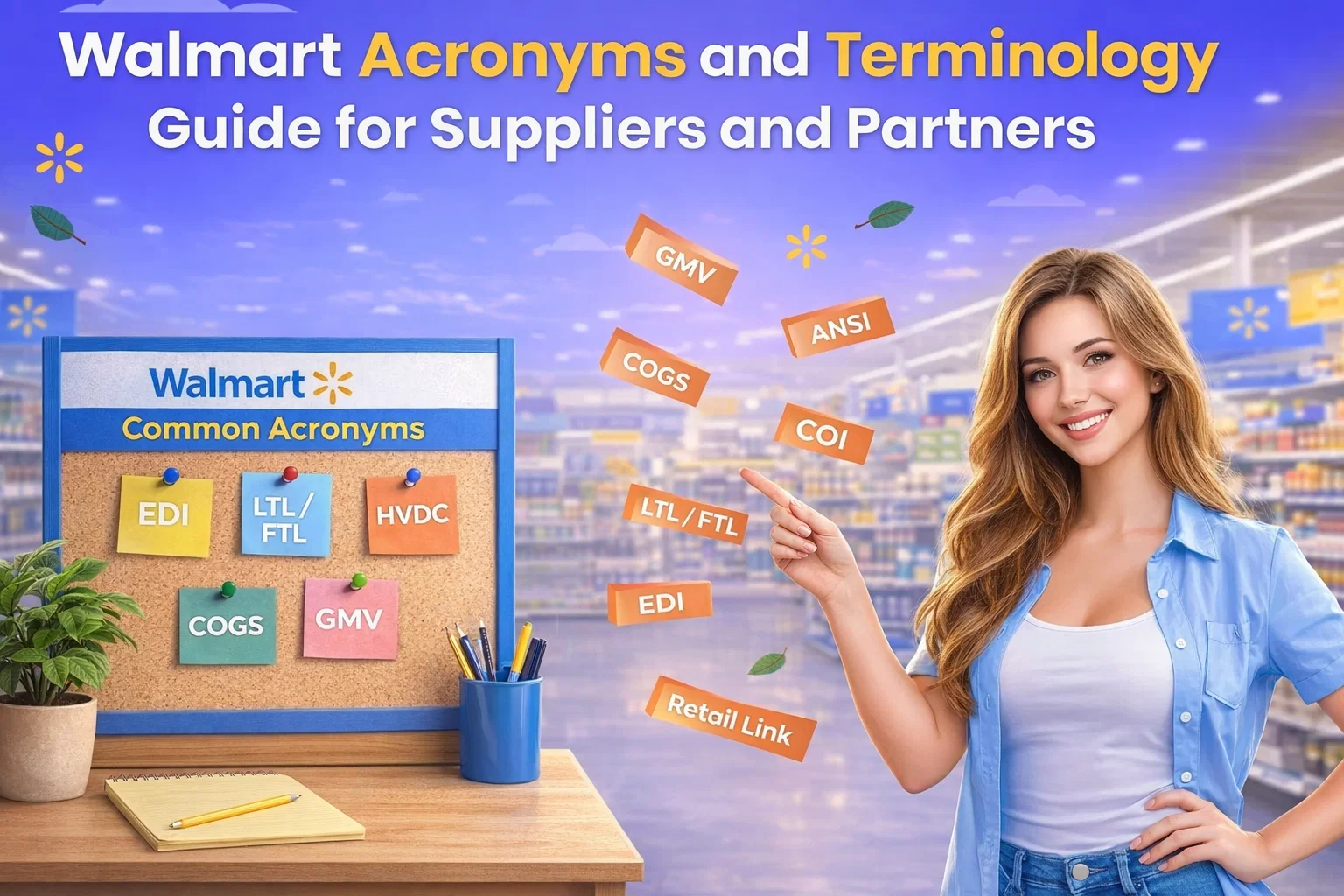
Walmart operates at a massive scale, which requires standardized internal terminology to manage suppliers, inventory, logistics, and compliance. As a result, Walmart relies heavily on acronyms and abbreviations across its systems, documentation, and communications. For suppliers and marketplace sellers, understanding these Walmart acronyms is essential to doing business effectively.
Walmart acronyms appear throughout Seller Center, Retail Link, purchase orders, shipping documentation, and performance reports. Sellers who misunderstand these terms often face avoidable challenges such as delayed onboarding, shipment errors, compliance violations, OTIF penalties, and chargebacks.
This Walmart Acronyms and Terminology Guide serves as a practical reference for understanding commonly used acronyms. It focuses on the terms sellers encounter most frequently while managing listings, fulfilling orders, working with Walmart logistics, and communicating with internal Walmart teams.
This guide is intended for:
Walmart Marketplace sellers
Product suppliers working with Walmart buyers
Operations, logistics, and compliance teams
Understanding Walmart’s terminology helps suppliers reduce risk, improve operational accuracy, and maintain strong performance across Walmart platforms.
Stay ahead of important selling dates in 2026 with our guide on Walmart Seller Key Event Dates
Why Understanding Walmart Acronyms Matters for Suppliers
Walmart suppliers operate within a tightly structured system where accuracy, timing, and compliance are critical. Walmart acronyms are embedded into nearly every operational process. Misunderstanding these terms can directly affect supplier performance, costs, and long-term eligibility to sell on Walmart.
Below are the key reasons why understanding Walmart acronyms is essential for suppliers and partners.
Prevents Compliance and Onboarding Errors
Walmart uses acronyms extensively during supplier onboarding and compliance setup. Terms such as ASN, EDI, OTIF, and PO appear in agreements and system notifications without detailed explanations. Suppliers who misinterpret these acronyms often submit incorrect documentation or miss required steps.
Clear understanding reduces:
Onboarding delays
Rejected shipments
Compliance violations
Improves Communication With Walmart Teams
Walmart buyers, logistics teams, and compliance departments communicate using standardized internal terminology. Suppliers are expected to understand and respond using the same language.
Knowing Walmart acronyms allows suppliers to:
Respond accurately to buyer requests
Resolve issues faster with support teams
Avoid miscommunication during audits or reviews
Reduces Chargebacks and Financial Penalties
Many Walmart chargebacks result from incorrect execution of processes tied to acronyms such as ASN, OTIF, and EDI. These penalties are often avoidable when suppliers fully understand the terminology and associated requirements.
Understanding Walmart abbreviations helps suppliers:
Submit correct advance shipment notices
Meet delivery and fulfillment standards
Avoid unnecessary deductions
Supports Strong Seller Performance Metrics
Walmart evaluates supplier performance using structured metrics and reports filled with acronyms. Misreading these reports can lead to incorrect assumptions about account health.
A strong grasp of Walmart acronyms enables suppliers to:
Monitor performance accurately
Identify risks early
Maintain compliance with Walmart standards
Enables Scalable and Efficient Operations
As supplier operations grow, teams rely on consistent internal documentation and training. Walmart acronyms form the foundation of these processes.
When teams understand Walmart terminology:
Training time is reduced
Errors decrease across departments
Operations scale more efficiently
Protects Long-Term Supplier Relationships
Walmart expects suppliers to operate professionally and independently within its systems. Repeated errors caused by misunderstanding basic terminology can impact buyer confidence and contract renewals.
Understanding Walmart acronyms helps suppliers:
Maintain credibility with Walmart buyers
Operate with fewer escalations
Build long-term partnerships
Walmart Acronyms Every Supplier Should Know
Supply Chain Walmart Acronyms
| Acronym | Description |
| 3PL | Third-Party Logistics; external providers managing warehousing, transportation, and delivery to optimize supply chain efficiency. |
| ASN | Advanced Shipping Notice; document sent by supplier to inform Walmart of pending shipments and expected arrival. |
| BOL | Bill of Lading; official shipping document listing contents, carrier, and terms of transport for legal and tracking purposes. |
| CDD | Carrier Due Date; the scheduled date when a carrier is expected to deliver goods to Walmart’s distribution network. |
| CLT | Collect Load Template; standardized shipping template to organize, track, and manage multiple shipments efficiently. |
| CPFR | Collaborative Planning, Forecasting, and Replenishment; joint vendor-retailer process to align inventory with demand forecasts. |
| CPU | Carrier Pickup Date; the scheduled date for a carrier to pick up goods from supplier or warehouse. |
| DC | Distribution Center; facility where Walmart stores products before distributing them to stores or fulfillment centers. |
| DCI | Direct Commerce Inc.; Walmart’s e-commerce division handling online order fulfillment and direct-to-consumer shipping. |
| DSD | Direct Store Delivery; suppliers deliver products directly to retail stores instead of going through distribution centers. |
| DSDC | Direct Store Delivery Consolidation; combining multiple direct deliveries into one shipment to reduce costs and improve efficiency. |
| DSV | Drop Ship Vendor; suppliers shipping products directly to customers rather than shipping to Walmart’s warehouse or store. |
| DTS | Direct to Store; method of sending inventory directly from supplier to retail location for immediate stocking. |
| EAN | European Article Number; barcode standard for identifying products internationally to enable automated tracking and scanning. |
| EDF | Event-Driven Fulfillment; supply chain approach triggered by sales, promotions, or inventory events to meet demand efficiently. |
| EDI | Electronic Data Interchange; digital communication system for exchanging purchase orders, invoices, and shipment information. |
| EOQ | Economic Order Quantity; inventory strategy to minimize total costs by optimizing order size for supply and demand. |
| EPCIS | Electronic Product Code Information Services; global standard for tracking items across supply chains for visibility and traceability. |
| FBQ | Freight Bill Quantity; the number of units invoiced and shipped on a freight bill for verification and accounting. |
| FC | Fulfillment Center; warehouse where online orders are processed, packed, and shipped directly to customers. |
| FDC | Fashion Distribution Center; specialized distribution center for apparel and fashion merchandise for Walmart stores. |
| FIFO | First In, First Out; inventory method ensuring oldest stock is sold or shipped before newer arrivals. |
| FISH | First In, Still Here; metric tracking inventory that has remained in stock for an extended period. |
| FOB | Freight on Board; shipping term specifying when ownership of goods transfers from supplier to Walmart. |
| GDSN | Global Data Synchronization Network; international platform for exchanging standardized product data across supply chains. |
| GDC | Grocery Distribution Center; specialized warehouse for storing and distributing perishable and grocery products. |
| GEPIR | Global Electronic Party Information Registry; database to track product and company identifiers globally for traceability. |
| GLN | Global Location Number; unique code identifying a specific physical location or business in supply chain management. |
| GOOS | Global Out-of-Stock Report; report tracking items unavailable at stores or distribution centers globally. |
| GPC | Global Product Categorization; system classifying products consistently across regions and vendors for inventory and reporting. |
| GRS | Global Replenishment Solution; system for automated inventory restocking and supply chain optimization across locations. |
| GSM | Global Supplier Management; managing relationships, performance, and compliance of suppliers worldwide. |
| GTIN | Global Trade Item Number; unique identifier for products to facilitate scanning, tracking, and inventory control. |
| HILT | High Inventory/Low Turns; inventory situation where stock levels are high but sales or movement is slow. |
| HTS | Harmonized Tariff Schedule; international system of codes classifying imported/exported goods for customs compliance. |
| HVDC | High-Velocity Distribution Center; DC designed for fast-moving products, ensuring quick replenishment to stores. |
| IDC | Import Distribution Center; warehouse dedicated to handling imported goods before distribution to stores or centers. |
| IED | Item Effective Date; the date a product becomes active or available for ordering in Walmart systems. |
| IOPD | In-store, Online, Pickup, Delivery; Walmart fulfillment options encompassing all sales channels for customer orders. |
| IOR | Importer of Record; entity legally responsible for ensuring imported goods comply with local laws and duties. |
| LIFO | Last In, First Out; inventory method where the most recently received items are sold or shipped first. |
| LTL | Less Than Truckload; shipment method for freight smaller than a full truckload, shared with other shippers. |
| MABD | Must Arrive by Date; latest date by which inventory must reach Walmart to meet store or promotion schedules. |
| OGD | Online Grocery Delivery; Walmart service fulfilling grocery orders directly to customers’ homes. |
| OGP | Online Grocery Pickup; Walmart service allowing customers to order groceries online and pick them up in store. |
| OIF | Online Item File; catalog or database of products available for online ordering and e-commerce fulfillment. |
| OLIF | Online Item File; alternative name for the same online product catalog system. |
| OMS | Order Management System; software coordinating, tracking, and fulfilling customer orders across channels. |
| OP | Order Point; inventory threshold that triggers automatic reordering to prevent stockouts. |
| OPD | Online Pickup and Delivery; system for managing orders fulfilled through customer pickup or home delivery. |
| OSA | Online Supplier Agreement / On-Shelf Availability; vendor agreement or metric ensuring products are in stock online. |
| OTF | On-Time Fulfillment; percentage or measure of orders shipped or delivered on schedule. |
| OTIF | On-Time, In-Full; measure of delivery performance ensuring complete and timely shipments. |
| PDC | Perishable Distribution Center; DC specialized in handling perishable items such as food and refrigerated goods. |
| PI | Packaging Identifier; unique code for identifying product packaging units for tracking and logistics. |
| PMPD | Print and Mail Distribution Center; warehouse handling printed materials, catalogs, and mail-in items. |
| POD | Proof of Delivery / Point of Distribution; confirmation of shipment receipt at customer or location. |
| PUT | Pick Up Today / Pick Up Team; same-day fulfillment option or the team responsible for order collection. |
| RDC | Regional Distribution Center; facility supplying multiple stores within a defined geographic region. |
| S2H | Ship to Home; fulfillment method delivering products directly to customers’ residences. |
| S2S | Ship to Store; inventory shipped directly to retail stores for shelf stocking. |
| SCAC | Standard Carrier Alpha Code; unique identifier for transport carriers. |
| SCIM | Supply Chain Inventory Manager; role or system managing inventory across supply chain. |
| SFS | Shipped from Store; online orders fulfilled directly from store inventory. |
| SIOC | Ships In Own Container; products shipped in their own packaging rather than with others. |
| SL&C | Shipper Load and Count; supplier responsible for loading and counting cartons for shipment. |
| SLIF | Store Level Item Forced; specific inventory forced at store level to maintain stock. |
| SLUF | Store Level UPC Forced; specific UPC units forced at individual stores. |
| SRR | Shortage Recovery Rate; metric for recovering inventory shortages or stockouts. |
| SS | Safety Stock; extra inventory held to prevent stockouts during demand fluctuations. |
| SSCC | Serial Shipping Container Code; unique identifier for tracking shipments or pallets. |
| SSO | Store-Specific Order; custom orders tailored to a particular store’s needs. |
| STH | Ship to Home; identical to S2H, direct home delivery. |
| SVIST | Supplier View Instock Tool; online tool for vendors to check inventory levels. |
| TCR | Total Cases Received; total quantity of cases received at DC or store. |
| TLO | Truckload Optimization; process to maximize freight truck efficiency and reduce costs. |
| TMS | Transportation Management System; software platform for planning and monitoring shipments. |
| TONU | Truck Ordered, Not Used; freight reserved but ultimately not required. |
| TSCP | Transportation Supply Chain Portal; online portal for carrier and shipment management. |
| VMI | Vendor Managed Inventory; supplier manages stock levels to optimize inventory. |
| WH | Warehouse; storage facility for inventory before distribution. |
| WOS | Weeks of Supply; inventory metric measuring how long stock will last at current sales rate. |
| WTMS | Walmart Transportation Management System; Walmart-specific TMS platform to manage shipments and logistics. |
Retail Walmart Acronyms
| Acronym | Description |
| ASOTV | “As Seen on TV”; products featured in televised marketing campaigns, often generating high customer interest. |
| AUR | Average Unit Retail; the average selling price of each item in a store or category. |
| BOP | Beginning of Period; inventory levels or stock status at the start of a reporting period. |
| BSM | Business Support Manager; role providing operational, logistical, or merchandising support to stores or departments. |
| BTS | Back to School; seasonal merchandising and promotional campaign targeting school-related products. |
| CDM | Client Development Manager; manages supplier relationships and develops merchandising strategies for product categories. |
| CID | Consumer ID; unique identifier for tracking individual customer purchasing patterns and loyalty metrics. |
| CMGS | Candy, Magazines, Gum, and Snacks; small consumable product category in stores. |
| COE | Correction of Errors; operational process for identifying and resolving errors in orders or shipments. |
| COI | Certificate of Insurance; proof that suppliers or vendors maintain proper insurance coverage. |
| CP | Center Point; key location within a store for strategic product placement or merchandising focus. |
| CPG | Consumer Packaged Goods; fast-moving consumer products such as food, beverages, and household items. |
| CTL | Consumer Testing Laboratory; facility testing product quality and compliance before release. |
| CWO | Cancel When Out; instruction to cancel orders if products are unavailable or out of stock. |
| DMM | Divisional Merchandise Manager; responsible for planning, inventory, and performance across a merchandise category. |
| DPM | Defect Per Million; measure of quality, tracking defects per million units produced. |
| EDLC | Everyday Low Cost; pricing strategy emphasizing consistent low product costs for customers. |
| EDLP | Everyday Low Price; strategy maintaining consistently low prices across products without temporary promotions. |
| EOL | End of Life; discontinued product removed from stores and ordering systems. |
| FTQ | First Time Quality; metric assessing the quality of products delivered correctly the first time. |
| GM | General Merchandise; category of non-grocery products such as home goods, electronics, and apparel. |
| GMM | General Merchandise Manager; oversees planning, inventory, and performance for general merchandise categories. |
| GNFR | Goods Not for Resale; items used internally, including supplies or operational products. |
| GO | General Order; standard merchandise order for regular stocking without special handling. |
| LAG | Local Assortment Guide; store-specific guide showing products relevant to local consumer demand. |
| LTO | Lead Time Out / Limited Time Offer; promotional product or sales event with defined time frame. |
| MBM | Modular-Based Merchandise; products organized in modular displays for efficient stocking and merchandising. |
| MSRP | Manufacturer’s Suggested Retail Price; price recommended by manufacturer for selling the product. |
| MTR | Merchandise Transfer Request; request to move products between stores or distribution centers. |
| MUMD | Markup/Markdown; pricing adjustments applied to products to manage inventory or promotions. |
| NCU | Non-Compliant Units; products failing quality, packaging, or compliance standards. |
| NHM | Neighborhood Market; smaller Walmart store format focusing on groceries and essential items. |
| NOVA | New Order Validation and Approval; system ensuring new orders meet operational and compliance requirements. |
| ODG | Outdoor Games; merchandise category including seasonal and recreational products for outdoor activities. |
| ODR | Order Deficit Rate; percentage of unfulfilled order quantity compared to requested amounts. |
| OOS | Out-of-Stock; indicates that a product is temporarily unavailable for sale. |
| OSCA | On-Shelf Customer Availability; metric tracking product presence on store shelves for customers. |
| OTC | Over-the-Counter; non-prescription pharmacy or health products sold directly to customers. |
| PDQ | Pretty Darn Quick; method for fast stocking, restocking, or display of merchandise. |
| PIM | Product Information Management; system managing product data, attributes, and categorization for inventory. |
| PLU | Price Lookup; system code used at checkout to identify item and pricing information. |
| POS | Point-of-Sale; system used for completing transactions and tracking sales data. |
| RA | Return Authorization; approval process for returning products to stores or suppliers. |
| RL | Retail Link; Walmart portal providing suppliers with sales, inventory, and analytics information. |
| RM | Replenishment Manager; ensures stock levels are maintained and products are available for customers. |
| ROM | Rest of Market; stores outside main priority regions used in reporting and distribution planning. |
| RRP | Retail Ready Packaging; packaging designed for immediate shelving and sale in stores. |
| RTV | Return to Vendor; process for returning defective or excess merchandise to the supplier. |
| SBU | Supplier Business Unit; vendor division responsible for managing products and performance metrics. |
| SCOG | Store Choice Order Guide; guide allowing stores to customize orders based on local demand. |
| SKU | Stock Keeping Unit; unique product identifier used for tracking inventory and sales. |
| SOG | Store Order Guide; guide for replenishing stores based on predicted demand and stock levels. |
| SOI | Store Only Item / Statement of Identity; product sold exclusively in store or with unique identifier. |
| SOTC | Store of the Community; Walmart store format focused on local engagement and community-specific offerings. |
| SPM | Supplier Performance Management; tracking and evaluating vendor performance across quality and delivery metrics. |
| SQEP | Supplier Quality Excellence Program; ensures suppliers meet Walmart quality standards consistently. |
| SRO | Stop Replenishment Only; directive to halt restocking a particular product or SKU. |
| SSM | Supplier Solutions Manager; role assisting vendors in inventory, sales, and compliance optimization. |
| SUP | Supercenter; Walmart store format combining groceries, general merchandise, and services under one roof. |
| SWAS | Store Within a Store; small branded or specialty section inside Walmart for targeted product categories. |
| UOM | Unit of Measure; standard measure for products, such as each, case, or pack, used in inventory. |
| UPC | Universal Product Code; barcode assigned to products for scanning, tracking, and sales reporting. |
| UCW | Units per Club per Week; metric tracking weekly unit sales per warehouse club store. |
| USW | Units per Store per Week; metric tracking weekly unit sales per individual store. |
| VCOE | Vendor Correction of Error; process for vendors to fix shipment or product errors. |
| WIC | Women, Infants, and Children; government assistance program products eligible for WIC benefits. |
| WM | Walmart / Walmart Marketplace; corporate brand or online marketplace for third-party sellers. |
| WM CA | Walmart Canada / Walmart Marketplace Canada; Canadian division managing retail and online marketplace. |
| WPM | Walmart Pre-Marked Merchandise; items pre-labeled with UPCs or pricing for easier stocking and checkout. |
Discover how influencers can partner with Walmart to promote products and earn through the Walmart Creator Program.
Finance Walmart Acronyms
| Acronym | Description |
| $SW | Dollars per Store per Week; metric tracking total weekly revenue generated per store. |
| ADS | Average Dollar Sale; average revenue per transaction in a store or category. |
| AP | Accounts Payable; department managing payments owed to vendors and suppliers. |
| APDP | Accounts Payable Disputes Portal; system for resolving invoice or payment discrepancies with vendors. |
| APIS | Accounts Payable Information System; platform tracking vendor invoices, payments, and financial transactions. |
| AR | Accounts Receivable; department managing money owed to Walmart by customers or partners. |
| BPS | Basis Point; measurement unit for interest rates, finance, or margin percentages. |
| CC | Combined Contribution; metric combining profit contributions from multiple categories or stores. |
| CCS | Cost Change Scenario; analysis of cost variations and their impact on profitability. |
| COGS | Cost of Goods Sold; direct cost incurred in producing or purchasing merchandise sold. |
| COOP | Cooperative Agreement; partnership agreement with vendors for shared marketing or promotional activities. |
| EFT | Electronic Funds Transfer; digital payment method used for paying vendors or suppliers. |
| FYE | Fiscal Year Ending; end date of Walmart’s financial reporting year. |
| GMROII | Gross Margin Return on Inventory Investment; profitability measure relating gross margin to inventory cost. |
| GMV | Gross Merchandise Value; total sales value of merchandise sold through Walmart or its marketplace. |
| OTB | Open to Buy; budgeted inventory capacity available for new purchases within a period. |
| PFS | Pay from Scan; system ensuring vendors are paid based on scanned and sold items. |
| PO | Purchase Order; official order document sent to suppliers requesting goods. |
| PSW | Profit per Store per Week; weekly profit metric measured at store level. |
| SCA | Sales Contribution; metric measuring each product’s contribution to overall sales. |
| Trans CP% | Transactional Contribution Profit Percent; profitability percentage from specific transactions or product lines. |
| WOW | Week-over-Week; comparison of sales or performance metrics between consecutive weeks. |
| YOY | Year-over-Year; comparison of sales or performance metrics from the same period in the previous year. |
Not sure what to list? Discover this year’s hottest Walmart best sellers and learn how to choose high-demand, profitable products for your store.
Additional Walmart Acronyms
Acronym | Description |
ANSI | American National Standards Institute; organization providing standards for quality, safety, and interoperability of products and processes. |
DSS | Decision Support System; software platform providing insights and analytics to help Walmart make data-driven operational decisions. |
EOC | Emergency Operations Center; central command facility coordinating responses to emergencies, disruptions, or operational incidents. |
GBS | Global Business Services; centralized corporate unit providing shared services such as HR, finance, and IT support. |
GEM | Global Enterprise Mailbox; centralized communication platform for internal corporate messaging and document sharing. |
HO | Walmart Home Office; Walmart’s corporate headquarters managing global operations, strategy, and administration. |
ISD | Information Systems Division; department managing Walmart’s IT infrastructure, software systems, and digital operations. |
RT | Review Time; time allocated for product, order, or performance review before decisions or approvals. |
SEO | Search Engine Optimization; practice of optimizing online Walmart content to improve visibility in search engines. |
WERCS | Worldwide Environmental and Regulatory Compliance Solutions; system ensuring products meet global environmental, safety, and regulatory standards. |
Walmart’s Online Event Codes
Event Code | Description |
OL4TH_WK | Online July 4th; promotion or special online merchandising for Independence Day shopping and seasonal products. |
OLAE__WK41 | Online Annual Event; major yearly online sales event for Walmart’s e-commerce platform. |
OLAE__WK42 | Online Annual Event; continuation of Walmart’s annual e-commerce promotional campaigns. |
OLAE__WK43 | Online Annual Event; part of yearly online marketing and sales strategy. |
OLASAPWK | Online Flow; regular online order processing week for continuous product replenishment. |
OLBTC_WK | Online Back to College; online promotions targeting college-related merchandise and school essentials. |
OLBTS_WK | Online Back to School; seasonal online campaign for school supplies, clothing, and accessories. |
OLCMASWK | Online Christmas; holiday season online sales, including gifts, décor, and seasonal merchandise. |
OLCYBRWK | Online Cyber Week; online-focused promotional period aligned with Black Friday and Cyber Monday sales. |
OLDAD_WK | Online Father’s Day; e-commerce campaign promoting gifts and products for Father’s Day. |
OLEASTWK | Online Easter; online seasonal promotion for Easter-related merchandise and gifts. |
OLGAMEWK | Online Game Time; online promotions for gaming consoles, video games, and related accessories. |
OLGRADWK | Online Graduation; seasonal online campaign for graduation gifts, apparel, and celebratory items. |
OLHALLWK | Online Halloween; seasonal online sales event for costumes, décor, and Halloween merchandise. |
OLHARVWK | Online Harvest; seasonal promotions for autumn or harvest-themed products. |
OLHOLIWK | Online Holiday; general holiday season online merchandising and promotional campaigns. |
OLMARDWK | Online Mardi Gras; online promotions for Mardi Gras-related merchandise or themed events. |
OLMEM_WK | Online Memorial Day; online campaign for Memorial Day sales and promotions. |
OLMOD_WK | Online Modular Orders; online order processing week for modular displays or merchandising. |
OLMOM_WK | Online Mother’s Day; e-commerce campaign promoting gifts and products for Mother’s Day. |
OLPHDYWK | Online Pre AE Promo; pre-AE (Annual Event) promotional online campaign for inventory readiness. |
OLPRESWK | Online President’s Day; online promotional campaign aligned with President’s Day sales. |
OLPRIMWK | Online Prime Day; online sales event aligned with Walmart Prime Day promotions. |
OLREPLWK | Default/Regular Ordering; standard online replenishment week for ongoing inventory maintenance. |
OLSEASWK | Online Seasonal; online campaign promoting products according to seasonal trends and holidays. |
OLSPRGWK | Online Spring; seasonal online promotions for spring-related merchandise and gifts. |
OLTAB_WK | Online Tab; online order week for tab-specific promotions or campaigns. |
OLTAX_WK | Online Tax Time; online promotions targeting tax season products and related merchandising. |
OLVAL_WK | Online Valentine’s Day; online campaign promoting Valentine’s gifts, cards, and seasonal products. |
OLWAY_WK | Online Wayfair Day; online event promoting home goods and furniture in partnership with Wayfair. |
Understand the key differences between Walmart 1P and 3P selling to choose the best model for your business.
Commonly Confused Walmart Acronyms
Walmart uses hundreds of internal acronyms across logistics, retail, finance, and online operations. Some acronyms are similar in appearance or context, which can cause confusion for employees, vendors, and suppliers. Below is a curated list of commonly confused Walmart acronyms, with explanations to help differentiate them.
DSD vs. DTS
DSD (Direct Store Delivery): Products delivered directly from the supplier to Walmart stores, bypassing distribution centers.
DTS (Direct to Store): Synonym of DSD; sometimes used interchangeably, but DTS often refers specifically to Walmart’s internal shipping systems.
Why confused: Both involve direct store deliveries, but DTS can also encompass system-driven order fulfillment.
S2H vs. STH
S2H (Ship to Home): Fulfillment method where products are shipped directly to the customer’s home.
STH (Ship to Home): Same meaning as S2H; acronym duplication exists in Walmart systems.
Why confused: Walmart uses both terms in reporting, depending on the department or IT system.
USW vs. UCW
USW (Units per Store per Week): Weekly sales metric measuring units sold per individual store.
UCW (Units per Club per Week): Weekly sales metric for warehouse or club stores (e.g., Sam’s Club).
Why confused: Acronyms differ by retail format but are often misapplied in reporting.
EOQ vs. LTO
EOQ (Economic Order Quantity): Inventory strategy calculating optimal order quantity to minimize total costs.
LTO (Lead Time Out / Limited Time Offer): Refers to promotional products or time-sensitive merchandise.
Why confused: Both relate to inventory planning but one is operational (EOQ) and the other promotional (LTO).
FIFO vs. LIFO
FIFO (First In, First Out): Oldest stock sold first; used for perishable or time-sensitive products.
LIFO (Last In, First Out): Newest stock sold first; primarily accounting method.
Why confused: Both are inventory management methods, but FIFO is operational while LIFO is accounting-focused.
AP vs. AR
AP (Accounts Payable): Department responsible for paying vendors and suppliers.
AR (Accounts Receivable): Department managing money owed to Walmart.
Why confused: Both involve financial transactions but represent opposite flows of money.
PO vs. POD
PO (Purchase Order): Official order request sent to suppliers.
POD (Proof of Delivery / Point of Distribution): Confirmation that products have been received.
Why confused: Both appear in shipping and vendor communications, but PO is the order, POD is proof of receipt.
OSA vs. OSCA
OSA (On-Shelf Availability / Online Supplier Agreement): Can refer to inventory availability or vendor agreements.
OSCA (On-shelf Customer Availability): Specific metric tracking shelf stock for customer purchase.
Why confused: Both track availability, but OSA may also refer to supplier contracts.
RT vs. RTV
RT (Review Time): Time allocated for evaluating products, orders, or reports.
RTV (Return to Vendor): Process of returning defective or excess merchandise.
Why confused: Acronyms share the “R-T” letters but serve very different operational purposes.
GM vs. GMM
GM (General Merchandise): Category of products including non-grocery items.
GMM (General Merchandise Manager): Role responsible for managing the GM category.
Why confused: One is a category; the other is a role managing that category.
DSV vs. DSDC
DSV (Drop Ship Vendor): Vendor fulfilling online orders directly to the customer.
DSDC (Direct Store Delivery Consolidation): Consolidates multiple DSD shipments for efficiency.
Why confused: Both relate to supply chain deliveries, but one is vendor-driven, the other logistics-driven.
FYE vs. YOY
FYE (Fiscal Year Ending): Marks the end of Walmart’s financial year.
YOY (Year-over-Year): Comparative metric between periods in consecutive years.
Why confused: Both are date-related financial terms but represent different types of analysis.
Interested in launching your own brand? Our guide to Walmart’s Private Label program explains the process and benefits of building a unique product line.
How Stores Automation Helps You Earn Passive Income from Walmart
Running a Walmart store can be complex and time-consuming — managing inventory, orders, and sales across multiple channels is a full-time job. That’s where Stores Automation comes in.
We provide “done-for-you” Walmart store automation services, so you don’t have to lift a finger. From inventory management to order fulfillment and pricing optimization, our system handles everything automatically.
With Stores Automation, you can:
Run a fully automated Walmart store with minimal effort.
Earn passive income while our technology and experts manage your operations.
Optimize profits with automated pricing, promotions, and inventory control.
Stop worrying about day-to-day store management — let Stores Automation do the work, and watch your Walmart business generate income effortlessly.