
A done for you Shopify store is a service where an agency handles store setup, product sourcing, supplier vetting, marketing, and daily operations on your behalf, typically in exchange for a one-time setup fee, an ongoing ad budget you fund, and a profit-split arrangement. My verdict after evaluating this model closely: it genuinely works when the provider is transparent about pricing, timelines, and results — the real differentiator isn't the marketing pitch, it's the profit-split transparency, a realistic 3–4 month timeline to breakeven, and whether the provider keeps you informed with real reporting rather than promising total silence and instant results.
💡 Key Takeaways
- A done for you Shopify store typically involves a one-time setup fee, an ongoing monthly ad spend budget you fund, and a profit-split arrangement — commonly around 60/40 in the client's favor — rather than a flat monthly service fee.
- The clearest sign of a trustworthy provider isn't the marketing pitch — it's whether they give you a specific, itemized breakdown of costs and a realistic timeline rather than a vague promise that "everything is handled."
- Realistic breakeven on a well-run DFY Shopify store typically runs 3–4 months, not the "profitable in week one" framing some marketing implies — a provider giving you this honest timeline upfront is showing you good faith, not a downside.
- The profit-split percentage you're quoted isn't your actual take-home. Ad spend is typically deducted before the split is calculated, meaning a 60% share of net profit can look very different from 60% of revenue.
- Counterintuitively, a provider promising total zero involvement from you is a weaker trust signal than one that sends monthly reports and occasionally asks for your input — ongoing reporting is what keeps you genuinely informed about your own store.
- Real performance data matters more than testimonial copy. Later in this guide, I break down four actual performance screenshots showing what store metrics look like over time under professional management.
- If you're evaluating our own done-for-you Shopify service, the same vetting questions in this guide apply — we cover exactly what we include and what we don't promise later in this piece.
📚 Table of Contents
- What Is a Done for You Shopify Store and How Does It Work?
- Why Are So Many People Searching for Done for You Shopify Automation in 2026?
- What Actually Separates a Transparent DFY Shopify Service From a Vague One?
- What Does a Legitimate Done-For-You Service Actually Include?
- What Results Did I Actually See?
- What Does the Profit-Split Model Actually Mean for Your Take-Home?
- Is "Zero Involvement" Really a Good Sign?
- How Long Does It Take to Become Profitable With a DFY Shopify Store?
- Done-For-You vs Doing It Yourself: Which Is Actually Better?
- What Should You Look for Before Signing Up for a DFY Shopify Service?
- Is Stores Automation a Good Choice for a Done-For-You Shopify Store?
- Frequently Asked Questions
I went into evaluating done for you Shopify store services with a specific question: does the "you do nothing, we handle everything, you collect profit" pitch actually hold up in practice? The honest answer is more useful than either blind enthusiasm or blanket skepticism — it depends entirely on how transparently a specific provider operates.
This guide covers done for you Shopify automation from every angle that actually matters to someone considering it: what a quality service includes, what genuinely sets a transparent provider apart, what the profit-split math really means for your take-home, and real performance data rather than testimonial copy alone. I'm also covering three things most reviews in this space skip entirely: what actually distinguishes a transparent provider from a vague one, the actual arithmetic behind a profit-split model once ad spend comes out first, and why a provider that wants your ongoing attention is showing you a better sign than one promising you'll never have to be involved.
What Is a Done for You Shopify Store and How Does It Work?
A done for you Shopify store is a service where an agency builds, stocks, markets, and manages a Shopify dropshipping store on your behalf, and you fund the setup and ongoing advertising while the agency handles execution. The core appeal is straightforward: you don't need to learn product research, supplier vetting, ad management, or store design yourself — someone with existing expertise does it for you.
The typical structure involves three financial components working together, not one flat fee:
- A one-time setup cost covering store build, branding, and initial configuration
- An ongoing monthly ad spend budget that you fund directly, since paid traffic is what actually drives sales in a new store
- A profit-split arrangement where the agency retains a percentage of net profit in exchange for ongoing management, commonly structured around a 60/40 split in the client's favor
This differs meaningfully from simply learning to dropship on Shopify yourself, where you'd absorb both the time cost of learning and the execution risk of early mistakes without a team's existing experience to lean on. The tradeoff is that you're paying for that experience through the setup fee and profit split rather than your own time.
What most marketing pages leave vague: "done for you" describes who executes the work, not how much capital you need to provide. Every legitimate service I looked at required the client to fund both the setup cost and ongoing ad spend — the agency isn't investing its own money into your specific store's advertising. Understanding this upfront prevents the common disappointment of expecting a truly zero-cost, zero-involvement arrangement that doesn't actually exist in the legitimate version of this model.
Why Are So Many People Searching for Done for You Shopify Automation in 2026?
Interest in done for you Shopify automation has grown alongside a broader shift toward passive and semi-passive income models, as more people look for ways to earn from ecommerce without the full-time hours it traditionally requires. The appeal is specific: dropshipping already removes inventory risk compared to traditional retail, and a DFY service removes the operational time burden on top of that.
That combination matters because the two biggest barriers to entry in Shopify dropshipping — inventory capital and hands-on daily management — are exactly what this model addresses. Someone working a full-time job who wants a second income stream doesn't have eight hours a week to learn product research, write ad copy, and manage supplier relationships from scratch. A legitimate DFY service compresses that learning curve into a paid service instead.
The cost structure is also a genuine factor in the search volume. Understanding Shopify's own fee structure is complex enough on its own before layering in supplier costs, ad platform costs, and app subscriptions — a DFY arrangement consolidates all of that into two predictable numbers: a setup fee and a monthly budget, which is meaningfully easier to evaluate than piecing together a dozen separate cost centers yourself.
What Actually Separates a Transparent DFY Shopify Service From a Vague One?
A transparent DFY Shopify service is defined by specific, verifiable details — an itemized cost breakdown, a realistic timeline, and real client access — rather than by broad promises. This is the single most useful section in this guide for actually evaluating a provider, and it's the one most competing reviews skip entirely in favor of generic "pros and cons" lists.
The good news is that spotting a genuinely transparent provider is straightforward once you know what to ask for. The pattern holds across the industry: the more specific and verifiable a provider's claims are, the more confidence you can have in the service itself.
| What to Look For | Why It Matters |
|---|---|
| Realistic timelines and ranges, not guarantees | No one can guarantee ecommerce results; honest ranges reflect real experience |
| Transparent, itemized setup fee | Shows the cost is tied to actual work performed, not a flat lump sum |
| Real, verifiable performance data specific to your store | Generic testimonials tell you less than your own store's actual numbers |
| No restriction on client feedback, public or private | A provider confident in their work has no reason to limit honest reviews |
| Specific, verifiable description of what's automated vs. human-managed | Clarity here tells you exactly what you're paying for |
The DFY model itself is a legitimate, workable business structure — the burden is simply on you to verify a specific provider against these markers before paying anything. Ask directly: what's the itemized breakdown of the setup fee, can you speak with an existing client independent of the sales process, and is there any restriction on your ability to leave honest feedback afterward. A transparent provider answers all three without hesitation, and later in this guide I walk through exactly how Stores Automation holds up against each of these questions.
See What a Transparent DFY Shopify Service Actually Looks Like
Our Shopify dropshipping service publishes exactly what's included, how the profit split works, and what timeline to expect — no guaranteed income claims, no vague "AI-powered" promises.
What Does a Legitimate Done-For-You Service Actually Include?
A legitimate done-for-you Shopify service includes store setup and branding, product research and curation, supplier sourcing and vetting, marketing and ad management, day-to-day store operations, customer support, and regular performance reporting — delivered as a defined scope, not a vague promise of "we handle everything."
- Store setup and branding: professional storefront design, theme configuration, and initial brand identity work
- Product research and curation: identifying winning products worth selling based on demand data rather than guesswork
- Supplier sourcing: vetting reliable Shopify dropshipping suppliers, often including AliExpress-based sourcing for standard dropshipping or dedicated 3PL fulfillment as the store scales past pure dropshipping
- Marketing and ad management: campaign setup, creative production, and ongoing optimization across paid channels
- Store management: inventory updates, order processing, and fulfillment coordination handled daily
- Customer support: responding to buyer inquiries so the client isn't fielding support tickets personally
- Monthly reporting: performance data showing sales, spend, and profit — the paper trail that separates a transparent operation from one relying on your disengagement
What varies meaningfully between providers: the specific tooling and platform stack behind the scenes. Some agencies rely heavily on Shopify dropshipping apps for automation, while others build more custom workflows. Neither approach is inherently better, but a provider who can explain their actual tech stack in specific terms is giving you more to verify than one who only speaks in outcomes.
What Results Did I Actually See With A DFY Shopify Store?
Rather than describing results in the abstract, here's what actual store performance data looked like across a real engagement — the kind of documentation a transparent provider should be willing to share directly, rather than vague testimonials with no verifiable numbers behind them.
These are four separate live client stores under active Stores Automation management, shown exactly as their Shopify Analytics dashboards report them — gross sales, order volume, and returning customer rate, each compared against the store's own prior period. Every store below was built from scratch and is run day-to-day by the Stores Automation team under the done-for-you model this guide has been evaluating — product sourcing, ad management, and store operations included.
Store A — Managed by Stores Automation — Aug 1–Oct 31, 2025
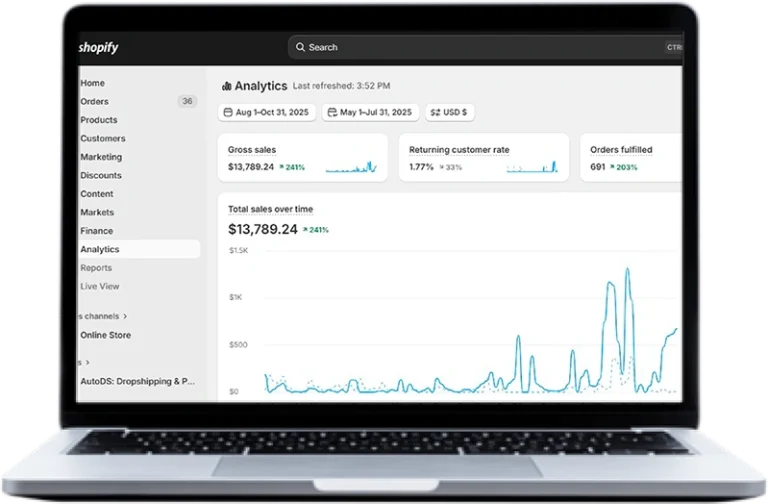
Under Stores Automation management, this store generated $13,789.24 in gross sales, up 241% versus the prior period (May 1–Jul 31, 2025). 691 orders fulfilled, up 203%, with a 1.77% returning customer rate. The sales trend line shows the store building momentum through a series of increasingly large spikes, with the strongest volume landing in the final weeks of the period.
Store B — Managed by Stores Automation — Apr 1–Oct 31, 2025
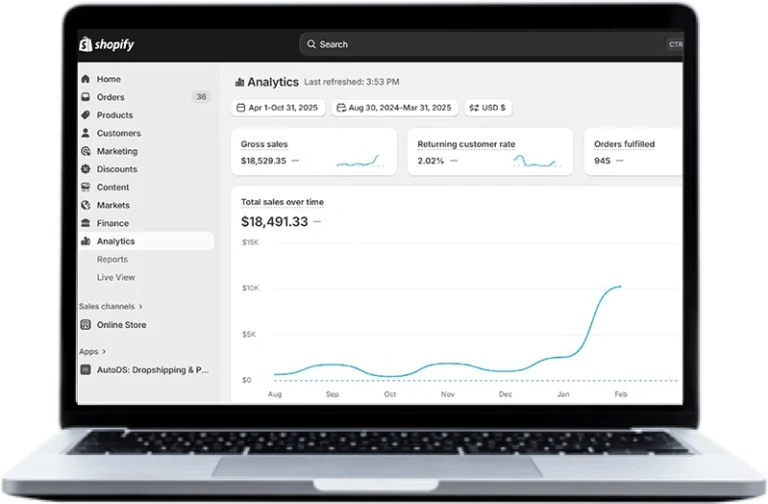
This store, built and run by the Stores Automation team, reached $18,529.35 in gross sales ($18,491.33 total sales over time) across a longer window, with 945 orders fulfilled and a 2.02% returning customer rate. This is the clearest example in this set of a slow-start, then a genuinely steep ramp once the store found its footing under active management — the chart sits close to flat through the fall before climbing sharply starting in January.
Store C — Managed by Stores Automation — Last Month vs Sep 1–30, 2025

The newest of the four stores in this set, launched and managed by Stores Automation, generated $10,240.64 in gross sales, up 303% month over month. 469 orders fulfilled, up 217%, with a 2.6% returning customer rate. The percentage jump reflects early-stage acceleration under active management more than a mature, steady-state run rate.
Store D — Managed by Stores Automation — Jun 1–Oct 31, 2025
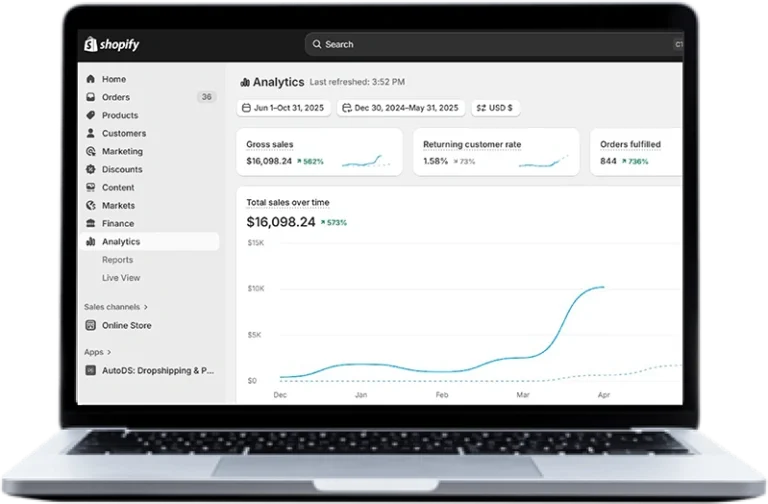
Managed end-to-end by Stores Automation, this store posted $16,098.24 in gross sales, up 562% ($16,098.24 total sales over time, up 573%) versus the prior six-month period. 844 orders fulfilled, up a striking 736%, with a 1.58% returning customer rate, up 73%. The largest percentage swings in this set of four, driven by a prior period that started from a very low base before management took over.
A note on how to actually read these screenshots: every figure above is labeled gross sales, not net profit — and that distinction matters as much here as it does anywhere else in this guide. Run the same profit-split math from earlier in this article against these numbers before treating them as take-home pay: subtract product cost, Shopify and payment fees, and ad spend, and the number left over is what a client and provider are actually splitting. This is exactly the kind of context a legitimate provider should walk you through without being asked, rather than letting a big gross number speak for itself.
See What a Transparent DFY Shopify Service Actually Looks Like
Our Shopify dropshipping service publishes exactly what's included, how the profit split works, and what timeline to expect — no guaranteed income claims, no vague "AI-powered" promises.
What Does the Profit-Split Model Actually Mean for Your Take-Home?
A profit-split model means the percentage you're quoted applies to net profit after expenses, not the number that determines your actual take-home pay, and this is the math almost no comparison article walks through concretely. A 60/40 split sounds simple until you trace exactly what gets subtracted before that 60% is calculated.
A Worked Example
Say your store generates $10,000 in revenue in a month. Product cost (COGS) runs $3,500. Shopify and payment processing fees take roughly $300. Ad spend — which you funded directly — comes to $3,000. That leaves $3,200 in net profit before the split is applied. At a 60/40 split, you receive $1,920, and the agency retains $1,280 for management.
| Line Item | Amount |
|---|---|
| Revenue | $10,000 |
| Product cost (COGS) | –$3,500 |
| Shopify/payment fees | –$300 |
| Ad spend (client-funded) | –$3,000 |
| Net profit before split | $3,200 |
| Your share (60%) | $1,920 |
| Agency share (40%) | $1,280 |
⚠️ The detail that changes everything: you funded the $3,000 in ad spend directly, out of pocket, before any split happens. That means your actual net result this month is $1,920 in split profit minus the $3,000 you already spent — a $1,080 net loss on paper for this specific month, even though the store technically generated a profit before your ad investment is accounted for. This is completely normal in the early months of any new store, DFY or self-managed, but providers rarely walk through it this explicitly upfront.
This is exactly why the realistic breakeven timeline matters more than the headline profit-split percentage. A 70/30 split with slow ad efficiency can net you less than a 50/50 split with a provider who's genuinely skilled at driving efficient traffic to a Shopify store. Ask any provider to walk through a worked example using their actual typical numbers, not a hypothetical, before signing anything.
Is "Zero Involvement" Really a Good Sign?
No — counterintuitively, a provider promising you'll never need to be involved after signup is a weaker trust signal than one that sends regular reports and occasionally requests your input. A provider genuinely confident in their results wants documented client engagement, because it builds the kind of long-term trust a one-off sales pitch never can.
Think through why this makes sense structurally. A provider managing your store well has nothing to hide in a monthly report — showing you real numbers, even mediocre ones during a slow month, builds the long-term trust that keeps a client relationship going. A provider more interested in you never looking closely is telling you something too, even without saying it directly.
✔ Healthy Involvement Looks Like
- Monthly or bi-weekly performance reports with real numbers
- Occasional requests for budget approval or product direction input
- A named point of contact who responds to direct questions
- Willingness to explain a slow month, not just highlight good ones
✗ Red-Flag "Zero Involvement" Looks Like
- No reporting cadence specified anywhere in the contract
- Vague reassurance that you'll "just see the money" with no process explained
- Discouragement from asking detailed questions about performance
- Marketing that frames any client involvement as a flaw in the service
This doesn't mean a legitimate DFY service should feel like a part-time job — the entire point is time savings compared to running a store yourself. The realistic middle ground is genuinely low time investment (checking a monthly report, occasionally approving a budget change) rather than literally zero contact ever. If a provider frames periodic engagement as unnecessary rather than as the accountability mechanism it actually is, treat that framing itself as the warning sign.
How Long Does It Take to Become Profitable With a DFY Shopify Store?
A realistic breakeven timeline for a legitimate DFY Shopify store runs three to four months, covering initial product testing, ad account optimization, and the natural learning curve of finding what actually converts for your specific store — treat any provider promising faster as overselling rather than being genuinely more skilled.
The first month typically involves store setup and initial product testing, often with mixed or negative ad performance while the campaign gathers data. Months two and three usually show gradual improvement as underperforming products and ad creative get cut and winners get scaled. By month three or four, a genuinely working store combination of product and marketing tends to either show a clear path to profitability or signal it's time to pivot the product line entirely.
What separates stores that break even on schedule from ones that don't: consistent, data-driven iteration rather than a single big bet on one product launch. Providers actively using competitive research tools to identify what's already working in a category, and building out proper email marketing sequences to capture repeat revenue from existing traffic, tend to compress this timeline more reliably than providers relying purely on cold paid traffic to a single product.
Marketing channel diversity also affects timeline. A provider only running one ad platform is more exposed to that platform's performance swings than one also building out organic social presence and broader marketing tooling alongside paid acquisition.
Done-For-You vs Doing It Yourself: Which Is Actually Better?
Done-for-you is better if your limiting factor is time and expertise rather than capital; doing it yourself is better if your limiting factor is capital rather than time, since self-managing trades your own hours for the setup fee and profit-split percentage you'd otherwise pay an agency.
| Factor | Done-For-You | Do It Yourself |
|---|---|---|
| Time investment | Low — monthly report review | High — daily hands-on management |
| Learning curve | None required from you | Steep initially, especially product research and ads |
| Total cost structure | Setup fee + ad spend + profit split | Ad spend + tool subscriptions + your time |
| Speed to first store live | Days to a couple weeks | Weeks to months, depending on learning pace |
| Control over decisions | Limited, provider-led with your input | Full control over every decision |
If you're leaning toward self-managing, you'll need to build out the same functions a DFY provider handles — sourcing your own reliable suppliers, selecting a theme built to convert, getting product photography specs right, and eventually layering in upsell apps to increase average order value once you have traffic flowing. None of this is impossible to learn, but the combined learning curve is exactly what a DFY setup fee is buying you out of.
Let Us Handle the Full Store Build While You Stay Informed, Not Absent
Our done-for-you Shopify service includes store setup, product curation, supplier sourcing, marketing, and monthly reporting — built around the kind of transparency this guide argues you should demand from any provider.
What Should You Look for Before Signing Up for a DFY Shopify Service?
Before signing up for any DFY Shopify service, verify the payment structure, the product strategy, and the contract terms specifically — these three areas are where the difference between a legitimate provider and a problematic one shows up most clearly, beyond the general red flags covered earlier.
- Payment transparency. Understand exactly how Shopify Payments and any additional processing fees flow through your specific arrangement, and get the setup fee itemized rather than presented as a single lump sum.
- Product sourcing strategy. Ask whether the provider sources from standard dropshipping suppliers, offers Shopify Collective partnerships with other verified brands, or works with print-on-demand suppliers and broader print-on-demand apps for custom product lines. A provider who can explain their specific sourcing model in detail is more credible than one who speaks only in generalities.
- Product research methodology. Ask how they identify what to sell — do they reference actual trending product data, or is product selection based on generic instinct? Data-backed selection is a meaningfully stronger signal.
- Contract exit terms. Confirm what happens if you want to stop the arrangement — do you retain ownership of the store, the domain, and the supplier relationships, or does everything revert to the agency?
- Content and copy quality. Ask whether product descriptions and ad copy are written specifically for your store or reused generically across multiple clients. Providers using tools like Shopify Magic for a first draft, then refining by hand, tend to produce more differentiated copy than fully templated approaches.
The single question that cuts through most marketing: "Can I speak with a current client, arranged independently of your sales process?" A legitimate provider with real client relationships can facilitate this without friction. Reluctance or excuses here is worth weighing heavily against everything else in the pitch.
Is Stores Automation a Good Choice for a Done-For-You Shopify Store?
Stores Automation is worth evaluating specifically because its structure matches the transparency checklist covered in this guide: a defined one-time setup cost, a client-funded monthly ad budget, and a documented 60/40 profit split in the client's favor, with monthly reporting built into the service rather than offered as an afterthought. The four store results shown earlier in this guide come from live client accounts managed under exactly this structure, not staged demo data.
What's Actually Included
The service scope covers the full list from earlier in this guide, delivered as a defined process rather than a vague promise:
- Done-for-you store setup and branding — professional storefront design and configuration handled before your store ever goes live
- Product curation based on demand research rather than guesswork, drawing on the same product validation approach covered earlier in this guide
- Supplier vetting to reduce fulfillment risk before a product ever gets listed
- Ad campaign setup and management, with ongoing optimization rather than a one-time launch and no further attention
- Day-to-day store operations, including inventory updates, order processing, and fulfillment coordination
- Customer support handled on your behalf, so buyer inquiries aren't landing in your personal inbox
- Monthly performance reporting with a dedicated project manager as your single point of contact throughout
Store owners also retain the ability to sync inventory and listings across additional channels, including Shopify Amazon integration, if they want to expand beyond a single sales channel later without starting a second engagement from scratch.
Why the Involvement Model Matters Here Specifically
Reflecting the "healthy involvement" pattern covered earlier rather than the "zero involvement" red flag, the arrangement includes ongoing communication through a dedicated project manager and monthly reports covering real performance data, not just favorable highlights. That's a deliberate structural choice, not an incidental feature — wanting your attention on a recurring basis is a sign of a provider confident enough in their work to show it to you regularly. Building genuine social proof matters here too — guidance on adding reviews to a Shopify store is part of the broader trust-building work that compounds with paid traffic over time.
What to expect realistically: a one-time setup cost, an ongoing monthly ad budget you fund directly, and a breakeven timeline in the 3–4 month range consistent with the rest of this guide — not a guaranteed income figure, because no legitimate provider offers one. That consistency between the marketing and the actual mechanics is precisely the thing to verify with any provider you're considering, including this one.
What Do Real Clients Say About Stores Automation?
Rather than asking you to take marketing copy at face value, here's what's actually posted publicly on Trustpilot, along with two direct client video testimonials, so you can weigh this the same way this guide has argued you should weigh any provider — against verifiable, independent evidence rather than a sales page alone.
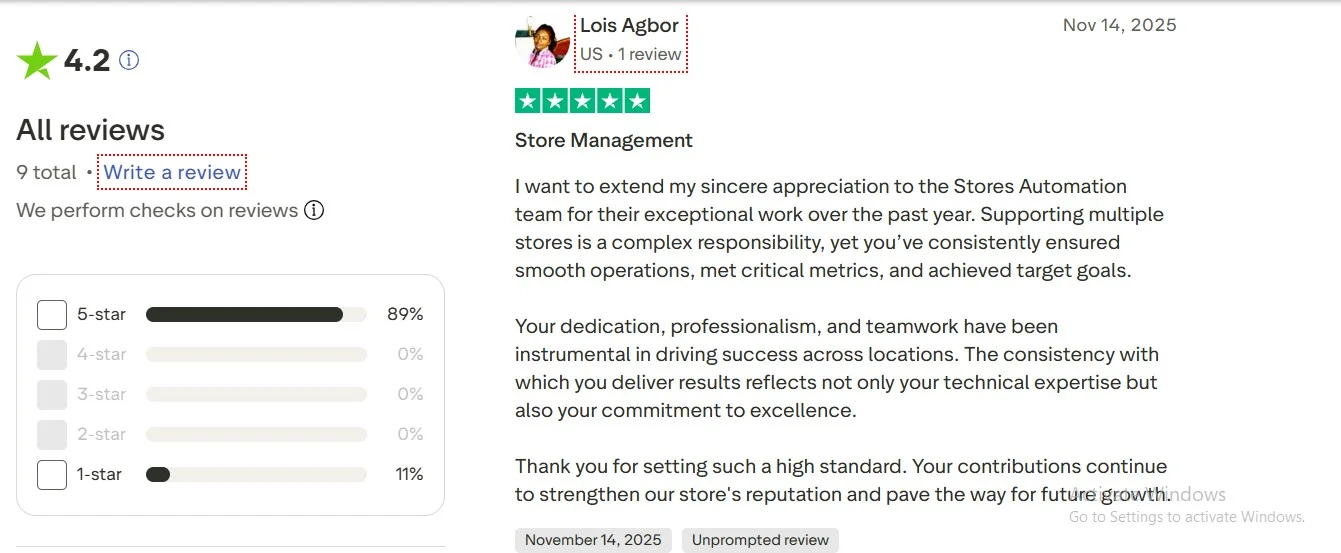
"Store Management"
Lois Agbor describes a year of working with the Stores Automation team supporting multiple stores, noting the team consistently met critical metrics and hit target goals. She writes that their "dedication, professionalism, and teamwork have been instrumental in driving success" across the locations she oversees.

"Highly Recommend for E-Commerce"
James Frank describes working with a Stores Automation account manager on both Walmart and Shopify for close to a year, saying he's "extremely pleased with the results" and pointing specifically to consistent sales growth and responsive, ongoing support across both marketplaces.
Client Video Testimonials
Beyond written reviews, here are two direct video testimonials from Stores Automation clients discussing their experience with the service in their own words.
Client Testimonial — Jamie
Client Testimonial — Jammy
This is exactly the kind of verifiable evidence this guide has argued you should demand from any provider before signing anything — independent reviews on a third-party platform, not just testimonials curated on the company's own site, alongside real clients speaking on camera in their own words.
Frequently Asked Questions About Done-For-You Shopify Stores
Is a done-for-you Shopify store a legitimate business model?
Yes, when structured transparently with a defined scope of services, an itemized setup cost, and a documented profit-split arrangement. The model itself is legitimate; the outcome depends entirely on the specific provider, since quality and transparency vary meaningfully across the industry. Vetting the specific provider against the checklist in this guide matters more than judging the business model as a category.
How much does a done-for-you Shopify store typically cost to start?
Costs vary by provider, but a well-structured setup typically involves a one-time setup fee plus an ongoing monthly ad spend budget you fund separately, rather than a single flat price covering everything indefinitely. Be cautious of any provider quoting tens of thousands of dollars upfront without a clear, itemized explanation of what that covers.
Do I need any prior ecommerce experience to use a DFY Shopify service?
No, prior experience isn't required for a legitimate done-for-you service, since the entire premise is that the provider brings the expertise. That said, understanding the basics covered in this guide — realistic timelines, profit-split math, and red flags — helps you evaluate providers more effectively even without hands-on ecommerce experience yourself.
What happens if my done-for-you Shopify store doesn't make a profit?
This depends entirely on the specific contract terms, which is exactly why reviewing them carefully before signing matters. Some providers offer a testing or optimization period before fully committing to a single product line; others do not guarantee results at all, since no legitimate provider can promise profitability given how much depends on market conditions and product-market fit. Clarify this specifically before paying any setup fee.
Can I take over management of my store later if I started with a DFY service?
This depends on the specific provider's contract terms regarding store and domain ownership, which is one of the checklist items covered earlier in this guide. Confirm before signing whether you retain full ownership and access if you later decide to self-manage, since some arrangements are structured to make an eventual transition to self-management straightforward, while others are not.
What's a reasonable profit split for a done-for-you Shopify service?
A 60/40 split in the client's favor is a common, reasonable benchmark in legitimate agency models, though the exact figure matters less than understanding what it's calculated against. A 50/50 split calculated after all expenses are deducted can net a client more than a 70/30 split calculated on gross revenue before costs. Always ask for the specific calculation method, not just the headline percentage, and run the worked-example math covered earlier in this guide against any offer you're considering.
What's the single best question to ask before signing up with any DFY Shopify provider?
Ask to speak with a current client, arranged independently of the sales process. A provider with genuine, satisfied clients can facilitate this without friction, and hearing directly from someone already using the service tells you more in five minutes than any amount of marketing copy. Pair that conversation with the itemized cost breakdown and profit-split math covered earlier in this guide, and you'll have a genuinely complete picture before committing.
Final Verdict: Is a Done-For-You Shopify Store Worth It?
My verdict, after evaluating this model closely: a done-for-you Shopify store is worth it if you specifically value time savings over full control, you can fund a realistic 3–4 month runway before expecting profitability, and you choose a provider who's transparent about costs, timelines, and results. It is not worth it if you're drawn in by guaranteed income promises, high-pressure upfront costs, or a pitch that frames your own involvement as unnecessary.
The three things worth carrying away from this guide: transparency is the actual checklist to test any provider against — an itemized cost breakdown, a realistic timeline, and real client access, not a general sense of the brand. The profit-split percentage you're quoted isn't your take-home number once ad spend and costs are subtracted first — run the real math before signing. And counterintuitively, a provider who wants your ongoing attention through regular reporting is showing you a stronger trust signal than one promising you'll never need to look at the numbers.
The single most useful habit if you're evaluating this model: ask every provider you're considering the same three questions — an itemized cost breakdown, a real client reference arranged independently, and a worked example of the profit-split math using their actual typical numbers. Providers who answer all three without friction are operating the legitimate version of this model. Providers who can't or won't are showing you exactly what you need to know before paying anything.
Ready for a Transparent, Done-For-You Shopify Store?
Our team handles store setup, product sourcing, supplier vetting, marketing, and daily operations — with a documented profit split, monthly reporting, and no guaranteed-income claims. Just the transparent version of this model.