
If you are wondering selling on Walmart Marketplace, the timing has never been more favourable. Walmart’s online marketplace has grown faster in 2025 than at any point in its history — adding 44,000 new sellers in just the first five months of the year and surpassing 200,000 active sellers globally for the first time. According to Walmart’s own fiscal year 2025 results, US e-commerce sales grew 20% year-over-year, third-party marketplace sales grew 34% in the final quarter, and the platform recorded its highest-ever single-day sales volume during the holiday period.
Despite this explosive growth, the opportunity remains exceptional by comparison to other major marketplaces. Amazon currently hosts approximately 9.7 million sellers against Walmart’s 200,000 — meaning Walmart sellers face roughly 48 times less competition for the same buyer traffic. With 438 million monthly shoppers visiting Walmart.com and a brand trust level that gives sellers instant credibility with US consumers, Walmart Marketplace is one of the most strategically valuable channels any e-commerce business can enter in 2026.
This guide covers everything you need to know: eligibility requirements, the application process, account setup, product listing, fulfilment options, fees, optimization strategies, Walmart dropshipping, and how to scale your store over time.
What Is Walmart Marketplace?
Walmart Marketplace is Walmart’s third-party seller platform, launched in 2009 and available at Walmart.com. It allows independent businesses — brands, resellers, wholesalers, and private label sellers — to list and sell products directly to Walmart’s enormous customer base without any involvement from Walmart’s own buying or merchandising teams.
The model is similar to Amazon’s Marketplace: you create product listings, set your own prices, manage your own inventory and fulfilment, and pay Walmart a referral fee on each completed sale. Walmart handles the website infrastructure, payment processing, customer-facing brand trust, and traffic generation. You handle the products and fulfilment.
Walmart Seller Center is the online portal where all seller operations are managed — listing creation and editing, order management, performance analytics, advertising campaign setup, and account settings. Every Walmart Marketplace seller accesses their business through Seller Center at seller.walmart.com.
Why Sell on Walmart Marketplace in 2026?
Lower Competition Than Amazon
The single most compelling reason to prioritise Walmart Marketplace in 2026 is the competitive landscape. Amazon hosts over 9.7 million registered sellers. Walmart Marketplace has approximately 200,000 active sellers. This 48:1 ratio means that on Walmart, your products face dramatically less competition for organic search visibility, the Buy Box, and buyer attention — even in popular product categories. Sellers who establish strong positions on Walmart now, while competition remains relatively low, will benefit as the platform continues to scale.
438 Million Monthly Visitors
Walmart.com receives approximately 438 million unique monthly visitors — a built-in buyer audience that took Walmart decades of physical retail dominance and brand trust to build. As a third-party Marketplace seller, you immediately access this traffic on your first day live, without any need to build an audience, invest in SEO, or run your own advertising. The platform brings the buyers; your job is to list the right products at competitive prices.
No Monthly Fees
Unlike Amazon, which charges monthly subscription fees for professional seller accounts, Walmart Marketplace has no setup fees, no monthly subscription fees, and no per-order transaction fees. You pay only a referral fee when a product sells — typically 6% to 15% depending on the product category. This makes Walmart Marketplace one of the lowest-risk e-commerce channels to launch on, with no fixed cost commitment while you test and build your catalogue.
Walmart’s Brand Trust
Walmart is one of the most recognised and trusted retail brands in the United States. Customers who shop on Walmart.com bring a pre-existing level of trust in the platform that transfers to the products they discover there — including yours. This brand halo effect gives Walmart Marketplace sellers a credibility advantage that independent e-commerce websites or newer platforms cannot replicate.
Walmart Fulfilment Services (WFS) Advantage
Walmart data shows that sellers using WFS see an average 50% lift in GMV on items tagged as Walmart Fulfilled and 2-Day Shipping. Products with the 2-Day Shipping badge convert significantly better and rank higher in Walmart’s search algorithm — creating a compounding advantage for sellers who invest in fast fulfilment.
Walmart Marketplace Eligibility Requirements
Walmart maintains a selective approval process that is more rigorous than Amazon’s but less restrictive than invitation-only platforms like Target Plus. Understanding the eligibility requirements before applying prevents wasted time and improves your approval chances significantly.
Core Requirements
- Registered US business: You must have a registered US business entity — an LLC, corporation, or sole proprietorship — with a valid US business tax ID (EIN). Personal Social Security Numbers are not accepted
- W-9 or W-8 form: A completed W-9 (for US persons and entities) or W-8 (for foreign entities with US nexus) tax form, along with an EIN Verification Letter from the Department of Treasury confirming your US business address
- E-commerce selling history: Walmart strongly favours applicants with a demonstrated track record of successful e-commerce selling on other platforms — Amazon, eBay, Shopify, or similar. A history of positive seller ratings, consistent fulfilment, and customer service quality significantly improves approval chances
- Compliant product catalogue: Your products must not appear on Walmart’s Prohibited Products Policy list. Review this before applying at marketplace.walmart.com
- Competitive pricing and reliable fulfilment: Walmart expects sellers to offer competitive prices relative to the market and to maintain reliable, fast fulfilment — ideally capable of meeting the 2-day shipping standard
How to Apply and Get Approved When Selling on Walmart Marketplace
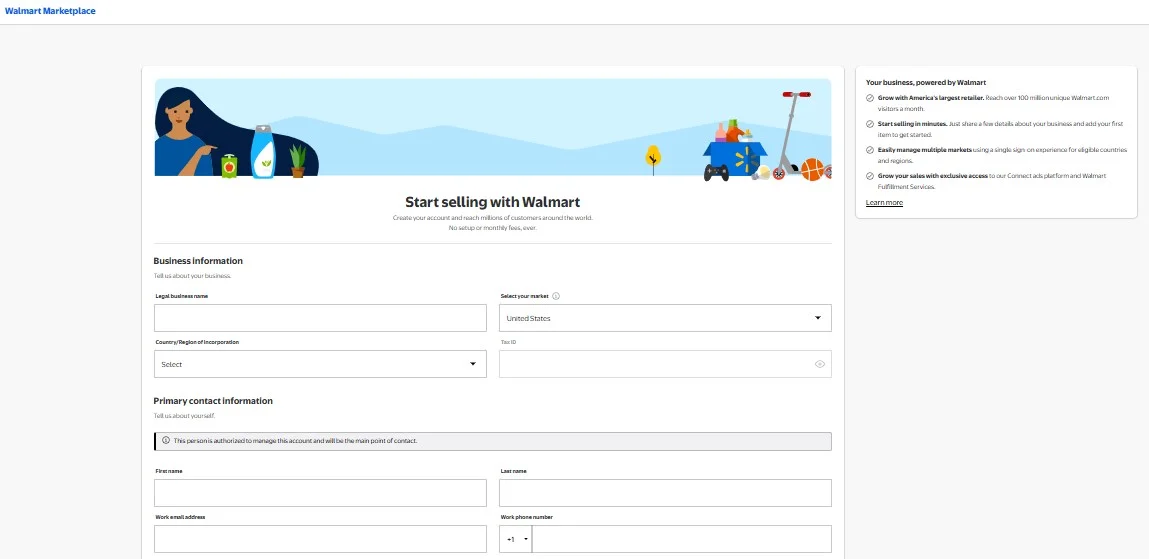
Step 1: Submit Your Seller Application
Go to marketplace.walmart.com and click “Join Marketplace”. The application takes approximately 15 minutes to complete when you have all required documents ready. You will be asked to provide:
- Your legal business name and registered address
- Your US business tax ID (EIN — not SSN)
- W-9 or W-8 form and EIN Verification Letter
- Your planned product integration method
- Primary product categories and estimated catalogue size
- Evidence of e-commerce selling history (links to your Amazon/eBay/Shopify store, sales volume, seller rating)
After submission, approval typically takes between 24 hours and several weeks depending on application completeness and Walmart’s current review queue. Incomplete applications take significantly longer. Providing thorough, accurate information at this stage is the most effective way to accelerate the process.
Step 2: Complete Business Registration
Once your application is approved, you will receive an email inviting you to complete your business registration in Seller Center. At this stage, you will:
- Sign Walmart’s Retailer Agreement — the legal contract governing your seller relationship
- Verify your business identity with Walmart’s compliance team
- Set up your payment details — Walmart pays sellers via ACH direct deposit to a US business bank account
- Configure your tax settings for accurate sales tax collection and remittance
Step 3: Set Up Your Seller Profile
Your seller profile is what buyers see when they view your store on Walmart.com. Complete every field thoroughly:
- Store display name: Choose a clear, professional name that represents your brand accurately. This appears on all your product listings
- Store logo: Upload a high-resolution logo. Professional branding builds buyer confidence
- Customer service information: Set up your customer service email and phone number. Walmart monitors response times as part of seller performance metrics
- Return policy: Configure your return window and conditions. Walmart’s baseline standard is a minimum 30-day return window for most categories
Step 4: Configure Shipping Settings
Shipping configuration directly impacts both your Listing Quality Score and your eligibility for the high-converting 2-Day Shipping badge. In Seller Center, set up shipping templates that define:
- Shipping methods offered: Value, Standard, Expedited. Offering multiple options improves conversion for different buyer needs
- Dispatch time: The number of business days from order placement to shipment. Faster dispatch times improve your search ranking
- Carrier selection: Choose carriers appropriate for your product size and weight categories
- Free shipping threshold: Walmart strongly encourages free shipping offers, which receive preferential algorithm treatment
To qualify for Walmart’s TwoDay Delivery badge — which Walmart’s own data shows drives significantly higher conversion rates — you need to demonstrate consistent on-time delivery at or above Walmart’s performance threshold. Sellers using WFS qualify automatically.
Step 5: Choose Your Fulfilment Method
Walmart offers two primary fulfilment paths, each with distinct advantages:
Option A: Seller-Fulfilled (Self-Fulfilment or 3PL)
In Seller Fulfilment or 3PL, you store inventory yourself or through a third-party logistics provider, and ship orders directly to Walmart customers. You retain full control over your inventory, packaging, and shipping operations. This option works well for sellers with existing warehouse infrastructure, oversized or heavy items that WFS does not accept, or operations where custom packaging is important.
Option B: Walmart Fulfilment Services (WFS)
WFS is Walmart’s equivalent of Amazon FBA. You send inventory to Walmart’s fulfilment centres, and Walmart picks, packs, and ships orders to your customers — handling customer service for fulfilment-related issues. The benefits are significant: automatic 2-Day Shipping badge eligibility, a 50% average GMV lift on enrolled items, lower per-item fulfilment costs (Walmart states WFS runs approximately 15% cheaper than competing providers), and multichannel fulfilment capability for orders from other platforms.
For most sellers building a scalable Walmart Marketplace business, WFS is the recommended fulfilment approach once your product catalogue is validated and selling consistently.
Step 6: Create Your Product Listings
With your account fully configured, creating high-quality product listings is your next priority. You can add products to Walmart Marketplace in three ways:
- Single item setup: Create individual listings through Seller Center. Best for small catalogues or testing specific products
- Bulk upload via spreadsheet: Upload multiple listings simultaneously using Walmart’s item spec template. Best for medium-sized catalogues of 50 to several hundred products
- API integration: Automated listing management through Walmart’s Marketplace API. Best for large catalogues, high-frequency inventory updates, or when connected to a multichannel management platform
Step 7: Run a Pre-Launch Test
Before going fully live, Walmart recommends placing test orders on your own listings to verify the complete buying and fulfilment experience works correctly — from checkout through to delivery confirmation. Testing catches configuration errors before they affect real customers and your performance metrics.
Walmart Marketplace Fees — A Complete Breakdown
Selling on Walmart marketplace involves a few types of fees, mainly referral charges and optional fulfillment expenses.
Referral Fees (per sale): Walmart takes a commission on every sale, which depends on the product category. These fees usually fall between 6% and 15% of the item’s selling price. For instance, Grocery items are charged around 8%, while Apparel & Accessories are about 15%.
Walmart Fulfillment Services (Optional): If you choose WFS, you’ll have to pay extra for storage and order fulfillment. These costs depend on the product’s size, weight, and how long it stays in storage, with additional charges for long-term storage. You can use the WFS Cost Calculator to estimate these expenses.
Return Fees (when applicable): If Walmart handles returns for you (through WFS), there may be fees for processing those returns.
Advertising Fees (Optional): Walmart also provides sponsored ads to increase product visibility. These operate on a pay-per-click (PPC) basis, similar to Amazon. You set your own budget and bids, and the total cost depends on competition and your bidding strategy.
Walmart Dropshipping: What Is Allowed and How It Works
Walmart dropshipping is a fulfilment model where you list products on Walmart Marketplace and fulfil orders from a third-party wholesale supplier who ships directly to your buyers, without you holding any inventory yourself. This model is explicitly permitted by Walmart under their dropshipping policy, provided specific compliance requirements are met.
What Walmart’s Dropshipping Policy Allows
- Purchasing products from a wholesale supplier and having them ship directly to your Walmart customer
- Using a third-party logistics provider or fulfilment centre that holds your inventory on your behalf
- Working with manufacturers and authorised distributors who fulfil orders in plain or your-branded packaging
What Walmart’s Policy Prohibits
- Retail arbitrage fulfilment: Purchasing products from another online retailer — including Amazon, Target, or eBay — and having them ship directly to your buyer. Walmart actively detects this through tracking number origins and buyer complaints about receiving competitor retailer packaging
- Third-party retailer branding in shipments: If a buyer receives an Amazon or Walmart-branded box from their order, this constitutes a policy violation regardless of seller intent
- Misrepresenting yourself as the seller: You must be identifiable as the seller of record on all order documentation
Key Dropshipping Compliance Requirements
- You must be the seller of record on all packing documentation
- You are responsible for accepting and processing all buyer returns — even if the fault lies with your supplier
- Your supplier must ship without any third-party branding, invoices, or marketing materials
- You must maintain Walmart’s performance standards regardless of supplier performance issues
- Dispatch must occur within your stated handling time — typically within two business days for US sellers
What Products to Sell on Walmart Marketplace
Walmart provides a wide range of products across many categories, meeting the needs of different types of customers. Knowing which categories are in high demand can help sellers adjust their strategies to match current market trends. While sales patterns may change due to factors like seasons, promotions, and shifting consumer preferences, some categories consistently perform well.
Top-Selling Categories on Walmart
Focusing on these popular categories can help sellers better satisfy customer demand and improve their performance on the platform:
- Grocery: Everyday essentials such as food and household items, which often see increased demand during times of economic uncertainty.
- Home and Kitchen: Items like cookware, appliances, and home décor that remain consistently popular.
- Cleaning Supplies: Products such as detergents, disinfectants, and general cleaners that are always in demand.
- Personal Care Products: Daily essentials including soap, toothpaste, shaving items, sunscreen, deodorant, and hair care products.
- Baby Care: Necessities like diapers, wipes, baby formula, and baby food, which ensure steady sales.
- Pet Supplies: With more people owning pets, products like pet food, grooming items, and accessories continue to grow in demand.
- Laundry Supplies: Items such as detergents and stain removers that are essential in most households.
- Health and Wellness: Products like vitamins, supplements, and essential oils that reflect the rising focus on health.
- Fitness: Smart fitness equipment and tools, showing the increasing blend of technology and exercise.
- Electronics: A strong category, especially during holidays and major sales events.
For the latest and most detailed list of best-selling products, you can check Walmart Marketplace’s official best sellers page.
Optimising Your Product Listings for Walmart Search
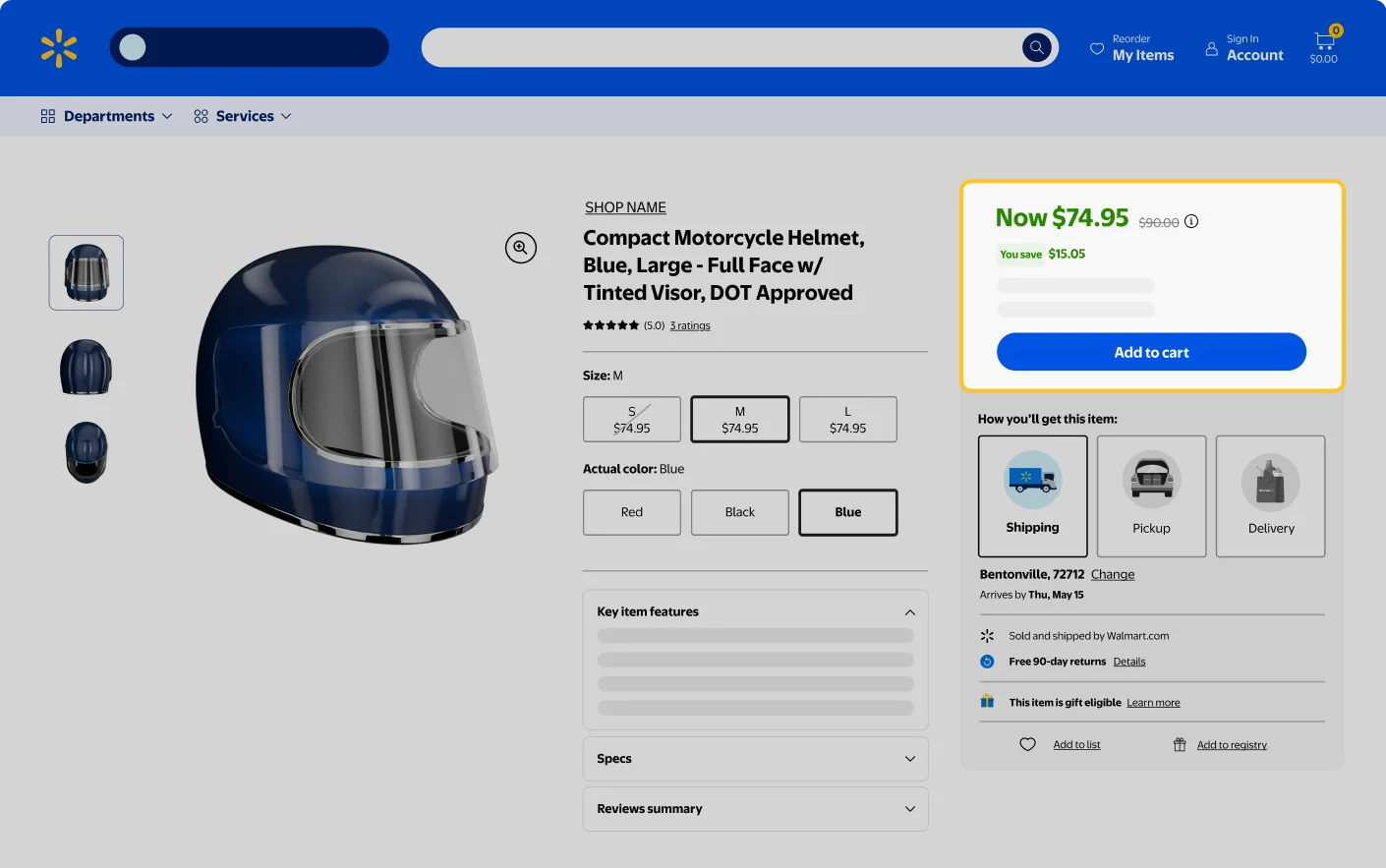
Product listing quality is the single most controllable factor in your Walmart Marketplace performance. Walmart provides sellers with a Listing Quality Score — a rating from 0 to 99 that measures how well-optimised each listing is across multiple dimensions. Higher Listing Quality Scores correlate directly with better search ranking, higher Buy Box win rates, and increased sales. Here is what the algorithm evaluates:
Product Title
Your title is the most important element for Walmart’s search algorithm. It should be 50 to 75 characters, include your primary search keyword near the beginning, and follow this structure: Brand + Product Type + Key Attributes (size, colour, quantity, model).
Weak: “Premium Knife Set”
Strong: “Cuisinart 15-Piece Stainless Steel Kitchen Knife Set with Block”
Research the exact keywords buyers use by reviewing top-performing competitor listings in your category, checking Walmart’s search autocomplete suggestions, and analysing which search terms are driving the most traffic to similar products in Seller Center’s analytics.
Product Images
Walmart requires a minimum of one image but allows up to 20. Use as many as possible — buyers who view multiple images convert at higher rates. Requirements:
- Main image: Product on pure white background, minimum 1000 x 1000 pixels, no text overlays or watermarks
- Additional images: Multiple angles, lifestyle shots showing the product in use, scale reference images, packaging shots, and detail close-ups
- Video: Walmart supports product videos on listings — video listings consistently outperform image-only listings in conversion rate
Product Description and Key Features
The Key Features section (bullet points) and the Product Description serve different but complementary purposes. Use the Key Features bullets — you get up to five — to highlight the top benefits and specifications buyers need to make a purchase decision. Lead each bullet with the most important information rather than burying it in the middle.
The Product Description should expand on the Key Features with more detail about use cases, compatibility, what is included in the package, care instructions, and any other information that reduces buyer uncertainty and pre-empts return triggers.
Categories
Clearly defining your product makes it easier for customers to find. Select the most accurate category so your item is properly classified and includes the correct set of details.
Product Variations:
Take advantage of Walmart’s variation feature to list different options of the same product, such as sizes, colors, or quantities. This helps customers easily choose what suits them best and can lead to higher sales.
Pricing Strategy
Competitive pricing is critical on Walmart Marketplace for two reasons: it is a direct factor in the Buy Box algorithm, and Walmart’s Price Parity Policy requires that your Walmart prices are not higher than the price you offer for the same product on other marketplaces or your own website. Regularly monitor your competitors’ pricing for key products and use dynamic pricing strategies to stay competitive without unnecessarily sacrificing margin.
How to win the Walmart Buy Box
Image Source: Marketplace Learn.Walmart
Walmart’s Buy Box determines which seller’s listing appears with the primary Add to Cart button when multiple sellers offer the same product. Winning the Buy Box is the difference between making the sale and being buried in the listing alternatives. The key factors Walmart’s algorithm uses to determine Buy Box winners are:
- Competitive pricing relative to other sellers on that item
- Fast shipping speed — 2-day shipping is strongly favoured
- High seller performance metrics — on-time delivery rate, cancellation rate, customer satisfaction
- In-stock availability — out-of-stock listings never win the Buy Box
- Positive seller history and review scores
Walmart Seller Performance Metrics — What You Must Maintain
Walmart monitors seller performance through six core metrics. Falling below the acceptable threshold on any of them can result in reduced search visibility, listing suppression, or account suspension. Understanding these metrics and managing them proactively is non-negotiable for sustainable Walmart Marketplace selling in 2026.
On-Time Delivery Rate (OTD)
The percentage of orders delivered by the promised delivery date. Walmart’s minimum threshold is 95%. Late deliveries are one of the most damaging metrics on the platform — they trigger buyer complaints, damage your search ranking, and can result in Walmart removing your Buy Box eligibility. The most reliable way to protect your on-time delivery rate is to set realistic delivery date estimates based on your actual fulfillment capability — never promise faster delivery than your supplier can reliably achieve.
Valid Tracking Rate (VTR)
The percentage of orders for which you upload a valid tracking number within the required timeframe. In 2026, Walmart requires valid tracking on 99% or more of all orders. Upload tracking immediately upon shipment confirmation from your supplier — do not wait. This is one of the easiest metrics to protect but also one where lapses can quickly accumulate if your fulfillment process is not disciplined.
Cancellation Rate
The percentage of orders you cancel — typically due to inventory being out of stock after a buyer has placed an order. Walmart’s maximum is 2% (though aiming for 1.5% is the 2026 gold standard). The most effective prevention is real-time inventory management — ensuring your listing quantities are always accurate and that out-of-stock items are promptly deactivated. For dropshippers, this requires a live inventory feed from your supplier.
Order Defect Rate (ODR) & New 2026 Standards
The Order Defect Rate is the overall measure of your account health, representing the percentage of orders that result in a defect. While the maximum acceptable ODR is 2%, Walmart has introduced specific sub-metrics in 2026 to track quality more granularly:
Item Not Received (INR) Rate (≤ 2%): A new 2026 requirement that tracks how often customers report missing packages. This ensures that “delivered” status actually matches the customer’s experience.
Return Rate – Seller Fault (≤ 6%): This measures items returned due to “not as described,” quality issues, or damaged goods. A high rate signals product quality or listing accuracy problems. Address it by ensuring your listings accurately represent your products and vetting suppliers rigorously.
Negative Feedback Rate (≤ 2%): Previously a “soft” metric, this is now a hard performance standard. You must respond quickly to buyer issues before they escalate to formal complaints to keep this below the 2% cap.
Pro Tip: If you find these thresholds difficult to maintain with self-fulfillment, consider moving your top-selling SKUs to Walmart Fulfillment Services (WFS). WFS-enrolled items are automatically protected from OTD and VTR defects, effectively “insuring” your account health against logistics errors
Orders and returns
Handling orders and returns efficiently is key to maintaining strong performance and earning customer trust. Walmart has strict standards focused on convenience, so sellers need to manage post-purchase processes quickly and carefully.
Managing Orders and Cancellations
Orders placed on Walmart Marketplace appear in Seller Center, where you can manage the entire process from fulfillment to delivery. You can handle orders manually or use automation tools and integrations.
Best practices for order management:
- Acknowledge orders quickly: Prompt confirmation helps maintain good performance metrics.
- Ship on time: Orders must be shipped within the promised handling time.
- Provide tracking: Every order should include a valid tracking number before the shipping deadline.
Cancellations should be kept to a minimum. High cancellation rates can lead to losing the Buy Box, reduced visibility, or even account suspension. If a cancellation is unavoidable (such as stock issues), process it quickly through Seller Center and clearly state the reason.
Walmart Return Policies and Seller Responsibilities
Walmart generally offers a 30-day return window for most items, although some categories like electronics or apparel may have different rules. Sellers are expected to follow these policies unless given special approval.
- With Walmart Fulfillment Services (WFS): Walmart manages returns, including receiving items and issuing refunds automatically.
- With self-fulfillment: Sellers must provide return shipping labels and process refunds promptly.
Key return requirements:
- A valid U.S. return address is required (no P.O. boxes or restricted locations like Alaska, Hawaii, or U.S. territories).
- Return shipping must be free for customers, with no restocking fees unless exceptions apply.
- In-store returns can be enabled but may not apply to oversized or restricted items.
- Refunds are usually issued once the return is scanned by the carrier, though Walmart may sometimes refund customers directly.
- “Keep It” rules can be used for low-value or non-resellable items you don’t want returned.
Failure to follow return policies—such as incomplete information or charging return fees—can result in penalties or Walmart stepping in to resolve the issue in favor of the customer.
Walmart Marketplace Advertising
Organic search performance is the foundation of a successful Walmart Marketplace business — but Walmart Connect, the platform’s advertising system, provides powerful tools for accelerating product visibility and sales velocity, particularly for new listings that have not yet built organic ranking history.
Sponsored Products
Sponsored Products are pay-per-click ads that place your product listings in premium positions within Walmart’s search results and product detail pages. You set a keyword bid and a daily budget — you only pay when a shopper clicks your ad. Sponsored Products are the most widely used and most effective advertising format on Walmart Marketplace for most sellers, particularly for driving initial sales on new product listings before organic ranking momentum builds.
Sponsored Brands
Sponsored Brand ads — available to sellers enrolled in Walmart’s Brand Portal as registered brand owners — appear at the top of search results and showcase your brand logo, a custom headline, and featured products. They are particularly effective for building brand awareness across your catalogue and for driving buyers to your Walmart brand store rather than individual product listings.
How to Approach Advertising as a New Seller
For new Walmart Marketplace sellers, start with Sponsored Products campaigns on your best three to five listings — the products most likely to convert based on price competitiveness, listing quality, and category demand. Begin with automatic targeting to identify which keywords drive the most clicks and conversions, then shift to manual keyword targeting to optimise bids on your highest-performing search terms. Monitor your Advertising Cost of Sales (ACoS) weekly and adjust bids and budgets based on which campaigns are delivering profitable returns.
Performance Metrics and Analytics for Marketplace Sellers
To evaluate how well your Walmart Marketplace business is performing, it’s important to keep track of key metrics and data. Here are some of the most important ones:
- Sales Revenue: Monitor your total revenue to understand how your business is growing and to get a clear picture of overall financial performance.
- Conversion Rate: Measure how many visitors actually make a purchase. A higher conversion rate means your product listings are effectively turning interest into sales.
- Customer Satisfaction: Keep an eye on customer reviews and feedback. Positive ratings help build trust and can attract more buyers.
- Inventory Levels: Regularly check your stock to make sure you can meet demand. Good inventory management helps avoid running out of products and losing sales. A good inventory management software can be very helpful in this.
- Shipping and Fulfillment: Track how efficiently orders are processed and delivered. Fast and reliable shipping plays a key role in keeping customers satisfied.
By consistently monitoring these metrics, you can spot areas that need improvement, streamline your operations, and make informed decisions to grow your business on Walmart Marketplace.
How to Scale Your Walmart Marketplace Business
Selling on Walmart Marketplace can be very profitable, but it takes the right approach and consistent performance to succeed. Here are some key strategies to help you grow your business:
- Set Competitive Prices: Walmart often highlights the lowest-priced offers in search results and the Buy Box. Using automated repricing tools can help you stay competitive while still protecting your profit margins.
Expand Your Catalogue Strategically: Walmart Marketplace rewards sellers with broad, well-organised catalogues across related product categories. Once you have validated two or three products, systematically expand into complementary items that serve the same buyer. A seller of kitchen knives expands into cutting boards, knife sharpeners, and kitchen storage. Category depth signals commercial credibility to Walmart’s algorithm and increases the likelihood of winning the Buy Box on related searches.
Use Walmart’s New AI-Powered Seller Tools: Walmart launched a suite of AI-powered seller tools at its 2025 Sellers Summit, including an AI smart assistant for sellers that provides real-time guidance on listing optimisation, pricing strategy, and performance improvement recommendations. Sellers who integrate these tools into their regular workflow gain a compounding operational advantage as the platform continues to invest in AI-driven seller support.
- Optimize Product Listings: Improve your visibility by using relevant keywords in your titles. Write clear, detailed descriptions that highlight key features and benefits, and include high-quality images to attract buyers.
- Use Walmart Fulfillment Services (WFS): WFS can simplify operations and boost sales. It offers benefits like 2-day shipping, better Buy Box placement, and reduced workload since Walmart handles storage and returns.
- Maintain Strong Seller Performance: Consistently meet performance standards such as on-time shipping, low defect rates, and responsive customer service. High-performing sellers are rewarded with better visibility.
- Leverage Sponsored Ads: Running pay-per-click (PPC) ads—especially during seasonal periods—can increase product visibility and drive more conversions. Walmart Connect is a useful tool for promoting your listings.
- Track and Optimize Performance: Regularly review your metrics using Walmart Seller Center analytics. Monitor conversion rates, traffic sources, and competitor activity to make informed improvements.
By applying these strategies and continuously optimizing your approach, you can increase sales and build a successful presence on Walmart Marketplace.
How Stores Automation Helps You Earn Passive Income from Walmart
Running a Walmart store can be complex and time-consuming — managing inventory, orders, and sales across multiple channels is a full-time job. That’s where Stores Automation comes in.
We provide “done-for-you” Walmart store automation services, so you don’t have to lift a finger. From inventory management to order fulfillment and pricing optimization, our system handles everything automatically.
With Stores Automation, you can:
Run a fully automated Walmart store with minimal effort.
Earn passive income while our technology and experts manage your operations.
Optimize profits with automated pricing, promotions, and inventory control.
Stop worrying about day-to-day store management — let Stores Automation do the work, and watch your Walmart business generate income effortlessly.
Final Thoughts: Selling on Walmart Marketplace
Walmart Marketplace has become a strong platform for sellers looking to expand their reach, increase sales, and grow their business. However, success doesn’t come automatically—it requires the right strategy, consistent performance, optimized listings, efficient order management, and effective marketing. By leveraging the available tools and services, and continuously improving your operations, you can build a sustainable and profitable presence on Walmart Marketplace over the long term.