

If you’re considering starting an online store, Shopify is one of the most popular eCommerce platforms for sellers worldwide. Its user-friendly interface, robust features, and scalability make it an attractive option for beginners and experienced entrepreneurs alike. However, before launching your store, it’s crucial to understand Shopify fees—the costs associated with running your business on this platform.
Knowing how much does shopify cost upfront can help you plan your budget effectively, avoid unexpected expenses, and maximize your profits. Many new sellers overlook the variety of costs involved, from monthly subscription fees to transaction charges and additional app expenses. These can add up quickly if not accounted for.
In this comprehensive guide, we will break down how much it costs to sell on Shopify in 2026, including a detailed look at pricing plans, transaction fees, optional costs, and tips to reduce expenses. By the end of this article, you’ll have a clear understanding of the financial commitment required to run a Shopify store, helping you make informed decisions for your business.
If you’d rather skip the setup and launch faster, explore how a done-for-you Shopify store works in 2026.
Overview of Shopify Fees
Before launching a Shopify store, understanding the different types of fees is essential. Shopify charges fees in several categories, and these costs vary depending on your chosen plan, payment method, and additional features. Being aware of these fees helps sellers budget accurately and optimize their profits.
Monthly Subscription Fees
The first cost to consider is the monthly subscription fee. Shopify offers multiple pricing plans, each providing different features and support levels. The plan you choose determines your base cost, access to advanced tools, and transaction fee rates.
Transaction Fees
Shopify applies transaction fees on each sale, which depend on your subscription plan and whether you use Shopify Payments or a third-party payment gateway. These fees typically range from 0.5% to 2% per transaction. Using Shopify Payments can reduce or eliminate additional transaction fees, making it a cost-effective option for many sellers.
Payment Processing Fees
In addition to transaction fees, sellers must consider payment processing fees. These are charged by the payment gateway you use, such as Shopify Payments, PayPal, or Stripe, and usually range between 2.4% and 2.9% per transaction plus a fixed fee per sale. These fees are separate from Shopify’s subscription or transaction fees.
Optional and Add-On Fees
Beyond the base costs, many Shopify sellers incur additional expenses for apps, premium themes, custom domains, and marketing tools. While optional, these add-ons can enhance your store’s functionality and customer experience but also increase overall costs.
Key Takeaway:
Shopify fees are not limited to a single monthly payment. Sellers must account for subscription plans, transaction and payment processing fees, and potential add-ons. Understanding these categories ensures a realistic picture of the total cost of selling on Shopify.
Explore trending beauty and cosmetic products for 2026 and find high-demand items perfect for boosting your online store’s sales.
How Much Does it Cost to Sell on Shopify?
Shopify Subscription Plans
Shopify Starter Plan
While Shopify’s core ecommerce pricing plans are the most common choice for online stores, Shopify also offers a Starter plan that lets entrepreneurs sell through social media, messaging apps, and simple product links. This plan is significantly cheaper than full online store plans and is ideal for sellers who don’t need a full website immediately.
Key Features:
Affordable entry point (as low as $5/month in some markets)
Sell via Instagram, Facebook, TikTok, and messaging apps
Simple buy button & checkout link functionality
Works well for early-stage sellers or micro-businesses
Best For:
Beginners or side-hustle sellers who want to test demand and generate sales before investing in a full online storefront.
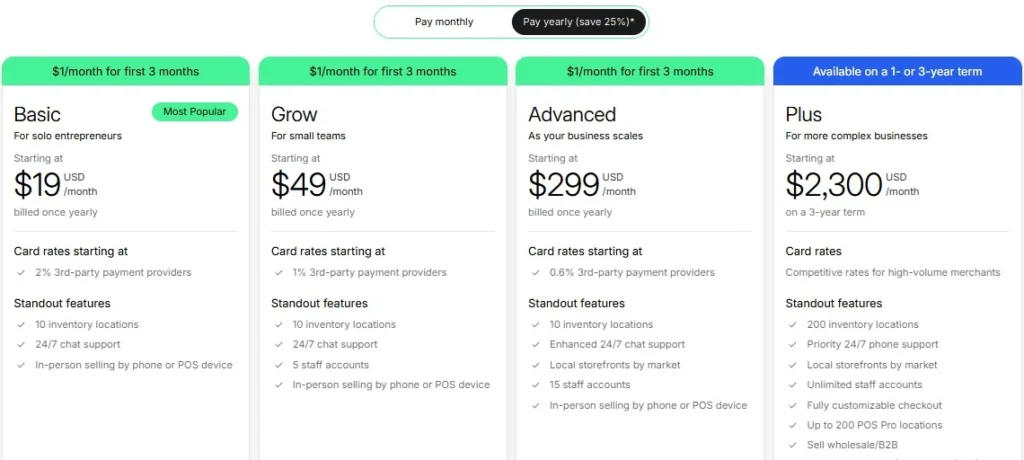
Basic Shopify Plan
Price:
$19/month (if billed annually — Shopify’s recommended pricing)
$25/month (billed monthly)
Who It’s For:
New ecommerce sellers launching their first online store.
Key Features:
Fully hosted online storefront (no coding required)
Unlimited products and file storage
SSL certificate for secure checkout
24/7 customer support via chat and email
Up to 10 inventory locations
Abandoned cart recovery (helps recover lost sales)
Sell on multiple channels (online store, social media)
Discount codes & promotional tools
Basic analytics dashboard
In-person selling via Shopify POS
Shipping discounts (up to ~77%)
Payment Fees (Shopify Payments):
2.9% + 30¢ per online transaction
2.6% + 10¢ for in‑person sales
2.0% fee if using a third‑party payment provider instead of Shopify Payments
This plan gives you everything needed to start selling online without advanced reporting or heavy customization.
Shopify Grow Plan
Price:
$49 USD per month (if billed annually)
$65 USD per month (if billed monthly)
Who It’s For:
Stores with increasing sales volume that need better reporting and lower fees.
Key Features Include:
Everything included in Basic Shopify
Up to 5 staff accounts (for team collaboration)
Professional reporting tools for business insights
Better shipping discounts and shipping insurance
Improved ecommerce analytics
Support for multiple sales channels (online store + marketplaces)
Lower third-party payment fee (1.0% if not using Shopify Payments)
Payment Fees (Shopify Payments):
2.7% + 30¢ per online sale
2.5% + 10¢ for in‑person transactions
Third‑party payment fees reduced to about 1.0%
This plan is ideal when your store has steady traffic and you want deeper insights and better fee structures.
Advanced Shopify Plan
Price:
$299 USD per month (if billed annually)
$399 USD per month (if billed monthly)
Who It’s For:
Established sellers with high sales volume, complex inventory, or advanced fulfillment needs.
Key Features Include:
All Shopify plan features
Up to 15 staff accounts
Third-party calculated shipping rates (real-time carrier rates at checkout)
Enhanced inventory and fulfillment tools
Local storefronts by markets (sell internationally with localized settings)
Higher shipping discounts (up to ~88%)
Advanced analytics and reports
Payment Fees (Shopify Payments):
2.5% + 30¢ online
2.4% + 10¢ in‑person
0.6% fee if using a third‑party payment provider
Advanced Shopify is tailored for merchants who need real‑time shipping insights, more team access, and deeper reporting.
Shopify Plus Plan
Price:
Starting at $2,500 USD per month on a 1‑year contract
Around $2,300 USD per month on a 3‑year contract
May include a variable platform fee depending on revenue and business model
Who It’s For:
High‑volume sellers, enterprise brands, and stores requiring advanced customization, wholesale/B2B tools, and priority support.
Key Features Include:
Unlimited staff accounts
Up to 200 inventory locations
Fully customizable checkout experience
Shopify POS Pro (multiple POS locations included)
Built-in B2B and wholesale features
Unlimited staging stores for testing and development
Managed Markets for global sales with localization tools
Priority 24/7 phone support
Access to advanced analytics tools such as ShopifyQL
Transaction Fees:
Shopify Plus often negotiates lower card processing fees, but exact rates depend on region and sales volume.
This plan is designed for merchants who need enterprise‑grade performance, flexibility, and support.
Want to expand beyond cosmetics? Learn how to dropship from AliExpress to Shopify with this complete 2026 guide.
Start a free trial and enjoy 3 months of Shopify for $1/month
🚀 Start Shopify TrialTrusted by over 2,000,000 businesses worldwide
Designs and Templates Fees
Shopify allows sellers to design their online store using pre-built themes available in the Shopify Theme Store. These themes control the layout, branding, and overall user experience of your store.
Shopify currently offers both free and paid themes. Free themes are suitable for beginners and small stores, while paid themes provide advanced design flexibility and built-in features.
-
Shopify offers approximately 10+ free themes
-
There are 70+ paid themes available in the official theme marketplace
-
Paid Shopify themes typically cost between $150 and $350 (one-time payment)
Some premium themes are sold by third-party theme developers such as Pixel Union, Out of the Sandbox, and Archetype. These themes often include advanced customization options, enhanced performance, and additional support.
-
Third-party premium themes can cost up to $500 as a one-time fee
There are no recurring charges for Shopify themes. Once purchased, the theme can be used indefinitely on a single store. However, switching themes later may require additional customization or development work.
Key Insight:
Themes are a one-time cost, but premium designs can significantly impact conversion rates, branding, and user experience.
Shopify Transaction Fees
Whenever a sale is made on Shopify, a transaction fee may apply. This fee is charged on top of payment processing fees and depends on whether you use Shopify Payments or a third-party payment provider.
Transaction fees are calculated as a percentage of the order value, and the rate decreases as you upgrade your Shopify subscription plan.
Transaction Fees by Plan (Using Shopify Payments)
-
Basic Shopify Plan:
2.9% + $0.30 per transaction -
Shopify Plan:
2.7% + $0.30 per transaction -
Advanced Shopify Plan:
2.5% + $0.30 per transaction
This means higher Shopify plans offer lower transaction fees, which can result in significant savings for high-volume sellers.
Third-Party Payment Gateway Fees
If you choose to use a third-party payment provider instead of Shopify Payments, Shopify charges an additional transaction fee:
-
Basic Shopify: 2.0%
-
Shopify Plan: 1.0%
-
Advanced Shopify: 0.6%
Key Insight:
Using Shopify Payments eliminates extra transaction fees, making it the most cost-effective option for most sellers.

Explore the best print-on-demand jewelry suppliers in 2026 to expand your beauty store with unique accessories
Shopify Payment Processing Fees
Payment processing fees are charged by the payment gateway when a customer completes a purchase. These fees apply regardless of whether the transaction is online or in-person.
Shopify supports multiple payment methods, including credit cards, debit cards, digital wallets, and local payment providers. Each payment provider has its own fee structure.
Online Credit Card Processing Fees
When customers pay online using Shopify Payments, the following fees apply:
Basic Shopify: 2.9% + $0.30
Shopify Plan: 2.7% + $0.30
Advanced Shopify: 2.5% + $0.30
In-Person Payment Processing Fees
For in-person transactions using Shopify POS and card readers:
Basic Shopify: 2.7% + $0.30
Shopify Plan: 2.5% + $0.30
Advanced Shopify: 2.4% + $0.30
Alternative Payment Providers
Payment gateways such as PayPal, Klarna, Clearpay, Apple Pay, and Google Pay may charge additional or separate fees based on their own pricing structures.
Key Insight:
Payment processing fees are unavoidable, but choosing the right Shopify plan and payment provider can significantly reduce overall selling costs.
Get inspired by top Shopify T-shirt store examples in 2026 and learn how successful brands design high-converting product pages.
Shopify Domain Fees
Every Shopify plan includes a free myshopify.com subdomain when you create your store. This allows you to launch and test your store without purchasing a custom domain.
However, most sellers choose to use a custom domain name to improve brand credibility and customer trust.
-
Custom domains can be purchased directly through Shopify or from third-party registrars
-
Domain pricing depends on the extension (e.g., .com, .store, .co, .io)
Typical domain costs:
-
Standard domains usually cost between $11 and $20 per year
-
Premium or specialty domains can cost up to $81 or more per year
Domain renewal fees are charged annually. Prices may increase depending on the domain provider and extension chosen.
Key Insight:
Using a custom domain is not mandatory, but it is strongly recommended for branding, SEO, and customer confidence.
Shopify App Fees
Shopify offers a large app ecosystem that allows merchants to extend store functionality beyond the core platform features. Apps can help with marketing, SEO, reporting, inventory management, accounting, customer support, and automation.
-
The Shopify App Store includes thousands of apps
-
Some apps are completely free
-
Others charge monthly subscription fees or usage-based pricing
Typical app pricing:
-
Free apps: $0 per month
-
Paid apps: $5 to $100+ per month
-
Advanced enterprise apps can exceed $300 per month
Some apps offer free trials, while others charge based on usage (orders, emails, or customers).
Key Insight:
While apps can increase efficiency and conversions, installing too many paid apps can significantly raise monthly Shopify costs.
Shopify Email Fees
Shopify includes a built-in email marketing tool called Shopify Email, available on all subscription plans.
Each Shopify plan includes a monthly free email allowance.
-
2,500 free emails per month are included
-
Each additional email costs $0.001
Shopify automatically provides a cost estimate before sending emails that exceed the free monthly limit, allowing merchants to control spending.
Example:
Sending 10,000 emails in a month would cost approximately $7.50 beyond the free allocation.
Key Insight:
Shopify Email is cost-effective for small to medium businesses and eliminates the need for third-party email tools in many cases.
Find the best third-party logistics providers to help scale your Shopify business through fast, reliable, and cost-effective order fulfillment.
Start a free trial and enjoy 3 months of Shopify for $1/month
🚀 Start Shopify TrialTrusted by over 2,000,000 businesses worldwide
Shopify Marketplace Connect Fees
Shopify Marketplace Connect allows merchants to integrate their Shopify store with major online marketplaces such as Amazon, eBay, and Walmart. This feature helps centralize inventory, orders, and product listings.
Pricing Structure:
-
The first 50 marketplace orders synced to Shopify each month are free
-
Orders beyond this limit incur a 1% transaction fee per order
There is a monthly fee cap:
-
Merchants are never charged more than $99 per month, regardless of the number of synced orders
This pricing structure ensures predictable costs even for high-volume marketplace sellers.
Key Insight:
Marketplace Connect fees scale with usage but remain capped, making it a cost-controlled solution for multi-channel selling.
Shopify Shipping Fees
Shopify includes an integrated shipping solution that allows merchants to purchase and print shipping labels directly from the Shopify admin dashboard. This feature helps streamline order fulfillment and reduce shipping costs.
Merchants can access discounted shipping rates from major carriers, including:
-
DHL Express
-
UPS
-
USPS
-
Canada Post (for Canadian sellers)
Depending on the Shopify plan and shipping destination, discounts can reach up to 77% off standard carrier rates.
Shipping Insurance (Beta Feature)
Shopify has introduced a shipping protection beta feature for eligible Shopify Shipping labels.
-
Merchants receive up to $200 coverage per eligible shipment
-
Coverage applies in cases of lost or damaged packages
-
This protection helps reduce financial risk for both sellers and customers
Key Insight:
Shopify Shipping discounts and built-in protection can significantly lower fulfillment costs, especially for businesses shipping high order volumes.
Shopify Tax Fees
Managing sales tax can be complex, particularly for businesses selling across multiple regions. Shopify Tax is designed to automate and simplify tax calculations.
Shopify Tax provides:
-
Accurate tax calculations at checkout
-
Product-specific tax rate handling
-
Address-based tax calculations
-
Automatic updates for tax rate changes, regulation updates, and tax holidays
-
Centralized tax tracking within the Shopify admin
Shopify Tax Pricing (U.S. Merchants)
-
The first $100,000 in U.S. online sales per calendar year with tax calculations is free
-
After exceeding this threshold, Shopify charges 0.35% per transaction
-
Fees are capped at $0.99 per order
-
Annual Shopify Tax fees are capped at $5,000 per year
This capped pricing structure helps prevent tax calculation fees from scaling uncontrollably as sales increase.
Key Insight:
Shopify Tax automates compliance while keeping costs predictable for growing businesses.
Master proven tactics for driving high-quality traffic to your Shopify store using SEO, social media, paid ads, and influencer marketing.
Shopify & VAT (Value Added Tax)
For merchants selling to customers in the European Union and other VAT-regulated regions, VAT compliance is a critical requirement.
Shopify assists with VAT management by:
-
Automatically calculating VAT rates based on the customer’s location
-
Applying VAT rules depending on the product type
-
Supporting VAT-inclusive and VAT-exclusive pricing
-
Helping merchants remain compliant with EU VAT regulations
Shopify also applies VAT to its own subscription and service fees in applicable regions. This VAT is charged based on the merchant’s billing address and local tax laws.
Key Insight:
Automated VAT calculations reduce compliance risks and minimize manual tax errors for international sellers.
Shopify Point of Sale (POS) Fees
Shopify’s Point of Sale (POS) system allows merchants to sell products in physical locations while keeping inventory, customers, and orders synced with their online store.
Shopify POS Lite
-
Included free with all Shopify subscription plans
-
Supports in-person payments and basic inventory tracking
-
Suitable for pop-ups, events, and small retail setups
Shopify POS Pro
For merchants who need advanced in-store capabilities, Shopify offers POS Pro.
-
$89 USD per month per location
-
Faster checkout workflows
-
Advanced staff roles and permissions
-
Detailed in-store inventory and sales reporting
-
Enhanced omnichannel selling tools
POS Pro is typically used by brick-and-mortar retailers or businesses operating multiple physical locations.
Key Insight:
POS Lite is sufficient for basic in-person selling, while POS Pro is designed for retailers with complex operational needs.
Stay ahead of the curve with trending, high-demand products to sell on your Shopify store in 2026.
How to Reduce Shopify Seller Fees
Reducing Shopify seller fees is essential for maximizing profit margins and scaling your e-commerce business efficiently. While Shopify provides a powerful platform, unchecked fees—like transaction costs, app subscriptions, and payment processing charges—can quietly eat into earnings. Fortunately, with smart strategies, you can significantly reduce these expenses and improve overall profitability.
Use Shopify Payments
One of the easiest and most impactful ways to lower fees is by using Shopify Payments instead of third-party gateways like PayPal or Stripe. Shopify charges extra transaction fees (0.5%–2%) when you use external processors—switching to Shopify Payments eliminates those surcharges entirely.
Choose the Right Plan
Evaluate your store’s sales volume and plan tier. Higher Shopify plans often come with lower transaction and credit card processing rates, which can save money as your revenue grows. Sometimes the added subscription cost is offset by these lower fees.
Review and Consolidate Apps
App subscriptions can quietly add up. Regularly audit your installed apps and remove those with overlapping features or low ROI. Consolidating functionality into one all-in-one solution can cut monthly costs and improve site performance.
Audit Fees Regularly
Make it a habit to review Shopify’s fee reports to identify patterns and unexpected costs. This can highlight opportunities to encourage more cost-effective customer behaviors—like using low-fee payment methods.
Reduce Refunds & Chargebacks
Chargebacks and refunds not only hurt revenue but often incur non-refunded processing fees. Clear return policies, quality product descriptions, and fraud tools can minimize these occurrences.
Optimize Theme Costs
While Shopify offers free themes with basic functionality, many sellers invest in premium themes ($150–$350 one-time) for better design and conversions. To reduce these costs:
Start with a free theme and customize as you grow.
Avoid unnecessary premium features that don’t directly boost sales.
Use lightweight, performance-optimized themes that reduce the need for paid speed-boosting apps.
By strategically optimizing your payment setup, plan choice, and app usage, you’ll see more of every sale stay in your pocket—boosting profit without compromising growth.
Start a free trial and enjoy 3 months of Shopify for $1/month
🚀 Start Shopify TrialTrusted by over 2,000,000 businesses worldwide
Discover the best Shopify dropshipping suppliers in 2026 to scale your store efficiently and boost profits.
Overall Financial Pros to Selling on Shopify
Selling on Shopify isn’t just about having an online store — it’s about financial efficiency, scalability, and profit optimization. Whether you’re a beginner or seasoned ecommerce seller, Shopify offers financial advantages that help merchants retain more revenue and grow sustainably.
Lower Long-Term Operating Costs
Unlike marketplace models with variable commissions up to 20% per sale, selling on Shopify means fixed monthly plans and predictable fees. This structure helps merchants forecast expenses and profits more accurately without surprising deductions per item sold.
Better Profit Retention
Shopify allows you to keep more of every sale — especially when you use Shopify Payments to avoid third-party transaction fees. Eliminating extra fees (0.5%–2%) by using Shopify’s integrated payment solution directly increases your net income per order.
Scalability That Reduces Marginal Costs
As your sales grow, Shopify scales with you. With more orders and higher GMV (Gross Merchandise Volume), the cost per sale effectively decreases because fixed platform costs spread over more revenue — improving overall margins as your business expands.
Multi-Channel Revenue Streams
Shopify enables multi-channel selling — syncing products and orders across social media, marketplaces, and your online store from one dashboard. This increases your sales opportunities without proportionally increasing operational costs, leading to higher revenues and better ROI on marketing spend.
Control Over Pricing & Promotions
With Shopify, you set your own pricing, discounts, and sales strategies — giving you control over margins and profitability. You’re not competing with platform rules on pricing or forced promotions like many marketplaces require.
Long-Term Brand Equity
Owning your Shopify store means building brand value and customer loyalty rather than renting exposure from third-party marketplaces. This translates to higher lifetime customer value (LTV) and a more sustainable business model.
Learn how to connect Shopify to Instagram to enable product tagging, boost visibility, and drive more sales through social shopping.
Final Thoughts: Shopify Fees
Understanding the full range of Shopify costs is essential for determining whether this ecommerce platform can support your business’s profitability goals. While Shopify is widely chosen for its powerful tools, ease of use, and scalability, its fees directly influence your margins and long-term sustainability.
From subscription plans and transaction fees to apps, shipping, and taxes, each Shopify cost plays a role in how efficiently your store operates. Evaluating these expenses in advance allows you to set realistic pricing, manage overhead, and plan growth more effectively.
By using the information outlined in this guide, you can better assess whether Shopify’s fee structure aligns with your sales targets and business model. This clarity helps you avoid unexpected expenses and make more informed decisions as your store grows.
FAQ: Shopify Fees
How much does it cost to sell on Shopify?
The cost to sell products on Shopify varies based on the plan and features used.
At a minimum, sellers pay:
$25/month (Basic Shopify, monthly billing)
Payment processing fees starting at 2.9% + $0.30 per transaction
Optional costs such as apps, domains, and shipping
For small stores, total monthly costs typically range from $25 to $100. Larger or high-volume stores may spend significantly more depending on tools and transaction volume.
Is Shopify $1 dollar for 3 months?
Yes, Shopify occasionally offers a promotional trial where new users can access the platform for $1 per month for the first 3 months after completing the free trial.
This promotion:
Is only available to new Shopify accounts
Provides access to most core features
Automatically converts to standard pricing after the promotional period
Availability and terms may vary by region and time.
How do I avoid fees on Shopify?
You cannot completely avoid Shopify fees, but you can reduce them significantly.
Ways to minimize fees include:
Using Shopify Payments to avoid extra transaction fees
Choosing the right subscription plan based on sales volume
Limiting paid apps and removing unused tools
Staying within free limits for email and tax calculations
Optimizing shipping and fulfillment costs
Smart optimization helps control costs without limiting growth.
What happens if I never pay Shopify?
If you don’t pay Shopify after your trial or billing period ends, your store will be paused and inaccessible to customers until payment is completed. Shopify retains your store data for a limited time so you can reactivate it by settling the balance, but extended nonpayment may lead to permanent closure.
Does Shopify charge a monthly fee?
Yes, Shopify charges a monthly fee to operate your store. The initial Shopify plan starts at $5 per month.
Need Help? Let’s Build Your Shopify Store the Smart Way With – Stores Automation
Why build alone when you can have a team do it for you? At Stores Automation, we create fully automated, done-for-you Shopify stores that are designed to grow while you focus on profits. No tech stress, no guesswork—just a streamlined system that works for you 24/7.
From store setup to product integration, branding, and automation—we handle everything so you don’t have to.
Call us: 302-204-8244
Email us: info@storesautomation.com
Sign up here and let us take it from there.
Let’s build you a store that runs on autopilot—because your time is better spent earning.