
💡 Key Takeaways
- Amazon controls 40.4% of US e-commerce; Walmart is the fastest-growing challenger, now firmly America's #2 online marketplace.
- Walmart charges no monthly subscription fee and lower referral fees — but has a smaller, more selective seller base.
- Amazon's approval process is instant; Walmart's application takes 2–4 weeks and includes manual vetting.
- Amazon FBA is the most mature fulfilment programme available; Walmart Fulfilment Services (WFS) is growing rapidly and more cost-effective for many categories.
- Walmart has significantly less seller competition — the same product can rank on page one at Walmart far faster than on Amazon.
- The smartest sellers in 2026 are not choosing between the two — they are selling on both simultaneously.
- Walmart's growing online customer base now exceeds 120 million monthly unique visitors, making it impossible to ignore.
📚 Table of Contents
- Platform Overview: Amazon vs Walmart Marketplace
- Market Share and Customer Reach
- Seller Approval and Onboarding
- Fee Structures Compared Side by Side
- Fulfilment Options: FBA vs WFS
- Seller Competition and Buy Box Dynamics
- Listing Requirements and SEO
- Advertising and Promotion Tools
- Seller Performance Standards
- Which Platform Is Right for You?
- Why the Best Sellers Use Both Platforms
- Real Client Results with Stores Automation
- Frequently Asked Questions
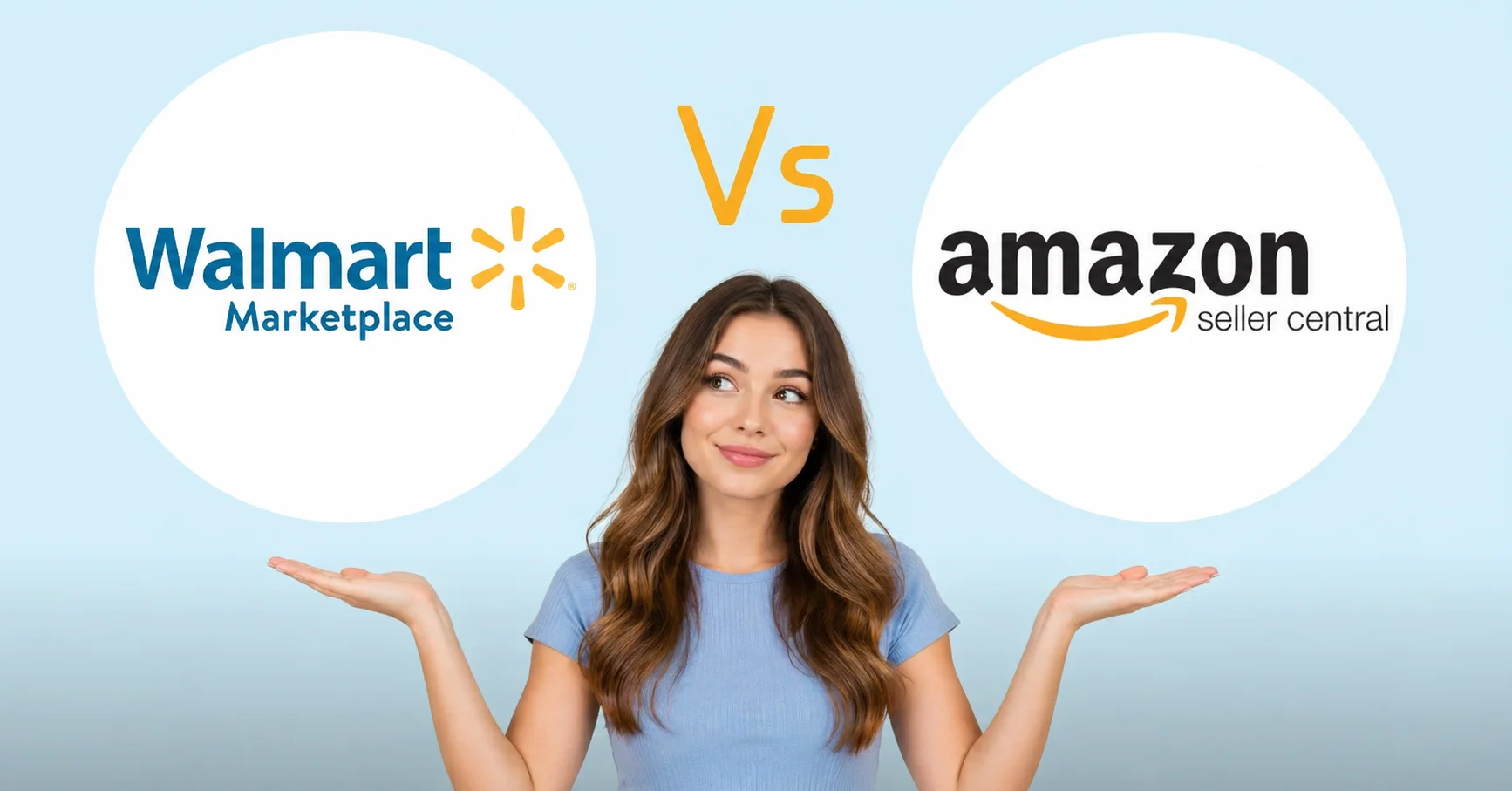
The Walmart Marketplace vs Amazon debate has become one of the most consequential decisions a new e-commerce seller faces in 2026. Both platforms offer extraordinary reach, established trust, and logistics infrastructure that would cost millions to replicate independently. But they are fundamentally different businesses with different seller economics, different customer demographics, and very different levels of competition. Choosing the wrong platform at the wrong stage of your business can mean wasted capital, missed revenue, and months of frustration.
This guide gives you the complete, data-driven picture. We are not going to tell you one platform is universally better than the other — because that is simply not true. What we will do is break down every dimension that matters for sellers: fees, fulfilment, competition, advertising, listing requirements, and approval processes. By the end of this comparison, you will know exactly which platform fits your product, your budget, and your growth strategy.
Let's start with the numbers that frame everything else.
Platform Overview: Walmart Marketplace vs Amazon
Before diving into the head-to-head comparison, it is worth understanding each platform's fundamental identity — because their origin stories directly explain why they behave differently as seller marketplaces today.
Amazon was built as an e-commerce business from day one. It launched as an online bookstore in 1994 and expanded methodically into every retail category over three decades. The Amazon Marketplace — where third-party sellers list alongside Amazon's own inventory — has been central to Amazon's growth strategy since 2000. Today, third-party sellers account for approximately 60% of all units sold on Amazon, and the platform's infrastructure (FBA, advertising, Brand Registry, A+ Content) is the most sophisticated seller ecosystem in existence.
Walmart Marketplace came from a completely different direction. Walmart is first and foremost the world's largest physical retailer — 4,700+ US stores, a logistics network built over 60 years, and a customer base anchored in value-conscious, everyday essentials shoppers. Walmart launched its third-party marketplace in 2009, but it only accelerated its digital ambitions seriously after 2020. The platform is selective by design: Walmart manually vets every seller application, and the barrier to entry is meaningfully higher than Amazon's automated approval. That selectivity is both a challenge and an opportunity, as we will explain.
- Founded: 1994 as online retailer
- Marketplace launched: 2000
- ~9.7 million global third-party sellers
- Monthly US visitors: ~2.5 billion page views
- 40.4% US e-commerce market share
- ~200M+ Prime members worldwide
- Instant seller approval (automated)
- Founded: 1962 as physical retailer
- Marketplace launched: 2009
- ~150,000+ approved sellers
- Monthly US visitors: ~120M+ unique visitors
- America's #2 online marketplace
- 4,700+ US physical store locations
- Manual application review (2–4 weeks)
Market Share and Customer Reach
Raw customer reach is the starting point for any platform comparison — because a marketplace with no buyers is worthless to a seller, regardless of how favorable its fees are.
Amazon's Dominance
Amazon is the undisputed leader in US e-commerce. According to eMarketer, Amazon captured 40.4% of all US e-commerce spending in 2024 — meaning roughly $2 out of every $5 spent online in America flows through Amazon. Its net sales for the twelve months ending September 2025 reached $691.33 billion, an 11.48% year-over-year increase. Approximately 38% of US shoppers begin their product searches on Amazon, making it the dominant product discovery engine ahead of Google in many categories. With over 200 million Prime members globally who are conditioned to purchase with one click, Amazon's customer base represents unmatched buying intent.
Walmart's Accelerating Growth
Walmart's online growth story is genuinely compelling. Walmart's e-commerce sales grew 22% year-over-year in fiscal year 2025, significantly outpacing Amazon's growth rate. Walmart.com now attracts over 120 million unique monthly US visitors — not the 2 billion-plus page views Amazon generates, but a customer base that is large, loyal, and increasingly online-first. Walmart's unique structural advantage is its 4,700+ physical stores, which function as distribution hubs for same-day delivery and pickup, enabling delivery speeds that rival Amazon Prime in many US zip codes.
What makes Walmart's customer base particularly interesting for sellers is its demographic profile. Walmart shoppers tend to be value-driven, family-oriented buyers who purchase across everyday essentials, home goods, grocery, apparel, and electronics. They are not the same buyer as the typical Amazon Prime subscriber — and for many product categories, that demographic distinction is a significant commercial opportunity.
Amazon wins on raw volume — 40% e-commerce market share vs Walmart's growing but smaller online footprint. However, Walmart's 22% annual e-commerce growth rate means the gap is narrowing. For sellers who need maximum exposure immediately, Amazon has the edge. For sellers building for the next three to five years, Walmart's growth trajectory is highly attractive.
Seller Approval and Onboarding
The application and approval process is the first practical difference sellers encounter — and it is a significant one. The two platforms could not be more different in their approach.
Amazon: Open Door, Instant Access
Amazon operates an open marketplace. Any business or individual can create a Professional Seller account, provide basic business and bank details, and begin listing products within 24–72 hours. The process is largely automated — Amazon verifies your identity and tax information, and you are live. This accessibility is why Amazon has nearly 10 million sellers globally. It also explains why competition on the platform is so intense: because the barrier to entry is essentially zero, every available niche has dozens of competitors.
Once approved, managing your Amazon store through Seller Central gives you access to the full suite of Amazon's tools immediately. You can list products, run ads, and enrol in FBA from day one.
Walmart: Selective Application, Higher Standards
Walmart's approach is the opposite. Every seller must submit a formal application that Walmart manually reviews. The application requires:
- Verified US business entity (LLC, corporation, or sole proprietorship)
- US Business Tax ID (EIN) — not a Social Security Number
- Demonstrated e-commerce history (prior sales on Amazon, Shopify, or similar platforms preferred)
- A product catalogue that does not duplicate items already sold by Walmart directly
- Ability to meet Walmart's performance standards: 95%+ on-time shipping, low cancellation and return rates
- US-based customer service capability
The review process typically takes 2–4 weeks. Many applicants are rejected on the first attempt — typically for insufficient sales history, problematic product categories, or inability to meet performance requirements. This feels discouraging if it happens to you, but here is the important context: Walmart's selectivity is what creates the low-competition environment that makes the platform so attractive for approved sellers.
💡 Practical tip: If you are applying to Walmart Marketplace for the first time, having at least 6 months of documented e-commerce sales history significantly improves your approval rate. A clean Amazon Seller Central account with positive metrics is one of the strongest signals Walmart looks for in new applicants. Read our complete guide to selling on Walmart Marketplace for the full application walkthrough and approval tips.
Amazon wins on speed and accessibility — you can be live in 48 hours. Walmart's 2–4 week manual review is a barrier that deters many sellers. However, that barrier is also the source of Walmart's low-competition advantage. If you can get approved, the reduced seller density on Walmart is a commercial asset that offsets the longer wait.
Fee Structures Compared Side by Side
Fees are where the platforms diverge most dramatically — and where Walmart's advantage for sellers is most concrete. Understanding the complete fee picture on both platforms is essential before deciding where to invest your resources.
| Fee Type | Amazon | Walmart Marketplace |
|---|---|---|
| Monthly Subscription | $39.99/month (Professional plan) | $0 — no monthly fee |
| Referral Fees | 6–15% (avg ~15%); some categories up to 20–45% | 6–20% depending on category |
| Closing Fee | $1.80/unit on media products (books, DVDs, etc.) | None |
| Fulfilment Fee (standard item) | FBA: $3.22–$6.10+ per unit | WFS: Competitive, often lower than FBA for standard items |
| Storage Fee (Jan–Sep) | $0.78/cubic foot/month | $0.75/cubic foot/month |
| Storage Fee (Oct–Dec) | $2.40/cubic foot/month | $0.75/cubic foot/month (no peak surcharge) |
| Long-term Storage | $6.90/cubic foot after 365 days | Lower surcharge thresholds |
| Refund Processing Fee | $5.00 or 20% of refund (whichever is less) | No refund processing fee |
| Returns Fee | Weight-based per unit for FBA returns | Varies by category |
The absence of a monthly subscription fee is Walmart's single most tangible advantage for new sellers. On Amazon, you pay $39.99/month regardless of whether you make a single sale — meaning your store must generate enough gross profit to cover the subscription before you break even. Walmart eliminates this baseline cost entirely, which is particularly meaningful during the early months when revenue is building.
Walmart's Q4 storage fee structure is also a significant advantage for sellers who stock seasonal inventory. Amazon charges $2.40 per cubic foot during October through December — a 207% jump from off-peak rates that can dramatically erode holiday season margins. Walmart's storage rate stays flat throughout the year at $0.75 per cubic foot. For sellers running heavy Q4 campaigns, this difference alone can translate to thousands of dollars in saved fees.
📊 Real margin example: On a $35 product in the home goods category, Amazon charges approximately $5.25 in referral fees (15%) plus $4.85 in FBA fulfilment fees — a total platform cost of $10.10 before your subscription allocation. Walmart charges approximately $3.50 in referral fees (10%) plus competitive WFS fulfilment — saving $3–$5 per unit. At 500 monthly sales, that is a $1,500–$2,500 monthly margin improvement just from the fee difference.
Walmart wins convincingly on fee structure. No monthly subscription, generally lower referral rates in many categories, no Q4 storage surcharge, and no refund processing fees add up to materially better economics per sale — particularly for sellers with moderate volumes. Amazon's higher fees are offset by higher sales volume potential, but that offset only works if your products actually achieve that volume.
Fulfilment Options: FBA vs WFS
Fulfilment infrastructure is one of the most important practical considerations for any marketplace seller. Both platforms offer managed fulfilment programmes — but they differ significantly in maturity, cost, and reach.
Amazon FBA (Fulfillment by Amazon)
FBA is the gold standard of marketplace fulfilment. You send your inventory to one of Amazon's 200+ fulfilment centres worldwide. Amazon picks, packs, and ships every order — often with Prime-speed delivery. FBA sellers gain automatic Prime eligibility, which is arguably the single most powerful commercial advantage on the Amazon platform: over 200 million Prime members actively filter search results to show Prime-eligible products only, meaning non-Prime listings are effectively invisible to a significant majority of Amazon's highest-value customers.
FBA also handles returns and customer service on your behalf — a substantial operational benefit. Its limitations are well-known: higher fees, strict packaging requirements, and the risk of inventory stranded at Amazon fulfilment centres when products underperform. For a detailed breakdown of FBA's cost structure and how to optimise your inventory levels, our inventory management guide covers the core principles applicable to both platforms.
Walmart Fulfilment Services (WFS)
WFS is Walmart's equivalent programme and it has matured significantly since its 2020 launch. You ship inventory to Walmart's fulfilment centres and WFS handles picking, packing, shipping, and returns. WFS listings receive the coveted "Fulfilled by Walmart" tag and the two-day delivery badge — Walmart's equivalent of Prime — which dramatically improves search ranking and conversion rate within the platform.
WFS has several structural advantages over FBA worth noting. Storage rates are lower and — crucially — do not spike during Q4. Fulfilment fees are competitive for standard-sized items and often lower than FBA for products in the $15–$50 range. WFS also benefits from Walmart's physical store network: in many markets, WFS can leverage store locations for same-day fulfilment, a capability FBA cannot match outside of select metros.
The main limitation of WFS is its smaller fulfilment centre footprint compared to Amazon. Coverage is more concentrated in certain US regions, and international fulfilment is more limited than FBA's global network.
| Factor | Amazon FBA | Walmart WFS |
|---|---|---|
| Prime / 2-Day Badge | Prime badge (200M+ subscribers) | 2-Day badge (growing customer base) |
| Fulfilment Centres | 200+ worldwide | Growing US network |
| Storage Fees (Q4) | $2.40/cubic ft (207% peak surcharge) | $0.75/cubic ft (no surcharge) |
| Returns Handling | Fully managed by Amazon | Fully managed by Walmart |
| Customer Service | Managed by Amazon | Managed by Walmart |
| Same-Day Capability | Limited metro coverage | 4,700+ store locations as hubs |
| International Fulfilment | Extensive global network | Primarily US-focused |
Seller Competition and Buy Box Dynamics
Competition level is where Walmart's case as a seller platform becomes most compelling — and where Amazon's biggest structural weakness is most visible.
Amazon: Intense Competition in Almost Every Niche
With 9.7 million sellers globally competing across Amazon's catalogue, the platform is aggressively competitive. Popular product categories like electronics accessories, kitchen tools, fitness equipment, and beauty products routinely feature dozens of sellers on a single listing — all competing on price, review count, and advertising spend. New sellers face two structural disadvantages: established competitors have hundreds or thousands of reviews (social proof that takes months or years to build), and Amazon itself competes directly against third-party sellers in many categories using its own private label products under brands like Amazon Basics.
The Amazon Buy Box — the default "Add to Cart" button that drives over 80% of all Amazon sales — is awarded by an algorithm that weights seller metrics, pricing, fulfilment method, and account history. New sellers frequently lose the Buy Box to established competitors even when offering identical products at lower prices, simply due to insufficient account history. Our guide on winning the Buy Box explains the underlying mechanics that apply across both platforms.
Walmart: Lower Competition, Faster Ranking
Walmart Marketplace has approximately 150,000 approved sellers — roughly 1.5% of Amazon's seller count. This is not a weakness: it is the platform's most significant commercial advantage for the sellers who are on it. In many product categories on Walmart, the first page of search results shows 5–10 sellers where Amazon's equivalent search shows 50–100. A product that takes 12–18 months to reach page one on Amazon can rank on page one at Walmart within 6–8 weeks with a well-optimised listing and competitive pricing.
Walmart's Buy Box algorithm also differs from Amazon's. Walmart places heavier weight on price competitiveness relative to the market rather than purely on seller metrics. This means a new seller with a well-priced, well-listed product can win the Walmart Buy Box much faster than they could on Amazon, even without an extensive sales history. For a deep dive into Walmart's Buy Box mechanics, read our guide on how to win the Walmart Buy Box.
Walmart wins clearly for new sellers. The 65x difference in seller count (150K vs 9.7M) translates directly into faster ranking, easier Buy Box wins, and less price pressure from competitors. For established brands with significant review bases and advertising budgets, Amazon's competitive environment is manageable. For sellers just starting out, Walmart's lower competition density is a genuine advantage that compounds over time.
Listing Requirements and SEO
How you optimise product listings differs meaningfully between the two platforms — and understanding those differences is essential to ranking well and converting visitors into buyers on each.
Amazon Listing Optimisation
Amazon's search algorithm (A9/A10) ranks products based on a combination of sales velocity, conversion rate, keyword relevance, customer reviews, and advertising spend. Listing optimisation on Amazon involves: a keyword-rich title (150–200 characters), five benefit-driven bullet points, a detailed product description or A+ Content module (for brand-registered sellers), backend search terms (250 bytes of hidden keywords), and high-quality images across all nine available image slots. Amazon's ranking signals weight recent sales performance heavily — meaning listings that sell well continue to rank well, creating a compounding advantage for established products.
Walmart Listing Optimisation
Walmart's search algorithm functions differently and is, in many ways, more transparent. Walmart Marketplace SEO prioritises relevance, competitive pricing, and fulfilment speed above all else. Unlike Amazon, Walmart does not use hidden backend keywords — all your keyword optimisation must be visible in your product title, description, and attributes. Walmart also places stronger weight on product attributes (size, colour, material, compatibility) than Amazon does, making attribute completeness a significant ranking factor that many sellers under-invest in.
The practical implication: Walmart listings require less advertising spend to rank organically than Amazon listings in most categories. A well-optimised Walmart listing with accurate attributes, a competitive price, and WFS fulfilment can achieve first-page organic rankings within weeks — something that typically requires months of ad spend on Amazon.
All Walmart listings require a valid GTIN (Global Trade Item Number) — either a UPC, EAN, or GTIN-14. If your products do not have GTINs, you need to purchase them through GS1 before listing. This is a one-time cost that adds a small barrier for new sellers but eliminates the catalogue quality problems that generic ASINs create on Amazon.
Advertising and Promotion Tools
Advertising capability is another area where Amazon's longer history shows — but Walmart is investing heavily in closing the gap.
Amazon Advertising
Amazon's advertising ecosystem is the most sophisticated available within any marketplace. Sponsored Products (keyword-targeted product ads within search results), Sponsored Brands (banner ads at the top of search), Sponsored Display (audience-based remarketing), and Amazon DSP (demand-side programmatic display advertising) give sellers granular control over where and how they appear across the platform. Amazon's advertising data is exceptionally rich — you can track exact search terms that converted, cost per click by keyword, and return on ad spend at the product level.
The limitation is cost. Average cost-per-click on Amazon has risen significantly in competitive categories as more sellers compete for the same ad placements. In high-volume categories like electronics, beauty, and home goods, CPCs regularly exceed $2–$4 per click, making advertising profitability increasingly challenging for sellers with thin margins.
Walmart Connect (Walmart Advertising)
Walmart's advertising platform — Walmart Connect — offers Sponsored Products ads within Walmart.com search results, display advertising on Walmart's homepage and category pages, and offsite advertising through Walmart's DSP. The platform is less mature than Amazon's but has several meaningful advantages: significantly lower average CPCs (often 50–70% cheaper than equivalent Amazon placements), less advertiser competition for the same placements, and access to Walmart's unique first-party purchase data from both online and in-store transactions.
Walmart's Sponsored Products programme is the starting point for most Walmart sellers and works on a cost-per-click model similar to Amazon's Sponsored Products. The key difference is that Walmart's lower seller density means organic rankings respond faster to advertising-driven sales velocity than Amazon's algorithm, creating a flywheel effect where early ad investment drives organic ranking improvements that reduce your long-term ad dependency.
Amazon wins on sophistication and data depth. Its advertising tools are more mature and offer more targeting options than Walmart Connect. However, Walmart wins on cost efficiency — lower CPCs and less competition mean your advertising budget goes further on Walmart in most categories. For sellers with limited advertising budgets, Walmart's advertising ROI is typically superior to Amazon's in 2026.
Seller Performance Standards
Both platforms hold sellers to strict performance standards — and the consequences of falling below them are severe. Understanding what each platform measures and what the thresholds are is essential to protecting your selling privileges.
| Metric | Amazon Requirement | Walmart Requirement |
|---|---|---|
| Order Defect Rate | Below 1% | Below 2% |
| On-Time Shipment Rate | Below 4% late shipment rate | 95%+ on-time delivery required |
| Cancellation Rate | Below 2.5% | Below 2% |
| Valid Tracking Rate | Above 95% | Above 99% |
| Refund Rate | No hard threshold (monitored) | Below 6% |
| Response Time | 24 hours for customer messages | 24 hours for customer messages |
| Consequence of Breach | Listing suppression or account suspension | Listing suppression, then account suspension |
Walmart's performance standards are in some ways more demanding than Amazon's — particularly the 95% on-time delivery requirement, which applies even when you are self-fulfilling orders rather than using WFS. However, Walmart generally gives sellers more warning and opportunity to improve before taking punitive action, whereas Amazon is known for sudden account suspensions with limited explanation. For sellers who manage their logistics carefully, Walmart's standards are highly achievable and its enforcement process is more transparent.
Tracking your performance metrics consistently is non-negotiable on both platforms. Using dedicated Walmart seller tools helps you monitor defect rates, track shipment performance, and identify problem areas before they reach the threshold that triggers platform action. Maintaining a strong track record also qualifies you for Walmart's Pro Seller Badge — a visible trust signal that significantly improves your conversion rate and search ranking within Walmart's algorithm.
Which Platform Is Right for You?
There is no universal answer to this question — but there are specific seller profiles that map clearly to each platform. Here is the honest breakdown:
Choose Amazon If:
- You want immediate access to the largest buyer base in US e-commerce
- Your products are already well-differentiated with strong branding and a review strategy
- You have budget to invest in advertising and can compete in a high-CPC environment
- You sell in categories with strong Amazon Prime demand (electronics, books, beauty, supplements)
- You want international selling capabilities through Amazon's global marketplace network
- You need the most mature fulfilment infrastructure available (FBA's 200+ fulfilment centres)
Choose Walmart If:
- You are a new seller looking for faster ranking with less competitive pressure
- You sell everyday value products — home goods, grocery, apparel, essentials — that align with Walmart's customer base
- You want lower fees and better per-unit economics, especially during Q4
- You have existing e-commerce history that qualifies you for approval
- You want to build a long-term position in a growing marketplace before it becomes as competitive as Amazon
- You are building a Walmart private label brand where the lower competition density gives you more room to establish brand authority
Why the Best Sellers Use Both Platforms
The most commercially sophisticated sellers in 2026 are not choosing between Walmart and Amazon. They are selling on both — and the two platforms complement each other in ways that are not immediately obvious.
Amazon provides immediate volume and exposure to the largest buyer pool available. Walmart provides better margins, faster organic ranking, and access to a different demographic of buyers. Together, they cover more of the US market than either platform can alone. Walmart's low-competition environment also allows you to test new products quickly and inexpensively before scaling them on Amazon — using Walmart's faster organic ranking as a validation signal before investing in Amazon's higher-cost advertising environment.
There are also pricing strategy benefits to selling on both. Walmart's algorithm heavily weights price competitiveness versus the broader market — and Amazon listings are part of that market. Maintaining price parity across both platforms helps you stay competitive on Walmart while avoiding Amazon's algorithmic penalties for price disparities.
📊 Multi-channel strategy tip: Use a multi-channel listing tool to sync your catalogue, inventory levels, and pricing across both platforms simultaneously. This prevents overselling (listing stock on both platforms that you only have inventory for one) and ensures price parity compliance. Our guide on Walmart inventory management software covers the best tools for managing this across platforms.
For sellers who want to build a full multi-channel presence without managing two separate operations manually, walmart dropshipping automation services provide a managed approach — where an experienced team handles the day-to-day operations of your Walmart store while you focus on strategic growth decisions.
Walmart Marketplace vs Amazon: Complete Side-by-Side Comparison
| Category | Amazon | Walmart Marketplace | Winner |
|---|---|---|---|
| Customer Reach | 40.4% US e-commerce share; 200M+ Prime members | #2 US online marketplace; 120M+ monthly visitors | Amazon |
| Seller Competition | 9.7 million global sellers | ~150,000 approved sellers | Walmart |
| Monthly Fee | $39.99/month | $0/month | Walmart |
| Referral Fees | 6–15% avg; some up to 45% | 6–20%; generally lower in many categories | Walmart (slight edge) |
| Q4 Storage Fees | $2.40/cubic ft (207% jump) | $0.75/cubic ft (no increase) | Walmart |
| Approval Speed | 24–72 hours (automated) | 2–4 weeks (manual review) | Amazon |
| Fulfilment Programme | FBA — most mature in industry | WFS — growing, competitive pricing | Amazon (maturity); Walmart (cost) |
| Organic Ranking Speed | Slow — requires months of sales history | Fast — achievable in weeks with good listing | Walmart |
| Advertising Sophistication | Most advanced marketplace ad platform | Growing; lower CPCs; less competition | Amazon (features); Walmart (ROI) |
| Buy Box Competition | Highly competitive; algorithm-heavy | Less competitive; price-weighted | Walmart (for new sellers) |
| Brand Tools | Brand Registry, A+, Vine, Storefronts | Brand Portal, Rich Media, Seller Reviews | Amazon (depth); Walmart (growing) |
| Global Selling | 20+ international marketplaces | Primarily US-focused | Amazon |
| Seller Reviews | Product and seller reviews | Seller reviews visible on listings | Even |
| Performance Standards | Strict; sudden suspensions common | Strict; more transparent enforcement | Walmart (process clarity) |
Real Results: What Our Clients Are Earning on Walmart
Since 2019, Stores Automation has helped hundreds of sellers build and scale profitable Walmart Marketplace businesses through our fully managed, done-for-you model. Our team handles everything — from account application and approval to product research, listing optimisation, order management, and performance monitoring — while clients collect the revenue and own the account.
Here is a look at real Walmart seller performance data from two of our actively managed client accounts:

Client Account A — Managed Walmart Seller Store
This client's Walmart seller account, built and managed entirely by our team, shows consistent order volume and growing revenue month over month. The store benefits from our product selection expertise, listing optimisation, and active performance monitoring — all the elements that keep a Walmart account in good standing and growing its organic search visibility within the platform.

Client Account B — Walmart Automation Service
A second client account demonstrating the kind of scalable, profitable growth that becomes achievable when product sourcing, supplier management, and Walmart's performance requirements are all handled by a specialist team. This client had no prior e-commerce experience — our team managed the entire application, setup, and operational process from day one.
These results reflect a consistent pattern across our client portfolio. Walmart's lower competition environment means that well-executed stores built on sound product research and optimised listings achieve measurable results faster than equivalent Amazon stores in the same timeframe. Our Walmart automation services are built to replicate this outcome for every client — with full transparency, monthly reporting, and dedicated account management throughout.
📬 Get in Touch with Stores Automation
Ready to launch your Walmart Marketplace store — or want our experienced team to build and manage it for you? We are available Monday to Friday, 9 am to 5 pm EST.
Wilmington, DE 19801, USA
Frequently Asked Questions
Final Verdict: Walmart Marketplace vs Amazon
The honest answer to the Walmart Marketplace vs Amazon debate in 2026 is that both platforms are worth serious consideration — but for different reasons and different seller profiles.
Amazon gives you the largest buyer pool in US e-commerce, the most mature marketplace infrastructure, and unmatched fulfilment capabilities through FBA. If your goal is maximum reach and you have the budget to compete in a high-CPC advertising environment, Amazon remains the dominant platform for volume-driven e-commerce.
Walmart Marketplace gives you a growing, high-intent customer base with dramatically less seller competition, better fee economics, and faster organic ranking potential. For new sellers who qualify for approval, Walmart offers a genuinely compelling path to profitability that many overlook because they default to Amazon without comparing the two.
The smartest approach in 2026 is not to choose one over the other — it is to build a presence on both. Start where your approval situation and budget allow, execute the fundamentals well, and expand to the second platform once your operations are stable. The sellers who will dominate their categories over the next five years are the ones building multi-channel positions now, before Walmart's marketplace matures and becomes as competitive as Amazon is today.
If you want expert help building and managing your Walmart seller account from day one, explore how Stores Automation's Walmart automation services can accelerate your path to profitability — without the operational burden of managing it alone.